Search
Invitrogen
WNT4 Polyclonal Antibody
{{$productOrderCtrl.translations['antibody.pdp.commerceCard.promotion.promotions']}}
{{$productOrderCtrl.translations['antibody.pdp.commerceCard.promotion.promocode']}}: {{promo.promoCode}} {{promo.promoTitle}} {{promo.promoDescription}}. {{$productOrderCtrl.translations['antibody.pdp.commerceCard.promotion.learnmore']}}
{{$ctrl.translations['antibody.pdp.skuNotes.additionalInformation']}}:
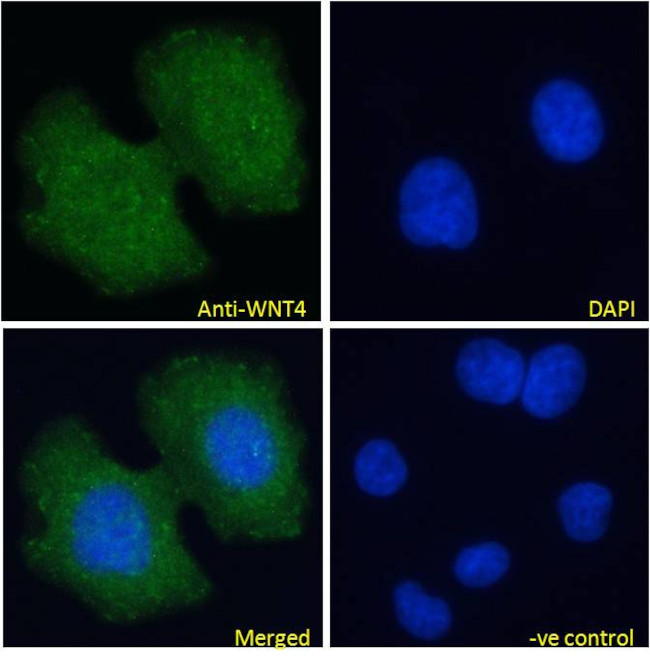
FIGURE: 1 / 3
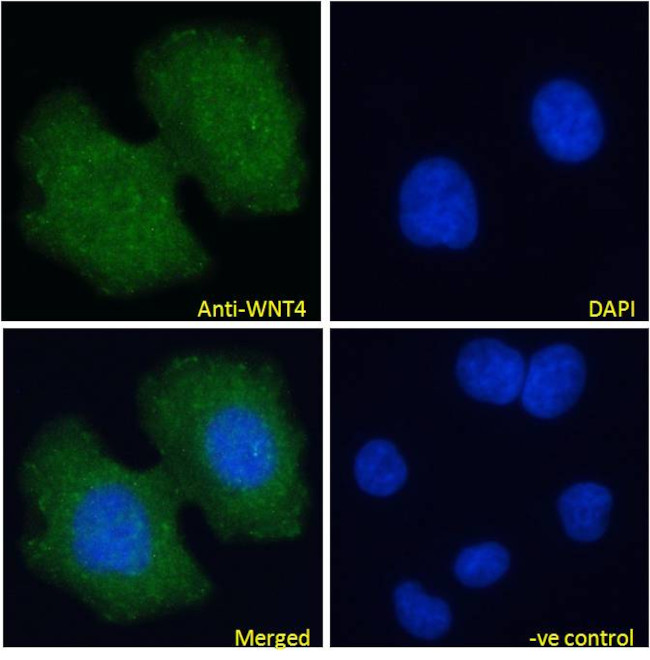
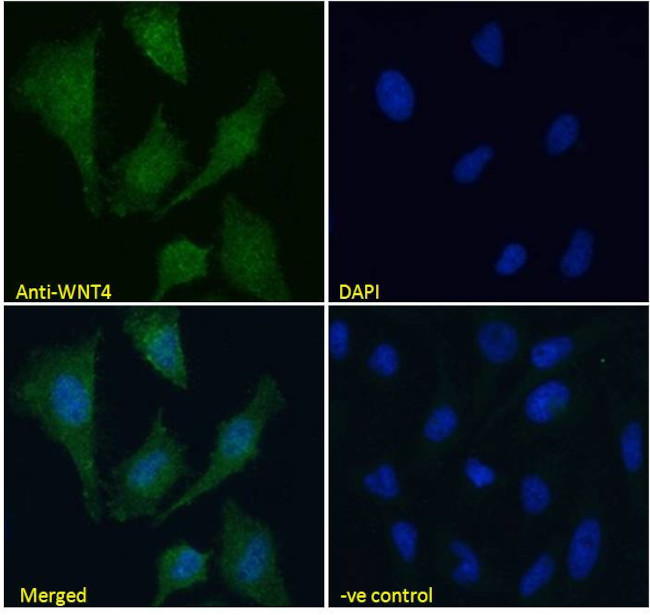
WNT4 Antibody (PA1-9118) in ICC/IF
Immunocytochemistry analysis of WNT4 using WNT4 Polyclonal Antibody (Product # PA1-9118) in paraformaldehyde fixed MCF7 cells, permeabilized with 0.15% Triton. Primary incubation 1hr (10 µg/mL) followed by Alexa Fluor 488 secondary antibody (4 µg/mL), showing vesicle staining. The nuclear stain is DAPI (blue). Negative control: Unimmunized goat IgG (10 µg/mL) followed by Alexa Fluor 488 secondary antibody (4 µg/mL).
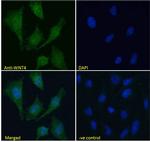
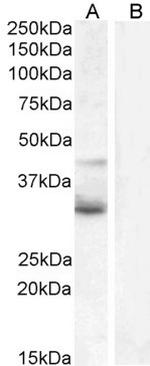
Please note: We are reviewing Western blot images included in the antibody testing data in our catalog, including those provided by third parties. Unless expressly labeled or annotated as “raw-unedited”, Western blot images included in the antibody testing data in our catalog may have been edited, optimized or otherwise adjusted for presentation.

Product Details
PA1-9118
Applications
Tested Dilution
Publications
Product Specifications
Species Reactivity
Human
Host/Isotype
Goat
/ IgG
Class
Polyclonal
Type
Antibody
Immunogen
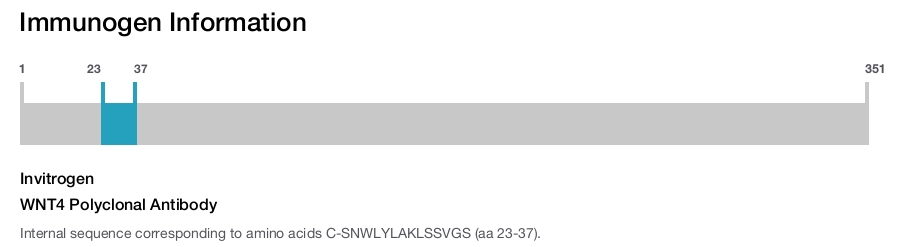
Internal sequence corresponding to amino acids C-SNWLYLAKLSSVGS (aa 23-37).
Conjugate
Unconjugated
Unconjugated
Unconjugated
Form
Liquid
Concentration
0.5 mg/mL
Amount
100 µg
Purification
Ammonium sulfate precipitation
Storage buffer
TBS, pH 7.3, with 0.5% BSA
Contains
0.02% sodium azide
Storage conditions
-20°C, Avoid Freeze/Thaw Cycles
Shipping conditions
Ambient (domestic); Wet ice (international)
RRID
Product Specific Information
This antibody is predicted to react with mouse and rat based on sequence homology.
This antibody is tested in Peptide ELISA: antibody detection limit dilution 4,000.
Target Information
The WNT gene family consists of structurally related genes which encode secreted signaling proteins. These proteins have been implicated in oncogenesis and in several developmental processes, including regulation of cell fate and patterning during embryogenesis. This gene is a member of the WNT gene family, and is the first signaling molecule shown to influence the sex-determination cascade. It encodes a protein which shows 98% amino acid identity to the Wnt4 protein of mouse and rat. This gene and a nuclear receptor known to antagonize the testis-determining factor play a concerted role in both the control of female development and the prevention of testes formation. This gene and another two family members, WNT2 and WNT7B, may be associated with abnormal proliferation in breast tissue. Mutations in this gene can result in Rokitansky-Kuster-Hauser syndrome and in SERKAL syndrome.
For Research Use Only. Not for use in diagnostic procedures. Not for resale without express authorization.
References (0)
Have you cited this product in a publication?
Let us know so we can reference it here.
Bioinformatics
Protein Aliases: unnamed protein product; wingless-type MMTV integration site family, member 4
Gene Aliases: SERKAL; WNT-4
UniProt ID: (Human) P56705
Entrez Gene ID: (Human) 54361
kidney development
mesonephros development
epithelial to mesenchymal transition
liver development
male gonad development
negative regulation of gene expression
negative regulation of steroid biosynthetic process
Wnt signaling pathway
neuron differentiation
female sex determination
adrenal gland development
negative regulation of cell migration
positive regulation of bone mineralization
positive regulation of aldosterone biosynthetic process
positive regulation of collagen biosynthetic process
non-canonical Wnt signaling pathway
positive regulation of MAPK cascade
cell fate commitment
positive regulation of osteoblast differentiation
negative regulation of transcription, DNA-templated
positive regulation of transcription, DNA-templated
negative regulation of Ras protein signal transduction
positive regulation of stress fiber assembly
positive regulation of focal adhesion assembly
canonical Wnt signaling pathway
negative regulation of wound healing
mammary gland epithelium development
positive regulation of dermatome development
paramesonephric duct development
negative regulation of testicular blood vessel morphogenesis
cellular response to transforming growth factor beta stimulus
metanephric mesenchymal cell differentiation
negative regulation of male gonad development
positive regulation of cortisol biosynthetic process
negative regulation of androgen biosynthetic process
negative regulation of testosterone biosynthetic process
Disclaimer

Clicking the images or links will redirect you to a website hosted by BenchSci that provides third-party scientific content. Neither the content nor the BenchSci technology and processes for selection have been evaluated by us; we are providing them as-is and without warranty of any kind, including for use or application of the Thermo Fisher Scientific products presented.

Performance Guarantee
If an Invitrogen™ antibody doesn't perform as described on our website or datasheet,we'll replace the product at no cost to you, or provide you with a credit for a future purchase.*
Learn more
We're here to help
Get expert recommendations for common problems or connect directly with an on staff expert for technical assistance related to applications, equipment and general product use.
Contact tech support