Search
Invitrogen
TFPI Polyclonal Antibody
{{$productOrderCtrl.translations['antibody.pdp.commerceCard.promotion.promotions']}}
{{$productOrderCtrl.translations['antibody.pdp.commerceCard.promotion.promocode']}}: {{promo.promoCode}} {{promo.promoTitle}} {{promo.promoDescription}}. {{$productOrderCtrl.translations['antibody.pdp.commerceCard.promotion.learnmore']}}
{{$ctrl.translations['antibody.pdp.skuNotes.additionalInformation']}}:
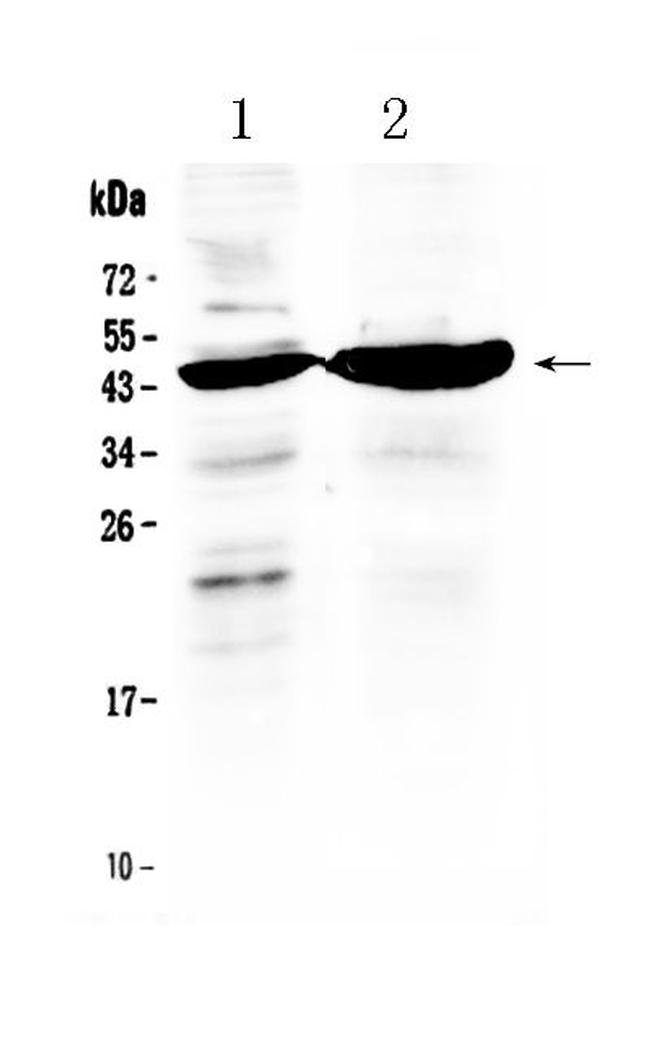
FIGURE: 1 / 1
TFPI Antibody (PA5-95443) in WB
Western blot analysis of TFPI in Lane 1: HeLa whole cell lysates, Lane 2: MCF-7 whole cell lysates. Electrophoresis was performed with 5-20% SDS-PAGE gel (70V, Stacking gel; 90V Resolving gel, Time: 2-3 hours), transferred to a nitrocellulose membrane and blocked using 5% Non-fat Milk/TBS (1.5 hrs at room temperature). Samples were incubated with TFPI polyclonal antibody (Product # PA5-95443) using a 0.5 µg/mL dilution, followed by a goat anti-rabbit IgG-HRP at a dilution of 1:10,000, and developed with enhanced chemiluminescence (ECL).
Please note: We are reviewing Western blot images included in the antibody testing data in our catalog, including those provided by third parties. Unless expressly labeled or annotated as “raw-unedited”, Western blot images included in the antibody testing data in our catalog may have been edited, optimized or otherwise adjusted for presentation.

Product Details
PA5-95443
Product Specifications
Species Reactivity
Human
Host/Isotype
Rabbit
/ IgG
Class
Polyclonal
Type
Antibody
Immunogen
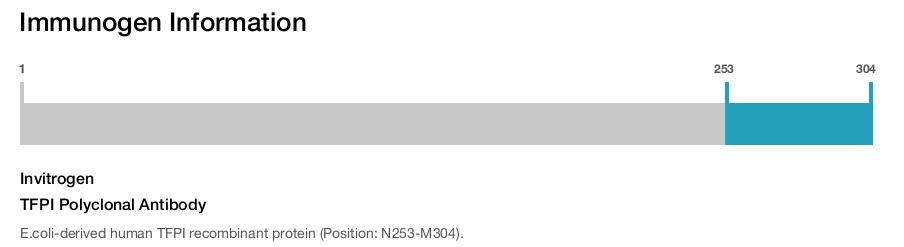
E.coli-derived human TFPI recombinant protein (Position: N253-M304).
Conjugate
Unconjugated
Unconjugated
Unconjugated
Form
Lyophilized
Concentration
500 µg/mL once reconstituted
Amount
100 µg
Purification
Affinity chromatography
Storage buffer
PBS with 4mg trehalose
Contains
0.05mg sodium azide
Storage conditions
-20°C
Shipping conditions
Ambient (domestic); Wet ice (international)
RRID
Product Specific Information
Human TFPI shares 51.1% and 53.2% amino acid (aa) sequence identity with mouse and rat TFPI, respectively.
Reconstitute with 0.2 mL of distilled water to yield a concentration of 500 µg/mL.
Positive Control - WB: HELA whole cell, MCF-7 whole cell.|Store at -20°C for one year from date of receipt. After reconstitution, at 4°C for one month. It can also be aliquotted and stored frozen at -20°C for six months. Avoid repeated freeze-thaw cycles.
Target Information
Tissue factor pathway inhibitor (TFPI), also known as lipoprotein-associated coagulation inhibitor, is a protease inhibitor that regulates the tissue factor (TF)-dependent pathway of blood coagulation. TFPI is glycosylated and predominantly found in the vascular endothelium and plasma in both free forms and complexed with plasma lipoproteins. The coagulation process initiates with the formation of a factor VIIa-TF complex, which proteolytically activates additional proteases (factors IX and X) and ultimately leads to the formation of a fibrin clot. TFPI inhibits the activated factor X and VIIa-TF proteases in an autoregulatory loop.
For Research Use Only. Not for use in diagnostic procedures. Not for resale without express authorization.
References (0)
Have you cited this product in a publication?
Let us know so we can reference it here.
Bioinformatics
Protein Aliases: anti-convertin; extrinsic pathway inhibitor; lipoprotein-associated coagulation inhibitor precursor; OTTHUMP00000163472; OTTHUMP00000205431; tissue factor pathway inhibitor (lipoprotein-associated coagulation inhibitor); unnamed protein product
Gene Aliases: EPI; LACI; TFI; TFPI1
UniProt ID: (Human) P10646
Entrez Gene ID: (Human) 7035
Disclaimer

Clicking the images or links will redirect you to a website hosted by BenchSci that provides third-party scientific content. Neither the content nor the BenchSci technology and processes for selection have been evaluated by us; we are providing them as-is and without warranty of any kind, including for use or application of the Thermo Fisher Scientific products presented.

Performance Guarantee
If an Invitrogen™ antibody doesn't perform as described on our website or datasheet,we'll replace the product at no cost to you, or provide you with a credit for a future purchase.*
Learn more
We're here to help
Get expert recommendations for common problems or connect directly with an on staff expert for technical assistance related to applications, equipment and general product use.
Contact tech support