Search
Invitrogen
RMI1 Polyclonal Antibody
{{$productOrderCtrl.translations['antibody.pdp.commerceCard.promotion.promotions']}}
{{$productOrderCtrl.translations['antibody.pdp.commerceCard.promotion.promocode']}}: {{promo.promoCode}} {{promo.promoTitle}} {{promo.promoDescription}}. {{$productOrderCtrl.translations['antibody.pdp.commerceCard.promotion.learnmore']}}
{{$ctrl.translations['antibody.pdp.skuNotes.additionalInformation']}}:
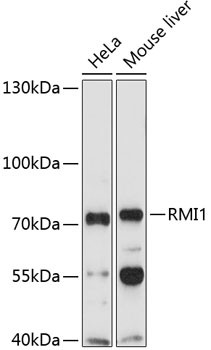
FIGURE: 1 / 1
RMI1 Antibody (PA5-110300) in WB
Western blot analysis of RMI1 in extracts of various cell lines. Samples were incubated with RMI1 Polyclonal antibody (Product # PA5-110300) using a dilution of 1:1,000, followed by HRP Goat Anti-Rabbit IgG (H+L) at a dilution of 1:10,000. Lysates/proteins: 25 µg per lane. Blocking buffer: 3% nonfat dry milk in TBST. Detection: ECL Enhanced Kit. Exposure time: 90s.
Please note: We are reviewing Western blot images included in the antibody testing data in our catalog, including those provided by third parties. Unless expressly labeled or annotated as “raw-unedited”, Western blot images included in the antibody testing data in our catalog may have been edited, optimized or otherwise adjusted for presentation.

Product Details
PA5-110300
Product Specifications
Species Reactivity
Human,
Mouse
Host/Isotype
Rabbit
/ IgG
Class
Polyclonal
Type
Antibody
Immunogen
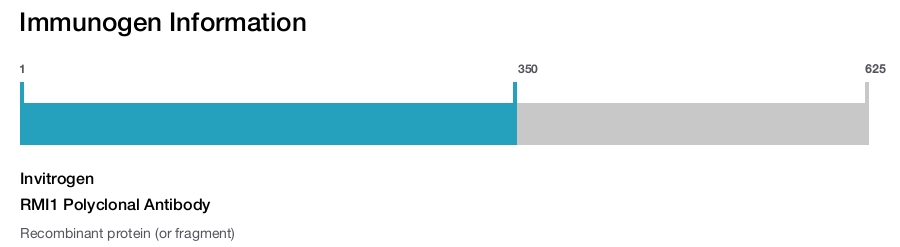
Recombinant protein (or fragment)
Conjugate
Unconjugated
Unconjugated
Unconjugated
Form
Liquid
Concentration
0.55 mg/mL
Amount
55 µg
Purification
Affinity Chromatography
Storage buffer
PBS, pH 7.3, with 50% glycerol
Contains
0.02% sodium azide
Storage conditions
-20°C, Avoid Freeze/Thaw Cycles
Shipping conditions
Ambient (domestic); Wet ice (international)
RRID
Product Specific Information
Immunogen sequence: MNVTSIALRA ETWLLAAWHV KVPPMWLEAC INWIQEENNN VNLSQAQMNK QVFEQWLLTD LRDLEHPLLP DGILEIPKGE LNGFYALQIN SLVDVSQPAY SQIQKLRGKN TTNDLVTAEA QVTPKPWEAK PSRMLMLQLT DGIVQIQGME YQPIPILHSD LPPGTKILIY GNISFRLGVL LLKPENVKVL GGEVDALLEE YAQEKVLARL IGEPDLVVSV IPNNSNENIP RVTDVLDPAL GPSDEELLAS LDENDELTAN NDTSSERCFT TGSSSNTIPT RQSSFEPEFV ISPRPKEEPS NLSIHVMDGE LDDFSLEEAL LLEETVQKEQ METKELQPLT FNRNADRSIE
Target Information
Protein kinases are enzymes that transfer a phosphate group from a phosphate donor, generally the g phosphate of ATP, onto an acceptor amino acid in a substrate protein. By this basic mechanism, protein kinases mediate most of the signal transduction in eukaryotic cells, regulating cellular metabolism, transcription, cell cycle progression, cytoskeletal rearrangement and cell movement, apoptosis, and differentiation. With more than 500 gene products, the protein kinase family is one of the largest families of proteins in eukaryotes. The family has been classified in 8 major groups based on sequence comparison of their tyrosine (PTK) or serine/threonine (STK) kinase catalytic domains. The STE group (homologs of yeast Sterile 7, 11, 20 kinases) consists of 50 kinases related to the mitogen-activated protein kinase (MAPK) cascade families (Ste7/MAP2K, Ste11/MAP3K, and Ste20/MAP4K). MAP kinase cascades, consisting of a MAPK and one or more upstream regulatory kinases (MAPKKs) have been best characterized in the yeast pheromone response pathway. Pheromones bind to Ste cell surface receptors and activate yeast MAPK pathway.
For Research Use Only. Not for use in diagnostic procedures. Not for resale without express authorization.
References (0)
Have you cited this product in a publication?
Let us know so we can reference it here.
Bioinformatics
Protein Aliases: BLM-associated polypeptide, 75 kDa; BLM-associated protein 75 kDa; FLJ12888; homolog of yeast RecQ-mediated genome instability 1 (RMI1); RMI1, RecQ mediated genome instability 1, homolog; RP11-346I8.1; unnamed protein product
Gene Aliases: 4932432N11Rik; BLAP75; C9orf76; FAAP75
UniProt ID: (Human) Q9H9A7, (Mouse) Q9D4G9
Entrez Gene ID: (Human) 80010, (Mouse) 74386
Disclaimer

Clicking the images or links will redirect you to a website hosted by BenchSci that provides third-party scientific content. Neither the content nor the BenchSci technology and processes for selection have been evaluated by us; we are providing them as-is and without warranty of any kind, including for use or application of the Thermo Fisher Scientific products presented.

Performance Guarantee
If an Invitrogen™ antibody doesn't perform as described on our website or datasheet,we'll replace the product at no cost to you, or provide you with a credit for a future purchase.*
Learn more
We're here to help
Get expert recommendations for common problems or connect directly with an on staff expert for technical assistance related to applications, equipment and general product use.
Contact tech support