Search
Invitrogen
KCNK9 Polyclonal Antibody
{{$productOrderCtrl.translations['antibody.pdp.commerceCard.promotion.promotions']}}
{{$productOrderCtrl.translations['antibody.pdp.commerceCard.promotion.promocode']}}: {{promo.promoCode}} {{promo.promoTitle}} {{promo.promoDescription}}. {{$productOrderCtrl.translations['antibody.pdp.commerceCard.promotion.learnmore']}}
{{$ctrl.translations['antibody.pdp.skuNotes.additionalInformation']}}:
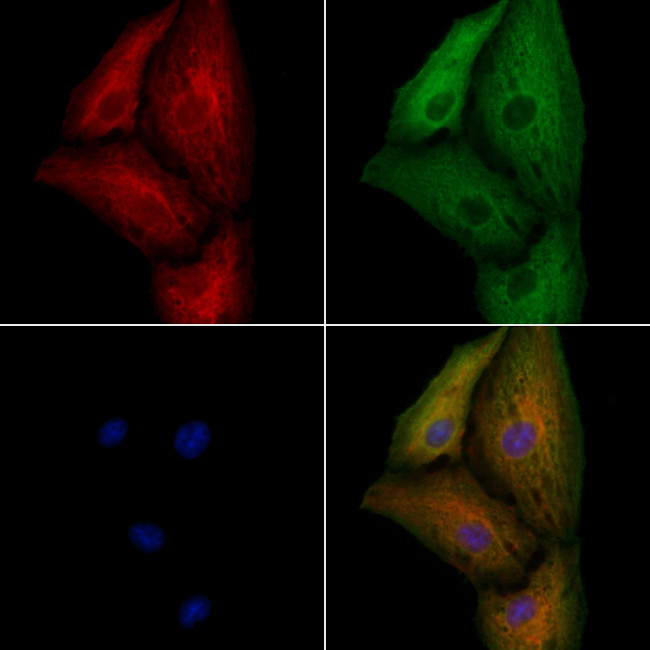
FIGURE: 1 / 6
KCNK9 Antibody (PA5-115454) in ICC/IF
Immunocytochemistry analysis of KCNK9 in A549 cells. Samples were treated with PFA, permeabilized in 0.1% Triton X-100, blocked in 10% serum (45 min at 25°C), and incubated with polyclonal antibody (Product # PA5-115454). Secondary staining was applied with mouse anti-beta tubulin (1 hr at 37°, AlexaFluor 594 conjugated goat anti-rabbit IgG (Red), AlexaFluor 488 conjugated goat anti-mouse IgG (Green) and DAPI.

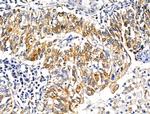
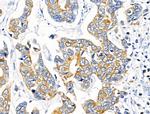
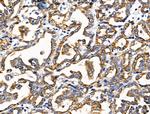
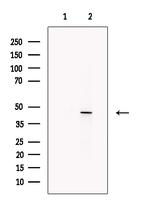
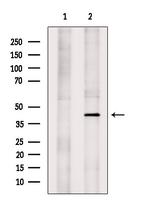
Please note: We are reviewing Western blot images included in the antibody testing data in our catalog, including those provided by third parties. Unless expressly labeled or annotated as “raw-unedited”, Western blot images included in the antibody testing data in our catalog may have been edited, optimized or otherwise adjusted for presentation.


Product Details
PA5-115454
Applications
Tested Dilution
Publications
Product Specifications
Species Reactivity
Human,
Mouse,
Rat
Host/Isotype
Rabbit
/ IgG
Class
Polyclonal
Type
Antibody
Immunogen
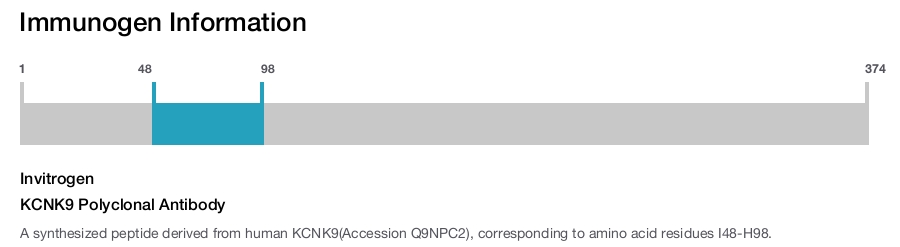
A synthesized peptide derived from human KCNK9(Accession Q9NPC2), corresponding to amino acid residues I48-H98.
Conjugate
Unconjugated
Unconjugated
Unconjugated
Form
Liquid
Concentration
1 mg/mL
Amount
100 µg
Purification
Affinity chromatography
Storage buffer
PBS with 50% glycerol
Contains
0.02% sodium azide
Storage conditions
-20°C
Shipping conditions
Ambient (domestic); Wet ice (international)
RRID
Product Specific Information
Antibody detects endogenous levels of total KCNK9.
Target Information
KCNK9 is one of the members of the superfamily of potassium channel proteins containing two pore-forming P domains. This open channel is highly expressed in the cerebellum. It is inhibited by extracellular acidification and arachidonic acid, and strongly inhibited by phorbol 12-myristate 13-acetate.This gene encodes one of the members of the superfamily of potassium channel proteins containing two pore-forming P domains. This open channel is highly expressed in the cerebellum. It is inhibited by extracellular acidification and arachidonic acid, and strongly inhibited by phorbol 12-myristate 13-acetate.
For Research Use Only. Not for use in diagnostic procedures. Not for resale without express authorization.
References (0)
Have you cited this product in a publication?
Let us know so we can reference it here.
Bioinformatics
Protein Aliases: 2P; acid-sensitive potassium channel protein TASK-3; ion channel; TASK-3 background K+ channel; KCNK9; leak channel; MGC138268; MGC138270; potassium 2-pore domain leak channel TASK3; potassium channel, subfamily K, member 9 (Task-3); potassium channel, two pore domain subfamily K, member 9; TWIK-related acid-sensitive K(+) channel 3; TWIK-related acid-sensitive K+ 3; two pore K(+) channel KT3.2; two pore potassium channel KT3.2
Gene Aliases: A930009L07Rik; BIBARS; K2p9.1; KT3.2; TASK-3; TASK3; TASK32
UniProt ID: (Human) Q9NPC2, (Mouse) Q3LS21, (Rat) Q9ES08
Entrez Gene ID: (Human) 51305, (Mouse) 223604, (Rat) 84429
potassium ion transport
visual perception
sodium ion transmembrane transport
regulation of resting membrane potential
cellular response to acidic pH
potassium ion transmembrane transport
regulation of action potential firing rate
potassium ion import across plasma membrane
negative regulation of aldosterone secretion
Disclaimer

Clicking the images or links will redirect you to a website hosted by BenchSci that provides third-party scientific content. Neither the content nor the BenchSci technology and processes for selection have been evaluated by us; we are providing them as-is and without warranty of any kind, including for use or application of the Thermo Fisher Scientific products presented.

Performance Guarantee
If an Invitrogen™ antibody doesn't perform as described on our website or datasheet,we'll replace the product at no cost to you, or provide you with a credit for a future purchase.*
Learn more
We're here to help
Get expert recommendations for common problems or connect directly with an on staff expert for technical assistance related to applications, equipment and general product use.
Contact tech support