Search
Invitrogen
Epiregulin Polyclonal Antibody
{{$productOrderCtrl.translations['antibody.pdp.commerceCard.promotion.promotions']}}
{{$productOrderCtrl.translations['antibody.pdp.commerceCard.promotion.promocode']}}: {{promo.promoCode}} {{promo.promoTitle}} {{promo.promoDescription}}. {{$productOrderCtrl.translations['antibody.pdp.commerceCard.promotion.learnmore']}}
{{$ctrl.translations['antibody.pdp.skuNotes.additionalInformation']}}:
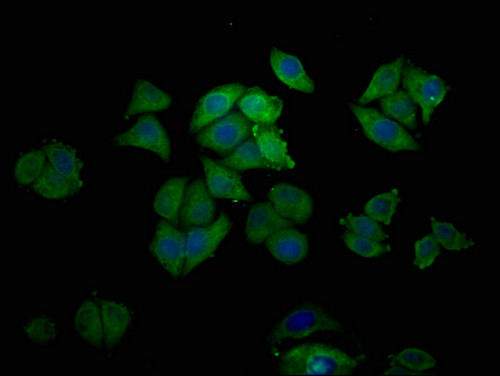
FIGURE: 1 / 1
Epiregulin Antibody (PA5-121403) in ICC/IF
Immunocytochemistry/Immunofluorescence analysis of Epiregulin in Hela cells using Epiregulin Polyclonal Antibody (Product # PA5-121403) at 1:200, counter-stained with DAPI. The cells were blocked in 10% normal Goat Serum and then incubated with the antibody overnight at 4°C. The secondary antibody was Alexa Fluor 488-congugated AffiniPure Goat Anti-Rabbit IgG(H+L).
Please note: We are reviewing Western blot images included in the antibody testing data in our catalog, including those provided by third parties. Unless expressly labeled or annotated as “raw-unedited”, Western blot images included in the antibody testing data in our catalog may have been edited, optimized or otherwise adjusted for presentation.

Product Details
PA5-121403
Applications
Tested Dilution
Publications
Product Specifications
Species Reactivity
Human
Host/Isotype
Rabbit
/ IgG
Class
Polyclonal
Type
Antibody
Immunogen
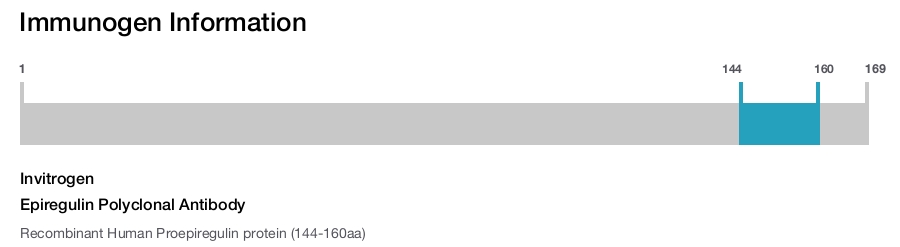
Recombinant Human Proepiregulin protein (144-160aa)
Conjugate
Unconjugated
Unconjugated
Unconjugated
Form
Liquid
Concentration
5 mg/mL
Amount
500 µg
Purification
Protein G
Storage buffer
PBS, pH 7.4, with 50% glycerol
Contains
0.03% ProClin 300
Storage conditions
-20°C or -80°C if preferred
Shipping conditions
Ambient (domestic); Wet ice (international)
RRID
Product Specific Information
Antibody tested in Indirect ELISA
Target Information
Epiregulin is an EGF-related growth factor that binds specifically to EGFR (ErbB1) and ErbB4, but not ErbB2 or ErbB3. It is expressed mainly in the placenta and peripheral blood leukocytes, as well as in certain carcinomas of the bladder, lung, kidney and colon. Epiregulin stimulates the proliferation of keratinocytes, hepatocytes, fibroblasts and vascular smooth muscle cells. It also inhibits the growth of several tumor-derived epithelial cell lines. Human Epiregulin is initially synthesized as a glycosylated 19.0 kDa transmembrane precursor protein, which is processed by proteolytic cleavage to produce a 6.0 kDa mature secreted sequence.
For Research Use Only. Not for use in diagnostic procedures. Not for resale without express authorization.
References (0)
Have you cited this product in a publication?
Let us know so we can reference it here.
Bioinformatics
Protein Aliases: EREG; unnamed protein product
Gene Aliases: Ep; EPR; ER
UniProt ID: (Human) O14944
Entrez Gene ID: (Human) 2069
ovarian cumulus expansion
oocyte maturation
positive regulation of cytokine production
female meiotic division
epidermal growth factor receptor signaling pathway
cell-cell signaling
positive regulation of cell proliferation
negative regulation of cell proliferation
mRNA transcription
anatomical structure morphogenesis
organ morphogenesis
cytokine-mediated signaling pathway
keratinocyte differentiation
ovulation
positive regulation of interleukin-6 production
ERBB2-EGFR signaling pathway
ERBB2-ERBB4 signaling pathway
ERBB4-ERBB4 signaling pathway
wound healing
positive regulation of phosphorylation
luteinizing hormone signaling pathway
response to peptide hormone
keratinocyte proliferation
positive regulation of innate immune response
positive regulation of DNA replication
positive regulation of mitotic nuclear division
positive regulation of protein kinase activity
negative regulation of transcription, DNA-templated
positive regulation of fibroblast proliferation
primary follicle stage
animal organ development
positive regulation of smooth muscle cell proliferation
negative regulation of epithelial cell proliferation
negative regulation of smooth muscle cell differentiation
positive regulation of multicellular organismal process
Disclaimer

Clicking the images or links will redirect you to a website hosted by BenchSci that provides third-party scientific content. Neither the content nor the BenchSci technology and processes for selection have been evaluated by us; we are providing them as-is and without warranty of any kind, including for use or application of the Thermo Fisher Scientific products presented.

Performance Guarantee
If an Invitrogen™ antibody doesn't perform as described on our website or datasheet,we'll replace the product at no cost to you, or provide you with a credit for a future purchase.*
Learn more
We're here to help
Get expert recommendations for common problems or connect directly with an on staff expert for technical assistance related to applications, equipment and general product use.
Contact tech support