Search
Invitrogen
Kir6.2 (KCNJ11) Polyclonal Antibody
{{$productOrderCtrl.translations['antibody.pdp.commerceCard.promotion.promotions']}}
{{$productOrderCtrl.translations['antibody.pdp.commerceCard.promotion.promocode']}}: {{promo.promoCode}} {{promo.promoTitle}} {{promo.promoDescription}}. {{$productOrderCtrl.translations['antibody.pdp.commerceCard.promotion.learnmore']}}
{{$ctrl.translations['antibody.pdp.skuNotes.additionalInformation']}}:
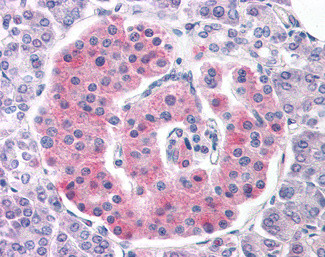
FIGURE: 1 / 2
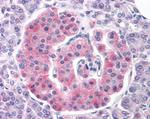
Kir6.2 (KCNJ11) Antibody (PA5-18711) in IHC (P)
Immunohistochemistry analysis of Kir6.2 (KCNJ11) in human pancreas. Samples were incubated with Kir6.2 (KCNJ11) polyclonal antibody (Product # PA5-18711) using a dilution of 75 µg/mL. Formalin-fixed, paraffin-embedded tissue after heat-induced antigen retrieval.
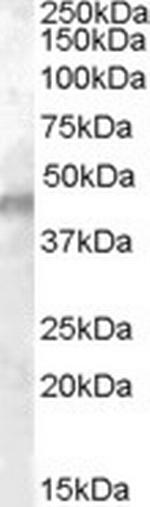
Please note: We are reviewing Western blot images included in the antibody testing data in our catalog, including those provided by third parties. Unless expressly labeled or annotated as “raw-unedited”, Western blot images included in the antibody testing data in our catalog may have been edited, optimized or otherwise adjusted for presentation.


Product Details
PA5-18711
Applications
Tested Dilution
Publications
Product Specifications
Species Reactivity
Human
Host/Isotype
Goat
/ IgG
Class
Polyclonal
Type
Antibody
Immunogen
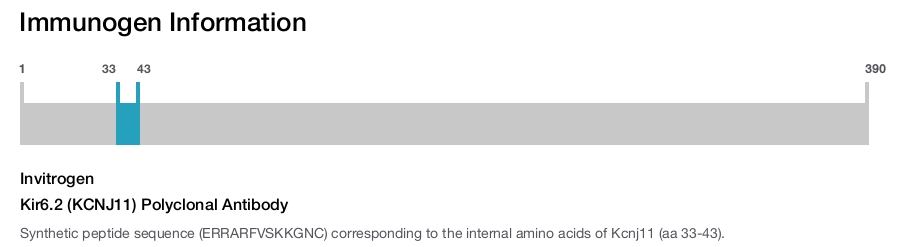
Synthetic peptide sequence (ERRARFVSKKGNC) corresponding to the internal amino acids of Kcnj11 (aa 33-43).
Conjugate
Unconjugated
Unconjugated
Unconjugated
Form
Liquid
Concentration
0.5 mg/mL
Amount
100 µg
Purification
Ammonium sulfate precipitation
Storage buffer
TBS, pH 7.3, with 0.5% BSA
Contains
0.02% sodium azide
Storage conditions
-20°C, Avoid Freeze/Thaw Cycles
Shipping conditions
Ambient (domestic); Wet ice (international)
RRID
Product Specific Information
This antibody is predicted to react with canine, mouse and rat based on sequence homology.
This antibody is tested in Peptide ELISA: antibody detection limit dilution 64,000.
Target Information
This receptor is controlled by G proteins. Inward rectifier potassium channels are characterized by a greater tendency to allow potassium to flow into the cell rather than out of it. Their voltage dependence is regulated by the concentration of extracellular potassium; as external potassium is raised, the voltage range of the channel opening shifts to more positive voltages. The inward rectification is mainly due to the blockage of outward current by internal magnesium. Can be blocked by extracellular barium. Subunit of ATP-sensitive potassium channels (KATP). Can form cardiac and smooth muscle-type KATP channels with ABCC9. KCNJ11 forms the channel pore while ABCC9 is required for activation and regulation.
For Research Use Only. Not for use in diagnostic procedures. Not for resale without express authorization.
References (0)
Have you cited this product in a publication?
Let us know so we can reference it here.
Bioinformatics
Protein Aliases: AI842722; AW491124; beta-cell inward rectifier subunit; inward rectifier K(+) channel Kir6.2; inwardly rectifing potassium channel subfamily J member 11; inwardly rectifying potassium channel KIR6.2; inwardly-rectifying potassium channel subfamily J member 11; IRK11; KATP; KATP channel; Kir6; MGC133230; potassium channel inwardly rectifing subfamily J member 11; potassium channel, inwardly rectifying subfamily J member 11; potassium voltage-gated channel subfamily J member 11; unnamed protein product
Gene Aliases: BIR; HHF2; IKATP; KIR6.2; MODY13; PHHI; PNDM2; TNDM3
UniProt ID: (Human) Q14654
Entrez Gene ID: (Human) 3767
inward rectifier potassium channel activity
voltage-gated potassium channel activity
protein binding
ATP binding
ATP-activated inward rectifier potassium channel activity
cation-transporting ATPase activity
ankyrin binding
potassium ion binding
ion channel binding
voltage-gated monoatomic ion channel activity involved in regulation of presynaptic membrane potential
glucose metabolic process
potassium ion transport
response to xenobiotic stimulus
response to ATP
regulation of membrane potential
negative regulation of insulin secretion
regulation of insulin secretion
neurological system process
transmembrane transport
potassium ion transmembrane transport
inorganic cation import across plasma membrane
regulation of presynaptic membrane potential
potassium ion import across plasma membrane
Disclaimer

Clicking the images or links will redirect you to a website hosted by BenchSci that provides third-party scientific content. Neither the content nor the BenchSci technology and processes for selection have been evaluated by us; we are providing them as-is and without warranty of any kind, including for use or application of the Thermo Fisher Scientific products presented.

Performance Guarantee
If an Invitrogen™ antibody doesn't perform as described on our website or datasheet,we'll replace the product at no cost to you, or provide you with a credit for a future purchase.*
Learn more
We're here to help
Get expert recommendations for common problems or connect directly with an on staff expert for technical assistance related to applications, equipment and general product use.
Contact tech support