Search
Invitrogen
CRYAB Polyclonal Antibody
{{$productOrderCtrl.translations['antibody.pdp.commerceCard.promotion.promotions']}}
{{$productOrderCtrl.translations['antibody.pdp.commerceCard.promotion.promocode']}}: {{promo.promoCode}} {{promo.promoTitle}} {{promo.promoDescription}}. {{$productOrderCtrl.translations['antibody.pdp.commerceCard.promotion.learnmore']}}
{{$ctrl.translations['antibody.pdp.skuNotes.additionalInformation']}}:
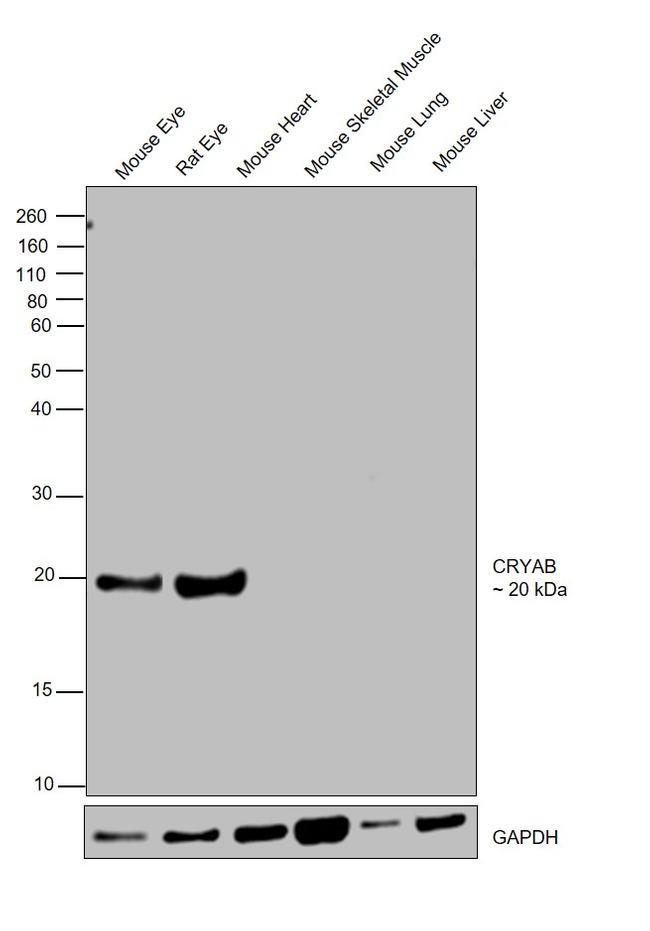
FIGURE: 1 / 3
CRYAB Antibody (PA5-18825) in WB
Western blot was performed using Anti-CRYAB Polyclonal Antibody (Product # PA5-18825) and a 20 kDa band corresponding to CRYAB was observed only in Mouse Eye and Rat Eye and not in any other tissues. Tissue extracts (30 µg lysate) of Mouse Eye (Lane 1), Rat Eye (Lane 2), Mouse Heart (Lane 3), Mouse Skeletal Muscle (Lane 4), Mouse Lung (Lane 5) and Mouse Liver (Lane 6) were electrophoresed using Novex® NuPAGE® 4-12 % Bis-Tris gel (Product # NP0321BOX). Resolved proteins were then transferred onto a nitrocellulose membrane (Product # IB23001... View More
Please note: We are reviewing Western blot images included in the antibody testing data in our catalog, including those provided by third parties. Unless expressly labeled or annotated as “raw-unedited”, Western blot images included in the antibody testing data in our catalog may have been edited, optimized or otherwise adjusted for presentation.


Product Details
PA5-18825
Product Specifications
Species Reactivity
Human,
Mouse,
Rat
Host/Isotype
Goat
/ IgG
Class
Polyclonal
Type
Antibody
Immunogen
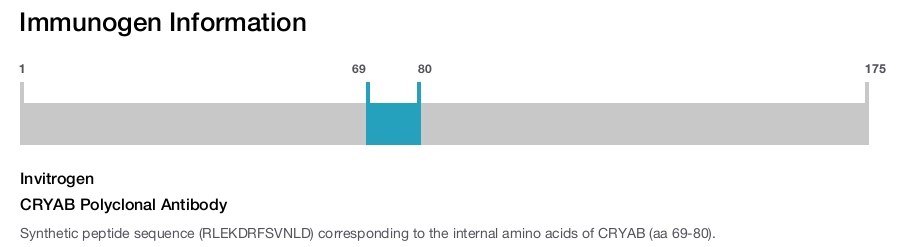
Synthetic peptide sequence (RLEKDRFSVNLD) corresponding to the internal amino acids of CRYAB (aa 69-80).
Conjugate
Unconjugated
Unconjugated
Unconjugated
Form
Liquid
Concentration
0.5 mg/mL
Amount
100 µg
Purification
Ammonium sulfate precipitation
Storage buffer
TBS, pH 7.3, with 0.5% BSA
Contains
0.02% sodium azide
Storage conditions
-20°C, Avoid Freeze/Thaw Cycles
Shipping conditions
Ambient (domestic); Wet ice (international)
RRID
Product Specific Information
This antibody is predicted to react with rat based on sequence homology.
This antibody is tested in Peptide ELISA: antibody detection limit dilution 128,000.
Target Information
Lens proteins consist almost entirely of crystallins (about 95%). Crystallins are also found vertebrate skeletal muscle tissue. In the lens, their structural function is to assist in maintaining the proper refractive index of the lens. The mammalian lens contains 3 major classes of crystallins: alpha, beta, and gamma. Alpha-crystallin is the largest of the crystallins and is composed of 2 primary gene products-alpha-A and alpha-B. There are at least 5 different proteins comprising the beta-crystallins. The gamma-crystallins are monomeric, but there are at least 5 gamma crystallins identified in bovine and rat lens. Alpha-Crystallin comprises 40% of total lens protein composition. In addition to maintaining proper refractive index, it also functions in a chaperone like manner by preventing the formation of aggregates possibly leading to cataract formation. It is believed that the phosphorylated states of the alpha-crystallin occur in response to cellular stress and may serve a structural control function and play a role in protein maintenance. Alpha-B crystallin has been linked to Alexander's disease where it accumulates in brain cells of those afflicted.
For Research Use Only. Not for use in diagnostic procedures. Not for resale without express authorization.
References (0)
Have you cited this product in a publication?
Let us know so we can reference it here.
Bioinformatics
Protein Aliases: alpha(B)-crystallin; Cryab; CryAB antibody; crystallin, alpha 2; Crystallin, alpha polypeptide 2; epididymis secretory protein Li 101; heat shock 20 kDa protein-like protein; heat shock protein beta-5; heat shock protein beta-5; heat shock protein CryAB; heat shock protein family B member 5; heat shock protein HspB5; heat-shock 20 kD like-protein; ORF1; ORF2; ORF32; renal carcinoma antigen NY-REN-27; Rosenthal fiber component; similar to human alpha B-crystallin Rosenthal fiber component encoded by GenBank Accession Number S45630; unnamed protein product
Gene Aliases: AACRYA; CMD1II; Crya-2; CRYA2; CTPP2; CTRCT16; HEL-S-101; HSPB5; MFM2; MFM2A; MFM2B; P23
UniProt ID: (Human) P02511, (Mouse) P23927, (Rat) P23928
Entrez Gene ID: (Human) 1410, (Mouse) 12955, (Rat) 25420
response to hypoxia
lens development in camera-type eye
protein folding
glutathione metabolic process
tubulin complex assembly
muscle organ development
response to heat
negative regulation of gene expression
negative regulation of cell growth
microtubule polymerization or depolymerization
negative regulation of protein complex assembly
response to estradiol
negative regulation of intracellular transport
protein refolding
response to hydrogen peroxide
camera-type eye development
negative regulation of apoptotic process
regulation of programmed cell death
negative regulation of transcription, DNA-templated
protein stabilization
stress-activated MAPK cascade
apoptotic process involved in morphogenesis
cellular response to gamma radiation
negative regulation of amyloid fibril formation
negative regulation of reactive oxygen species metabolic process
muscle contraction
Disclaimer

Clicking the images or links will redirect you to a website hosted by BenchSci that provides third-party scientific content. Neither the content nor the BenchSci technology and processes for selection have been evaluated by us; we are providing them as-is and without warranty of any kind, including for use or application of the Thermo Fisher Scientific products presented.

Performance Guarantee
If an Invitrogen™ antibody doesn't perform as described on our website or datasheet,we'll replace the product at no cost to you, or provide you with a credit for a future purchase.*
Learn more
We're here to help
Get expert recommendations for common problems or connect directly with an on staff expert for technical assistance related to applications, equipment and general product use.
Contact tech support