Search
Invitrogen
NOX2 Polyclonal Antibody
{{$productOrderCtrl.translations['antibody.pdp.commerceCard.promotion.promotions']}}
{{$productOrderCtrl.translations['antibody.pdp.commerceCard.promotion.promocode']}}: {{promo.promoCode}} {{promo.promoTitle}} {{promo.promoDescription}}. {{$productOrderCtrl.translations['antibody.pdp.commerceCard.promotion.learnmore']}}
{{$ctrl.translations['antibody.pdp.skuNotes.additionalInformation']}}:
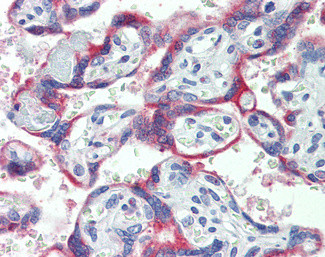
Please note: We are reviewing Western blot images included in the antibody testing data in our catalog, including those provided by third parties. Unless expressly labeled or annotated as “raw-unedited”, Western blot images included in the antibody testing data in our catalog may have been edited, optimized or otherwise adjusted for presentation.

产品信息
PA5-19010
产品规格
种属反应
Human
宿主/亚型
Goat
/ IgG
分类
Polyclonal
类型
Antibody
抗原
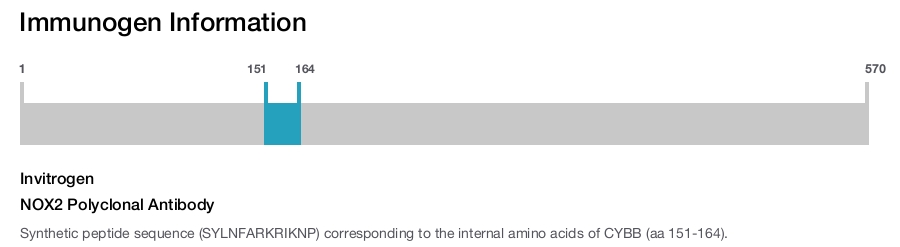
Synthetic peptide sequence (SYLNFARKRIKNP) corresponding to the internal amino acids of CYBB (aa 151-164).
偶联物
Unconjugated
Unconjugated
Unconjugated
形式
Liquid
浓度
0.5 mg/mL
规格
100 µg
纯化类型
Ammonium sulfate precipitation
保存液
TBS, pH 7.3, with 0.5% BSA
内含物
0.02% sodium azide
保存条件
-20°C, Avoid Freeze/Thaw Cycles
运输条件
Ambient (domestic); Wet ice (international)
RRID
产品详细信息
This antibody is predicted to react with canine based on sequence homology.
This antibody is tested in Peptide ELISA: antibody detection limit dilution 64,000.
靶标信息
Mox1 and the glycoprotein gp91-phox are largely related proteins that are essential components of the NADPH oxidase. The superoxide-generating NADPH oxidase complex expresses in phagocytes, neuroepithelial bodies, vascular smooth muscle cells, and endothelial cells. It includes a membrane bound flavocytochrome containing two subunits, gp91-phox and p22-phox, and the cytosolic proteins p47-phox and p67-phox. The p22- and gp91-phox subunits also function as surface O2 sensors that initiate cellular signaling in response to hypoxic conditions. Mox1 and gp91 contain identical C-terminal sequence identity, yet possess distinct expression patterns. gp91-phox expresses in eosinophils, neutrophils, monocytes, and B-lymphocytes, whereas Mox1 is predominantly detected in the colon, with low expression in the uterus and prostate.
仅用于科研。不用于诊断过程。未经明确授权不得转售。
篇参考文献 (0)
您是否在文献中引用过该产品?请点击下方按钮邮件告知我们。
生物信息学
蛋白别名: CGD91-phox; cytochrome b(558) subunit beta; cytochrome b-245 beta polypeptide; cytochrome b-245 heavy chain; cytochrome b558 subunit beta; GP91 PHOX; GP911; heme-binding membrane glycoprotein gp91phox; neutrophil cytochrome b 91 kDa polypeptide; p22 phagocyte B-cytochrome; p91PHOX; superoxide-generating NADPH oxidase heavy chain subunit; unnamed protein product
基因别名: AMCBX2; CGD; CGDX; GP91-1; GP91-PHOX; GP91PHOX; IMD34; NOX2; p91-PHOX
UniProt ID: (Human) P04839
Entrez Gene ID: (Human) 1536
protein binding
electron carrier activity
NAD(P)H oxidase activity
superoxide-generating NADPH oxidase activity
oxidoreductase activity
heme binding
voltage-gated proton channel activity
protein heterodimerization activity
flavin adenine dinucleotide binding
NADPH binding
FAD binding
superoxide-generating NADPH oxidase activity
superoxide metabolic process
defense response
inflammatory response
response to nutrient
response to xenobiotic stimulus
positive regulation of tumor necrosis factor production
superoxide anion generation
innate immune response
response to ethanol
respiratory burst
positive regulation of angiogenesis
cellular response to cadmium ion
cellular response to ethanol
cellular response to hypoxia
hypoxia-inducible factor-1alpha signaling pathway
response to aldosterone
cellular response to L-glutamine
response to angiotensin
Disclaimer

Clicking the images or links will redirect you to a website hosted by BenchSci that provides third-party scientific content. Neither the content nor the BenchSci technology and processes for selection have been evaluated by us; we are providing them as-is and without warranty of any kind, including for use or application of the Thermo Fisher Scientific products presented.

