Search
Invitrogen
CRYM Polyclonal Antibody
{{$productOrderCtrl.translations['antibody.pdp.commerceCard.promotion.promotions']}}
{{$productOrderCtrl.translations['antibody.pdp.commerceCard.promotion.promocode']}}: {{promo.promoCode}} {{promo.promoTitle}} {{promo.promoDescription}}. {{$productOrderCtrl.translations['antibody.pdp.commerceCard.promotion.learnmore']}}
{{$ctrl.translations['antibody.pdp.skuNotes.additionalInformation']}}:
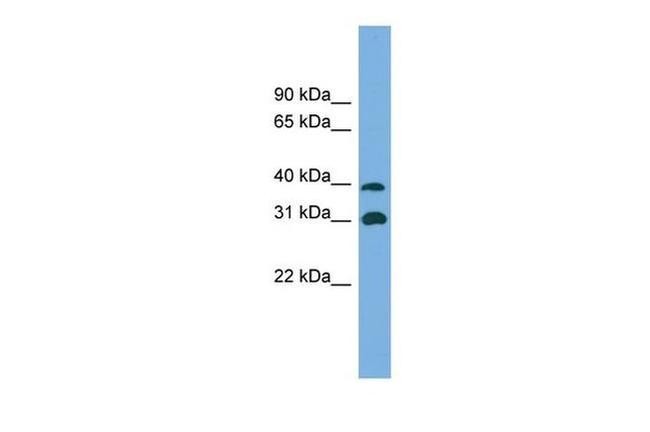
Please note: We are reviewing Western blot images included in the antibody testing data in our catalog, including those provided by third parties. Unless expressly labeled or annotated as “raw-unedited”, Western blot images included in the antibody testing data in our catalog may have been edited, optimized or otherwise adjusted for presentation.

Product Details
PA5-43759
Product Specifications
Species Reactivity
Human
Host/Isotype
Rabbit
/ IgG
Class
Polyclonal
Type
Antibody
Immunogen
Synthetic peptide directed towards the middle region of human CRYM
Conjugate
Unconjugated
Unconjugated
Unconjugated
Form
Liquid
Concentration
0.5 mg/mL
Amount
50 µg
Purification
Affinity Chromatography
Storage buffer
PBS with 2% sucrose
Contains
0.09% sodium azide
Storage conditions
-20°C, Avoid Freeze/Thaw Cycles
Shipping conditions
Ambient (domestic); Wet ice (international)
RRID
Product Specific Information
Peptide sequence: AHINAVGASR PDWRELDDEL MKEAVLYVDS QEAALKESGD VLLSGAEIFA
Sequence homology: Cow: 100%; Dog: 100%; Goat: 100%; Guinea Pig: 93%; Horse: 100%; Human: 100%; Mouse: 93%; Rabbit: 100%; Rat: 93%
Target Information
Crystallins are separated into two classes: taxon-specific and ubiquitous. The former class is also called phylogenetically-restricted crystallins. The latter class constitutes the major proteins of vertebrate eye lens and maintains the transparency and refractive index of the lens. This gene encodes a taxon-specific crystallin protein that binds NADPH and has sequence similarity to bacterial ornithine cyclodeaminases. The encoded protein does not perform a structural role in lens tissue, and instead it binds thyroid hormone for possible regulatory or developmental roles. Multiple alternatively spliced transcript variants have been found for this gene.
For Research Use Only. Not for use in diagnostic procedures. Not for resale without express authorization.
References (0)
Have you cited this product in a publication?
Let us know so we can reference it here.
Bioinformatics
Protein Aliases: 1-piperideine-2-carboxylate/1-pyrroline-2-carboxylate reductase; mu-crystallin homolog; NADP-regulated thyroid-hormone binding protein; P2C/Pyr2C reductase; thiomorpholine-carboxylate dehydrogenase; unnamed protein product
Gene Aliases: DFNA40; THBP
UniProt ID: (Human) Q14894
Entrez Gene ID: (Human) 1428
Disclaimer

Clicking the images or links will redirect you to a website hosted by BenchSci that provides third-party scientific content. Neither the content nor the BenchSci technology and processes for selection have been evaluated by us; we are providing them as-is and without warranty of any kind, including for use or application of the Thermo Fisher Scientific products presented.

Performance Guarantee
If an Invitrogen™ antibody doesn't perform as described on our website or datasheet,we'll replace the product at no cost to you, or provide you with a credit for a future purchase.*
Learn more
We're here to help
Get expert recommendations for common problems or connect directly with an on staff expert for technical assistance related to applications, equipment and general product use.
Contact tech support