Search
Invitrogen
BCAR3 Polyclonal Antibody
{{$productOrderCtrl.translations['antibody.pdp.commerceCard.promotion.promotions']}}
{{$productOrderCtrl.translations['antibody.pdp.commerceCard.promotion.promocode']}}: {{promo.promoCode}} {{promo.promoTitle}} {{promo.promoDescription}}. {{$productOrderCtrl.translations['antibody.pdp.commerceCard.promotion.learnmore']}}
{{$ctrl.translations['antibody.pdp.skuNotes.additionalInformation']}}:
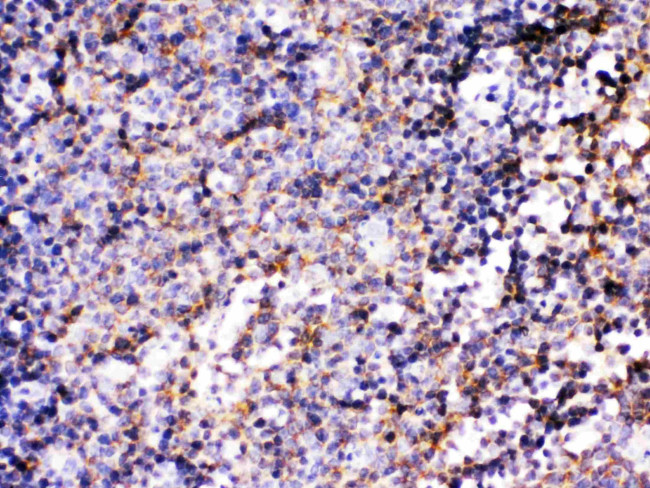
FIGURE: 1 / 5
BCAR3 Antibody (PA5-78858) in IHC (P)
Immunohistochemistry analysis of BCAR3 on paraffin-embedded mouse lymphaden tissue. Sample was incubated with BCAR3 polyclonal antibody (Product# PA5-78858) with a dilution of 1 µg/mL, and developed by Streptavidin-Biotin-Complex (SABC) with DAB chromogen method.
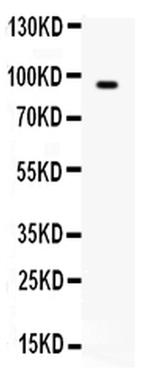
Please note: We are reviewing Western blot images included in the antibody testing data in our catalog, including those provided by third parties. Unless expressly labeled or annotated as “raw-unedited”, Western blot images included in the antibody testing data in our catalog may have been edited, optimized or otherwise adjusted for presentation.


Product Details
PA5-78858
Applications
Tested Dilution
Publications
Product Specifications
Species Reactivity
Human,
Mouse,
Rat
Published species
Mouse
Host/Isotype
Rabbit
/ IgG
Class
Polyclonal
Type
Antibody
Immunogen
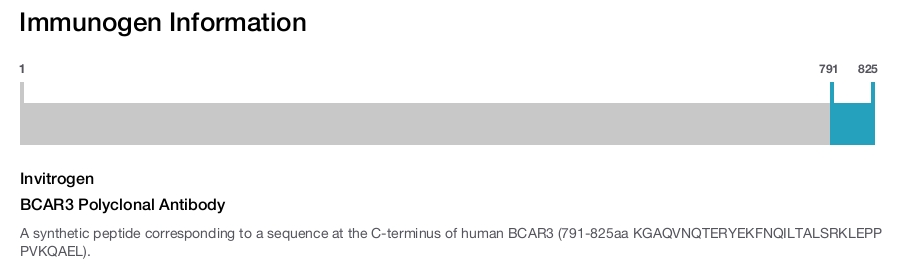
A synthetic peptide corresponding to a sequence at the C-terminus of human BCAR3 (791-825aa KGAQVNQTERYEKFNQILTALSRKLEPPPVKQAEL).
Conjugate
Unconjugated
Unconjugated
Unconjugated
Form
Lyophilized
Concentration
500 µg/mL once reconstituted
Amount
100 µg
Purification
Antigen affinity chromatography
Storage buffer
PBS with 5mg BSA
Contains
0.05mg sodium azide
Storage conditions
-20°C
Shipping conditions
Ambient (domestic); Wet ice (international)
RRID
Product Specific Information
Reconstitute with 0.2 mL of distilled water to yield a concentration of 500 µg/mL.
Positive Control - WB: HEPG2 whole cell. IHC: mouse lymphaden tissue, rat spleen tissue, human tonsil tissue.
Target Information
Breast tumors are initially dependent on estrogens for growth and progression and can be inhibited by anti-estrogens such as tamoxifen. However, breast cancers progress to become anti-estrogen resistant. Breast cancer anti-estrogen resistance gene 3 was identified in the search for genes involved in the development of estrogen resistance. The gene encodes a component of intracellular signal transduction that causes estrogen-independent proliferation in human breast cancer cells. The protein contains a putative src homology 2 (SH2) domain, a hall mark of cellular tyrosine kinase signaling molecules, and is partly homologous to the cell division cycle protein CDC48.
For Research Use Only. Not for use in diagnostic procedures. Not for resale without express authorization.
Bioinformatics
Protein Aliases: BCAR3 adapter protein, NSP family member; BCAR3, NSP family adaptor protein; BCAR3, NSP family adaptor protein 3; breast cancer anti-estrogen resistance 3; breast cancer antiestrogen resistance 3 protein; dJ1033H22.2 (breast cancer anti-estrogen resistance 3); epididymis secretory sperm binding protein; KIAA0554; mig-7; migration inducting gene-7; novel SH2-containing protein 2; OTTHUMP00000011961; p130Cas-binding protein AND-34; putative ras-family GDP exchange factor; SH2 domain-containing protein 3B; unnamed protein product
Gene Aliases: AND-34; MIG7; NSP2; SH2D3B
UniProt ID: (Human) O75815, (Rat) D3ZAZ5, (Mouse) Q9QZK2
Entrez Gene ID: (Human) 8412, (Rat) 310838, (Mouse) 29815
lens morphogenesis in camera-type eye
epidermal growth factor receptor signaling pathway
small GTPase mediated signal transduction
positive regulation of cell proliferation
insulin receptor signaling pathway
positive regulation of peptidyl-serine phosphorylation
positive regulation of MAPK cascade
positive regulation of GTPase activity
endothelin receptor signaling pathway
signal transduction
response to xenobiotic stimulus
Disclaimer

Clicking the images or links will redirect you to a website hosted by BenchSci that provides third-party scientific content. Neither the content nor the BenchSci technology and processes for selection have been evaluated by us; we are providing them as-is and without warranty of any kind, including for use or application of the Thermo Fisher Scientific products presented.

Performance Guarantee
If an Invitrogen™ antibody doesn't perform as described on our website or datasheet,we'll replace the product at no cost to you, or provide you with a credit for a future purchase.*
Learn more
We're here to help
Get expert recommendations for common problems or connect directly with an on staff expert for technical assistance related to applications, equipment and general product use.
Contact tech support