Search
Invitrogen
Menin Polyclonal Antibody
{{$productOrderCtrl.translations['antibody.pdp.commerceCard.promotion.promotions']}}
{{$productOrderCtrl.translations['antibody.pdp.commerceCard.promotion.promocode']}}: {{promo.promoCode}} {{promo.promoTitle}} {{promo.promoDescription}}. {{$productOrderCtrl.translations['antibody.pdp.commerceCard.promotion.learnmore']}}
{{$ctrl.translations['antibody.pdp.skuNotes.additionalInformation']}}:
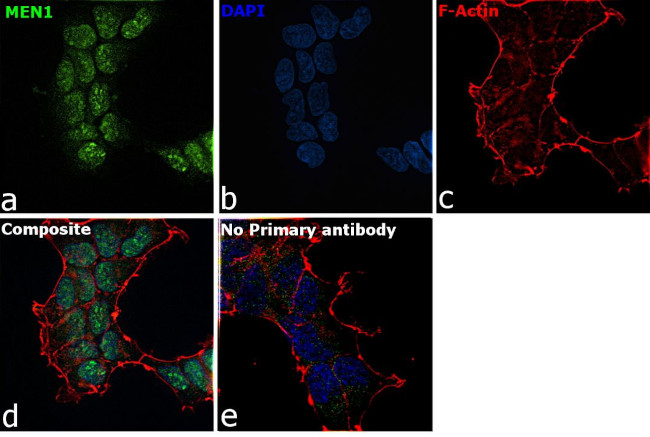
FIGURE: 1 / 6
Menin Antibody (PA5-79663) in ICC/IF
Immunofluorescence analysis of MEN1 was performed using 70% confluent log phase HEK cells. The cells were fixed with 4% paraformaldehyde for 10 minutes, permeabilized with 0.1% Triton™ X-100 for 15 minutes, and blocked with 2% BSA for 1 hour at room temperature. The cells were labeled with MEN1 Polyclonal Antibody (Product # PA5-79663) at 1:100 dilution in 0.1% BSA, incubated at 4 degree Celsius overnight and then labeled with Goat anti-Rabbit IgG (Heavy Chain) Superclonal™ Recombinant Secondary Antibody, Alexa Fluor® 488 conjugate (Produc... View More
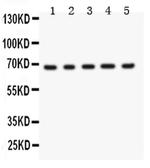
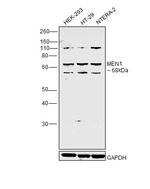
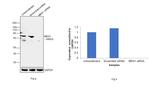
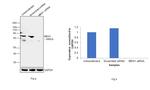
Please note: We are reviewing Western blot images included in the antibody testing data in our catalog, including those provided by third parties. Unless expressly labeled or annotated as “raw-unedited”, Western blot images included in the antibody testing data in our catalog may have been edited, optimized or otherwise adjusted for presentation.


Product Details
PA5-79663
Applications
Tested Dilution
Publications
Product Specifications
Species Reactivity
Human,
Mouse
Published species
Human
Host/Isotype
Rabbit
/ IgG
Class
Polyclonal
Type
Antibody
Immunogen
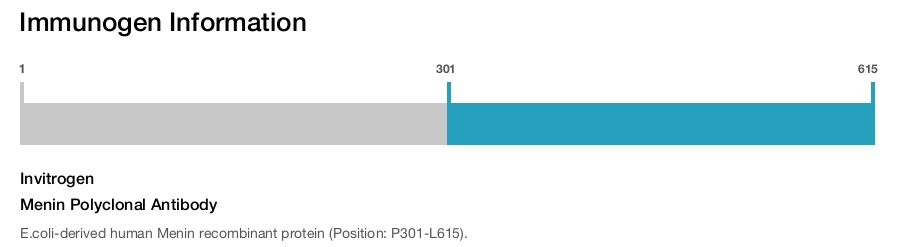
E.coli-derived human Menin recombinant protein (Position: P301-L615).
Conjugate
Unconjugated
Unconjugated
Unconjugated
Form
Lyophilized
Concentration
500 µg/mL once reconstituted
Amount
100 µg
Purification
Antigen affinity chromatography
Storage buffer
0.9mg NaCl, 0.2mg Na2PO4, 5mg BSA
Contains
0.05mg sodium azide
Storage conditions
-20°C
Shipping conditions
Ambient (domestic); Wet ice (international)
RRID
Product Specific Information
Reconstitute with 0.2 mL of distilled water to yield a concentration of 500 µg/mL.
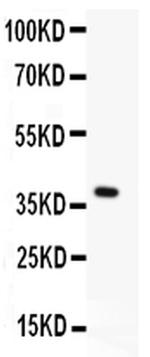
Positive Control - WB: HELA whole cell, 293T whole cell, SMMC whole cell, HEPA whole cell, COLO320 whole cell.
Target Information
Potassium channels are a group of ubiquitously expressed proteins that serve numerous functions in excitable and non-excitable cells. One class of integral membrane potassium channels is the large conductance, calcium-activated potassium channel (Maxi K+). Maxi K+ differs from most other potassium channels in that its activation is controlled by both increases in intracellular calcium and by membrane depolarization. Maxi K+ dual activation is possible because of its structure. The core of the channel, which is similar to other potassium channels, is a Maxi K+ alpha homotetramer that contains both a voltage sensor and an intracellular calcium binding domain. In vascular smooth muscle, an auxiliary beta-subunit is found in a 1:1 stoichiometry. The beta-subunit exhibits its effect on the Maxi K+ channel by effectively decreasing by 5- to 10- fold the concentration of calcium required to keep the pore open.
For Research Use Only. Not for use in diagnostic procedures. Not for resale without express authorization.
Bioinformatics
Protein Aliases: similar to Homo sapiens MENIN; unnamed protein product
Gene Aliases: MEAI; SCG2
UniProt ID: (Human) O00255, (Mouse) O88559
Entrez Gene ID: (Human) 4221, (Mouse) 17283
four-way junction DNA binding
Y-form DNA binding
transcription regulatory region sequence-specific DNA binding
bacterial-type RNA polymerase transcriptional activator activity, sequence-specific DNA binding
DNA binding
chromatin binding
double-stranded DNA binding
protein binding
protein binding, bridging
sequence-specific DNA binding
phosphoprotein binding
R-SMAD binding
negative regulation of transcription from RNA polymerase II promoter
MAPK cascade
ossification
leukocyte homeostasis
negative regulation of protein phosphorylation
osteoblast fate commitment
osteoblast development
type B pancreatic cell differentiation
chromatin remodeling
regulation of transcription from RNA polymerase II promoter
cellular response to DNA damage stimulus
negative regulation of cell proliferation
response to UV
response to gamma radiation
regulation of gene expression
positive regulation of gene expression
negative regulation of cell-substrate adhesion
hemopoiesis
positive regulation of transforming growth factor beta receptor signaling pathway
regulation of activin receptor signaling pathway
positive regulation of apoptotic process
T-helper 2 cell differentiation
positive regulation of cell differentiation
negative regulation of osteoblast differentiation
positive regulation of osteoblast differentiation
negative regulation of cyclin-dependent protein serine/threonine kinase activity
negative regulation of cell cycle
positive regulation of gene expression, epigenetic
negative regulation of transcription, DNA-templated
positive regulation of transcription, DNA-templated
positive regulation of transcription from RNA polymerase II promoter
negative regulation of JNK cascade
negative regulation of organ growth
embryonic skeletal system morphogenesis
negative regulation of epithelial cell proliferation
positive regulation of cell division
palate development
maternal process involved in female pregnancy
regulation of type B pancreatic cell proliferation
response to transforming growth factor beta
negative regulation of cell cycle G1/S phase transition
regulation of G1/S transition of mitotic cell cycle
DNA repair
Disclaimer

Clicking the images or links will redirect you to a website hosted by BenchSci that provides third-party scientific content. Neither the content nor the BenchSci technology and processes for selection have been evaluated by us; we are providing them as-is and without warranty of any kind, including for use or application of the Thermo Fisher Scientific products presented.

Performance Guarantee
If an Invitrogen™ antibody doesn't perform as described on our website or datasheet,we'll replace the product at no cost to you, or provide you with a credit for a future purchase.*
Learn more
We're here to help
Get expert recommendations for common problems or connect directly with an on staff expert for technical assistance related to applications, equipment and general product use.
Contact tech support