Search


Citations & References (3)
Invitrogen™
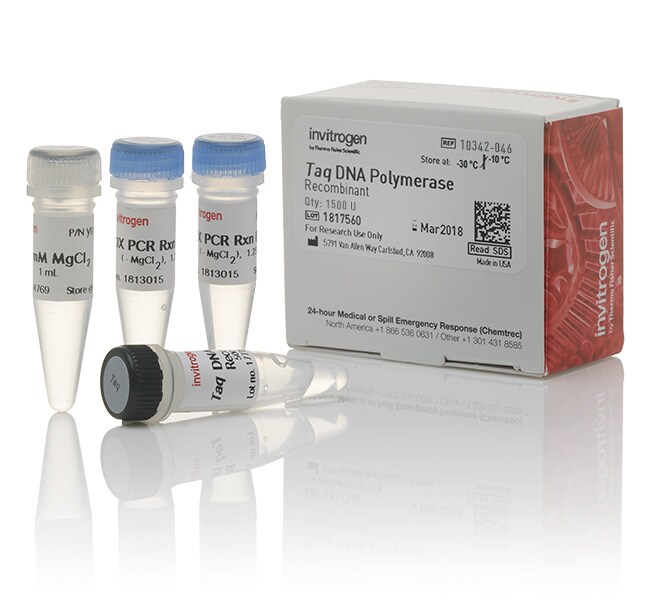
Taq DNA Polymerase, recombinant
Taq DNA Polymerase is a thermostable enzyme that synthesizes DNA from single-stranded templates in the presence of dNTPs and a primer.
Have Questions?
Change view

| Catalog Number | No. of Reactions |
|---|---|
| 10342046 | 1500 Reactions |
| 10342053 | 100 Reactions |
| 10342020 | 500 Reactions |
| 10342178 | 5000 Reactions |
Catalog number 10342046
Price (CNY)
6,652.00
Online exclusive
Ends: 31-Dec-2026
9,503.00Save 2,851.00 (30%)
Each
No. of Reactions:
1500 Reactions
Price (CNY)
6,652.00
Online exclusive
Ends: 31-Dec-2026
9,503.00Save 2,851.00 (30%)
Each
Taq DNA Polymerase, recombinant, is a thermostable enzyme that synthesizes DNA from single-stranded templates in the presence of dNTPs and a primer. This recombinant enzyme is purified from the cloned Thermus aquaticus DNA polymerase gene expressed in E. coli and consists of a single polypeptide with a molecular weight of 94 kDa. It has a 5' to 3' DNA polymerase activity and a 5' to 3' exonuclease activity.
Features
- A choice of recombinant or native enzyme
- Amplification of PCR products up to 5 kb in size
- Enzyme is licensed and qualified for PCR
Applications
- Amplification of DNA from complex genomic, viral, and plasmid templates
- RT-PCR
- Sequencing ssDNA
- Cycle sequencing
Notes
- One unit of Taq DNA Polymerase is the amount of enzyme required to incorporate 10 nmoles of deoxyribonucleotide into DNA in 30 minutes at 74°C.
- For superior PCR performance, DreamTaq DNA Polymerase is recommended.
For Research Use Only. Not for use in diagnostic procedures.
Specifications
Exonuclease Activity5' - 3'
Fidelity (vs. Taq)1X
FormatStand-alone enzyme
Hot StartNo
No. of Reactions1500 Reactions
Overhang3'-A
PolymeraseTaq DNA Polymerase
Product TypeDNA Polymerase
Quantity3 x 500 Units
Reaction FormatSeparate Components
Shipping ConditionDry Ice
Size (Final Product)5 kb or less
Starting MaterialDNA
Concentration5 U/μL
For Use With (Application)Standard PCR
GC-Rich PCR PerformanceLow
PCR MethodqPCR, Standard PCR
Reaction SpeedStandard
Unit SizeEach
Contents & Storage
• Taq DNA Polymerase (5 U/μL), 3 x 100 μL
• 10X PCR buffer, 7.5 mL
• 50 mM MgCl2, 3 mL
Store at -10°C to -30°C in a non-frost-free freezer.
Guaranteed stable for 6 months when stored properly.
• 10X PCR buffer, 7.5 mL
• 50 mM MgCl2, 3 mL
Store at -10°C to -30°C in a non-frost-free freezer.
Guaranteed stable for 6 months when stored properly.
Frequently asked questions (FAQs)
My oligonucleotide does not appear to be the right length when I checked by gel electrophoresis. Why is this?
The primers I am using worked for PCR initially, but over time, have stopped working. What happened?
I don't see a pellet in my oligo tube order. Should I ask for a replacement?
There is a ball-shaped pellet at the bottom of my oligo tube. What is this and can I still use my oligo?
There is a green color in my lyophilized oligo. Can I still use it?
Citations & References (3)
Citations & References
Abstract
alpha-Methylacyl coenzyme A racemase as a tissue biomarker for prostate cancer.
Journal:JAMA
PubMed ID:11926890
'Edited due to space constraints: CONTEXT: Molecular profiling of prostate cancer has led to the identification of candidate biomarkers and regulatory genes. Discoveries from these genome-scale approaches may have applicability in the analysis of diagnostic prostate specimens. OBJECTIVES: To determine the expression and clinical utility of alpha-methylacyl coenzyme A racemase
Molecular cross-talk between the TRAIL and interferon signaling pathways.
Journal:J Biol Chem
PubMed ID:11677236
TRAIL/APO-2L induces apoptosis in a variety of transformed cells and has potential as an anti-cancer therapeutic. The physiologic role of TRAIL is presumably more complex than merely activating caspase-mediated cell death. To shed light into TRAIL-mediated signaling, we used DNA microarrays to profile gene expression mediated by TRAIL in breast
Association between CYP2C9 genetic variants and anticoagulation-related outcomes during warfarin therapy.
Journal:JAMA
PubMed ID:11926893
Edited for space constraints: Warfarin is a commonly used anticoagulant that requires careful clinical management to balance the risks of overanticoagulation and bleeding with those of underanticoagulation and clotting. The principal enzyme involved in warfarin metabolism is CYP2C9, and 2 relatively common variant forms with reduced activity have been identified,