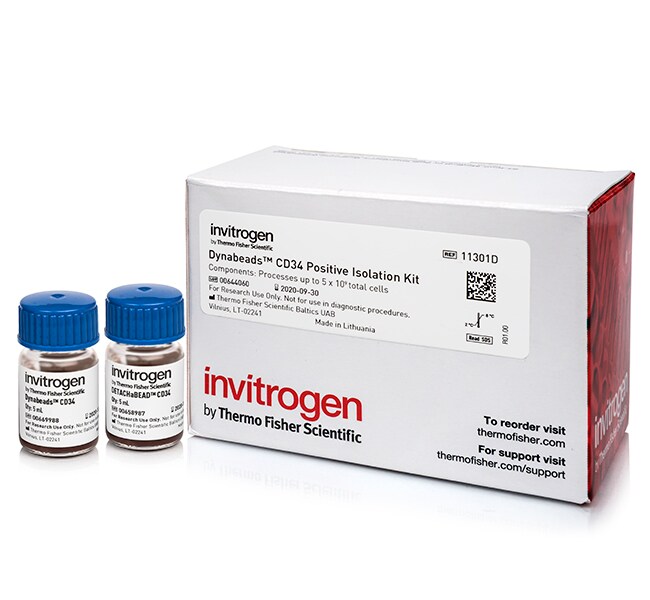
Dynabeads™ CD34 Positive Isolation Kit
Invitrogen™

Dynabeads™ CD34 Positive Isolation Kit

Use this kit to isolate a high purity and yield of human CD34+ progenitor stem cells. Positively isolated cells areRead more
Have Questions?
Catalog NumberQuantity
11301D5 mL
Catalog number 11301D
Price (CNY)
12,388.00
Online Exclusive
Ends: 31-Dec-2025
16,907.00
Save 4,519.00 (27%)
Each
Add to cart
Quantity:
5 mL
Price (CNY)
12,388.00
Online Exclusive
Ends: 31-Dec-2025
16,907.00
Save 4,519.00 (27%)
Each
Add to cart
Use this kit to isolate a high purity and yield of human CD34+ progenitor stem cells. Positively isolated cells are bead and antibody-free, phenotypically unaltered and suitable for any downstream applications including flow cytometry, functional studies, and cell culture to produce dendritic cells (DC's). The Dynal™ CD34 Progenitor Cell Isolation System can also be used to isolate CD34+ cells from rhesus monkey (Macaca mulatta).

• Positive isolation of human CD34+ progenitor stem cells with bead release
• Stem cells can be isolated directly from whole blood, cord blood or bone marrow
• Isolated CD34+ cells can be used in any application, i.e. be derived into dendritic cells (DC's)

Starting samples:
PBMC from mobilized peripheral blood, bone marrow or cord blood.
For Research Use Only. Not for use in diagnostic procedures.
Specifications
Cell TypeStem Cells, Stem Cells (Hematopoietic)
Isolation TechnologyPositive Isolation
No. of CellsProcesses ∼5 x 10⁹ cells total
Output Viability>95%
Product LineDETACHaBEAD, DYNAL, Dynabeads
Purity or Quality GradeResearch Grade
Quantity5 mL
Sample TypeBlood (Mobilized Peripheral), Blood (Umbilical Cord), Bone Marrow
Shipping ConditionRoom Temperature
Starting Material Cell No.1 x 108 PBMCs per isolation
Target SpeciesHuman
Product TypePositive Cell Isolation Kit
Unit SizeEach
Contents & Storage
Each kit contains 5 mL Dynabeads™ coated with anti-CD34 monoclonal antibody, and 5 mL DETACHaBEAD™ CD34.

The kit can process up to 5 x 10⁹ cells. Store components at 2°C to 8°C.

Frequently asked questions (FAQs)

My Dynabeads magnetic beads are not pelleting well with the magnet. Do you have any suggestions for me?

Please review the following possibilities for why your Dynabeads magnetic beads are not pelleting:

- The solution is too viscous.
- The beads have formed aggregates because of protein-protein interaction.

Try these suggestions: - Increase separation time (leave tub on magnet for 2-5 minutes)
- Add DNase I to the lysate (~0.01 mg/mL)
- Increase the Tween 20 concentration to ~0.05% of the binding and/or washing buffer.
- Add up to 20 mM beta-merecaptoethanol to the binding and/or wash buffers.

Find additional tips, troubleshooting help, and resources within our Dynabeads Nucleic Acid Purification Support Center.

I have a long double-stranded DNA fragment I would like to isolate. What product do you recommend?

For biotin-labeled DNA that is less than 1 kb, we recommend you use Dynabeads M270 Streptavidin (Cat. No. 65305) and MyOne C1 magnetic beads (Cat. No. 65001). We recommend our Dynabeads KilobaseBINDER Kit (Cat. No. 60101), which is designed to immobilize long (>1 kb) double-stranded DNA molecules. The KilobaseBINDER reagent consists of M-280 Streptavidin-coupled Dynabeads magnetic beads along with a patented immobilization activator in the binding solution to bind to long, biotinylated DNA molecules for isolation. Please see the following link (https://www.thermofisher.com/us/en/home/life-science/dna-rna-purification-analysis/napamisc/capture-of-biotinylated-targets/immobilisation-of-long-biotinylated-dna-fragments.html) for more information in regards to long biotinylated DNA fragment isolation.

Find additional tips, troubleshooting help, and resources within our Dynabeads Nucleic Acid Purification Support Center.

Can I use Dynabeads magnetic beads to isolate single-stranded DNA templates?

Yes, Dynabeads magnetic beads can be used to isolate single-stranded DNA. Streptavidin Dynabeads magnetic beads can be used to target biotinylated DNA fragments, followed by denaturation of the double-stranded DNA and removal of the non-biotinylated strand. The streptavidin-coupled Dynabeads magnetic beads will not inhibit any enzymatic activity. This enables further handling and manipulation of the bead-bound DNA directly on the solid phase. Please see the following link (https://www.thermofisher.com/us/en/home/life-science/dna-rna-purification-analysis/napamisc/capture-of-biotinylated-targets/preparing-single-stranded-dna-templates.html) for more information in regards to single-stranded DNA capture.

Find additional tips, troubleshooting help, and resources within our Dynabeads Nucleic Acid Purification Support Center.

What is the magnetic susceptibility for Dynabeads magnetic beads?

Magnetic susceptibility is a measure of how quickly the beads will migrate to the magnet. This will depend on the iron content and the character of the iron oxide. The magnetic susceptibility given for the Dynabeads magnetic beads is the mass susceptibility, given either as cgs units/g or m^3/kg (the latter being an SI unit). For ferri- and ferromagnetic substances, the magnetic mass susceptibility is dependent upon the magnetic field strength (H), as the magnetization of such substances is not a linear function of H but approaches a saturation value with increasing field. For that reason, the magnetic mass susceptibility of the Dynabeads magnetic beads is determined by a standardized procedure under fixed conditions. The magnetic mass susceptibility given in our catalog is thus the SI unit. Conversion from Gaussian (cgs, emu) units into SI units for magnetic mass susceptibility is achieved by multiplying the Gaussian factor (emu/g or cgs/g) by 4 pi x 10^-3. The resulting unit is also called the rationalized magnetic mass susceptibility, which should be distinguished from the (SI) dimensionless magnetic susceptibility unit. In general, magnetic mass susceptibility is a measure of the force (Fz) influencing an object positioned in a nonhomogenous magnetic field. The magnetic mass susceptibility of the Dynabeads magnetic beads is measured by weighing a sample, and then subjecting the sample to a magnetic field of known strength. The weight (F1) is then measured, and compared to the weight of the sample when the magnetic field is turned off (F0). The susceptibility is then calculated as K x 10^-3 = [(F1-F0) x m x 0.335 x 10^6], where K is the mass susceptibility of the sample of mass m. The susceptibility is then converted to SI units.

Find additional tips, troubleshooting help, and resources within our Dynabeads Nucleic Acid Purification Support Center.

How can I determine coupling efficiency of Dynabeads magnetic beads?

There are different methods to check binding of ligands to the beads, including optical density (OD) measurement, fluorescent labeling, and radioactive labeling.

For OD measurement, you would measure the OD of the ligand before immobilization to the beads and compare it with the ligand concentration that is left in the supernatant after coating. This gives a crude measurement of how much protein has bound to the beads.

Protocol:

1.Set spectrophotometer to the right wavelength. As a blank, use the Coupling Buffer.
2.Measure the absorbance of the Pre-Coupling Solution. A further dilution may be necessary to read the absorbance, depending upon the amount of ligand added.
3.Measure the absorbance of the Post-Coupling Solution. A dilution may be necessary to read the absorbance.
4.Calculate the coupling efficiency, expressed as the % protein uptake, as follows. [(Pre-Coupling Solution x D) - (Post-Coupling Solution x D)] x 100/(Pre-Coupling Solution x D) where D = dilution factor.

For fluorescent labeling, we suggest negatively quantifying the amount of ligand bound by measuring ligand remaining in the coupling supernatant (compared to the original sample), rather than directly measuring the ligands on the beads. Add labeled ligand to the beads, and measure how much ligand is left in the supernatant (not bound to the beads). By comparing this with the total amount added in the first place, you can then calculate how much of the ligand that has been bound to the beads. Keep in mind that the Dynabeads magnetic beads are also autofluorescent, which is why direct measuring of fluorescence of the bead-bound ligands is not recommended, but rather this indirect approach. The label could be, for example, FITC/PE. Some researchers perform a direct approach with success (using a flow cytometer).

Radioactive labeling is the most sensitive method of the three, but it is also the most difficult one. It involves radioactively labeling a portion of the ligand. We use radiolabeled I-125 in tracer amounts and mix it with "cold" ligands in a known ratio before coupling. The absolute quantities for the ligand on the beads should be obtained by measuring the beads in a scintillation (gamma) counter and comparing the cpm with a standard.

Protocol:

1.Take out an appropriate amount of beads and wash the beads in 1 mL of binding buffer.
2.Pipette out desired amount of human IgG in a separate tube.
3.Mix the human IgG with I-125-labeled human IgG (30,000 - 100,000 cpm).
4.Dilute the mixture of human IgG and I-125-labeled human IgG to 100 mL in binding buffer.
5.Incubate for 30 minutes at room temperature and measure the cpm in a scintillation counter.
6.Wash the beads (with coating) four times, and measure cpm again.
The % binding is calculated by using the equation : (cpm after washing/cpm before washing)x100%.

Find additional tips, troubleshooting help, and resources within our Dynabeads Nucleic Acid Purification Support Center.

Citations & References (5)

Citations & References
Abstract
Gene expression analysis of hematopoietic progenitor cells identifies Dlg7 as a potential stem cell gene.
Authors:Gudmundsson KO, Thorsteinsson L, Sigurjonsson OE, Keller JR, Olafsson K, Egeland T, Gudmundsson S, Rafnar T,
Journal:Stem Cells
PubMed ID:17322106
'Inducible hematopoietic stem/progenitor cell lines represent a model for studying genes involved in self-renewal and differentiation. Here, gene expression was studied in the inducible human CD34+ acute myelogenous leukemia cell line KG1 using oligonucleotide arrays and suppression subtractive cloning. Using this approach, we identified Dlg7, the homolog of the Drosophila ... More
Infection of human CD34+ progenitor cells with Bartonella henselae results in intraerythrocytic presence of B. henselae.
Authors:Mändle T, Einsele H, Schaller M, Neumann D, Vogel W, Autenrieth IB, Kempf VA,
Journal:Blood
PubMed ID:15860668
'Although there is evidence that endothelial cells are important targets for human pathogenic Bartonella species, the primary niche of infection is unknown. Here we elucidated whether human CD34+ hematopoietic progenitor cells (HPCs) internalize B. henselae and may serve as a potential niche of the pathogen. We showed that B. henselae ... More
I branching formation in erythroid differentiation is regulated by transcription factor C/EBP{alpha}.
Authors:Twu YC, Chen CP, Hsieh CY, Tzeng CH, Sun CF, Wang SH, Chang MS, Yu LC,
Journal:Blood
PubMed ID:17855628
'The histo-blood group i and I antigens have been characterized as straight and branched repeats of N-acetyllactosamine, respectively, and the conversion of the straight-chain i to the branched-chain I structure on red cells is regulated to occur after birth. It has been demonstrated that the human I locus expresses 3 ... More
Early lymphoid progenitors in mouse and man are highly sensitive to glucocorticoids.
Authors:Igarashi H, Medina KL, Yokota T, Rossi MI, Sakaguchi N, Comp PC, Kincade PW,
Journal:Int Immunol
PubMed ID:15746243
Glucocorticoids are extensively used in anti-inflammatory therapy and may contribute to the normal regulation of lymphopoiesis. This study utilized new information about the early stages of lymphopoiesis in mouse and man to determine precisely which cell types are hormone sensitive. Cycling B lineage precursors were depleted in dexamethasone-treated mice, while ... More
T cells modulate Epstein-Barr virus latency phenotypes during infection of humanized mice.
Authors:Heuts F, Rottenberg ME, Salamon D, Rasul E, Adori M, Klein G, Klein E, Nagy N,
Journal:
PubMed ID:24390326
Human B cells, the main target of Epstein-Barr virus (EBV), can display several types of latent viral protein expression, denoted 0, I, IIa, IIb, or III. Of these, only type III expression induces proliferation of cells in vitro. These latency types are present at specific stages of infection and are ... More