Search


Citations & References (1)
Gibco™
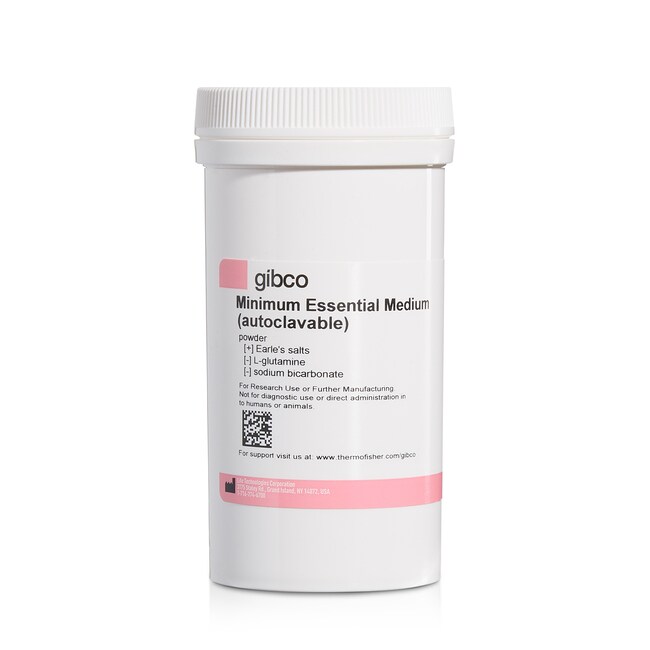
MEM, autoclavable, no glutamine, powder
Minimum Essential Medium (MEM) is one of the most commonly used of all cell culture media. MEM can be usedRead more
| Catalog Number | Quantity |
|---|---|
| 11700077 | 10 L |
Catalog number 11700077
Price (CNY)
534.00
飞享价
Ends: 31-Dec-2026
668.00Save 134.00 (20%)
Each
Quantity:
10 L
Price (CNY)
534.00
飞享价
Ends: 31-Dec-2026
668.00Save 134.00 (20%)
Each
Minimum Essential Medium (MEM) is one of the most commonly used of all cell culture media. MEM can be used with a variety of suspension and adherent mammalian cells, including HeLa, BHK-21, 293, HEP-2, HT-1080, MCF-7, fibroblasts, and primary rat astrocytes. We offer a variety of Gibco MEM modifications for a range of cell culture applications. Find the right formulation using the media selector tool.
This MEM is modified as follows:
With: Phenol Red, Earle's salts
Without: L-glutamine, HEPES, Sodium Bicarbonate
The complete formulation is available.
Gibco MEM, developed by Harry Eagle, was based on his earlier formulation of Basal Medium Eagle (BME). Many other modifications of MEM followed, including Glasgow's MEM, MEM α, DMEM, and Temin's Modification. To allow autoclaving this medium, choline chloride is substituted with choline bitartrate, phenol red is reduced, and succinic acid is added to prevent precipitation at low pH. This MEM formulation contains Earle's salts for use in a CO2 incubator. This product is made with Earle's salts.
MEM contains no proteins, lipids, or growth factors. Therefore, MEM requires supplementation, commonly with 10% Fetal Bovine Serum (FBS). MEM uses a sodium bicarbonate buffer system (2.2 g/L) and therefore requires a 5–10% CO2 environment to maintain physiological pH.
This autoclavable form of Gibco™ cell culture medium requires pH adjustment to 4.1–4.2 before autoclaving, following by sodium bicarbonate and L-glutamine supplementation and final pH adjustment to 7.2–7.4 (see protocol for details).
Please note that the shelf life on delivered products varies. This product has a minimum shelf life of 6 months at time of shipment. For more information regarding product shelf life, including details on specific product lots, please contact Customer Service.
Not for human or animal therapeutic use. Uses other than the intended use may be a violation of local law. For in vitro diagnostic use.
Specifications
Cell LineHeLa, BHK-21, 293, HEP-2, HT-1080, MCF-7, and fibroblasts
Cell TypePrimary Rat Astrocytes
Manufacturing QualitycGMP-compliant under the ISO 13485 standard
Product LineGibco
Product TypeMEM (Minimum Essential Medium)
Quantity10 L
Shelf Life36 Months From Date of Manufacture
Shipping ConditionRoom Temperature
ClassificationAnimal Origin-free
FormPowder
Serum LevelStandard Serum Supplementation
SterilitySterile-filtered
With AdditivesPhenol Red, Earle's Balanced Salt Solution (EBSS)
Without AdditivesNo HEPES, No Sodium Bicarbonate
Unit SizeEach
Contents & Storage
Storage conditions: 2-8°C
Shipping conditions: Ambient
Shelf life: 36 months from date of manufacture
Shipping conditions: Ambient
Shelf life: 36 months from date of manufacture
Frequently asked questions (FAQs)
Where can I find the osmolality for MEM Medium?
What is the shelf life of my powdered media once I reconstitute it?
How long can I keep my media after supplementing with serum?
My medium was shipped at room temperature but it is supposed to be stored refrigerated. Is it okay?
How can I remove mycoplasma contamination from my cell culture medium?
Citations & References (1)
Citations & References
Abstract
Novel polyaminolipids enhance the cellular uptake of oligonucleotides.
Journal:J Biol Chem
PubMed ID:8537413
'Two new polyaminolipids have been synthesized for the purpose of improving cellular uptake of oligonucleotides. The amphipathic compounds are conjugates of spermidine or spermine linked through a carbamate bond to cholesterol. The polyaminolipids are relatively nontoxic to mammalian cells. In tissue culture assays, using fluorescent-tagged or radiolabeled triple helix-forming oligonucleotides,