Search


Citations & References (1)
Invitrogen™
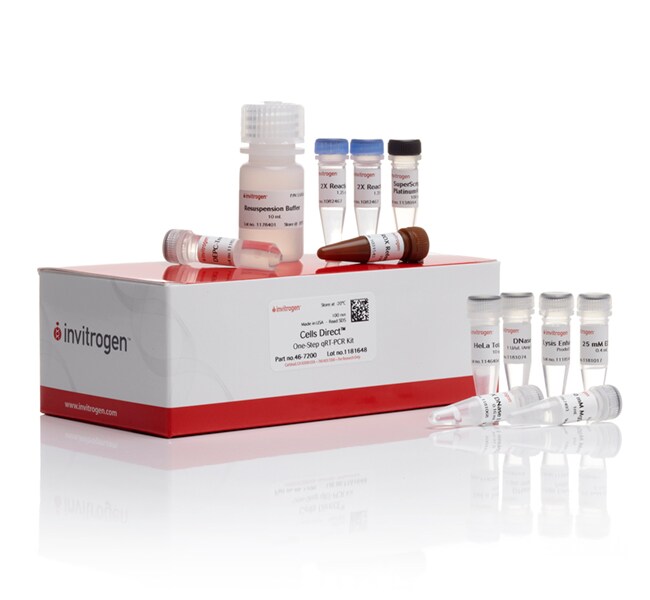
CellsDirect™ One-Step qRT-PCR Kit
The CellsDirect™ One-Step qRT-PCR Kit delivers highly sensitive and specific real-time qPCR results directly from cells, without the need forRead more
Have Questions?
Change view

| Catalog Number | No. of Reactions |
|---|---|
| 11753100 | 100 reactions |
| 11753500 | 500 reactions |
Catalog number 11753100
Price (CNY)
8,529.00
Each
No. of Reactions:
100 reactions
Price (CNY)
8,529.00
Each
The CellsDirect™ One-Step qRT-PCR Kit delivers highly sensitive and specific real-time qPCR results directly from cells, without the need for an RNA purification step.
Features of the CellsDirect™ One-Step qRT-PCR Kit include:
• Efficiency—offers significant time and cost savings for increased throughput
• Convenience—enzyme mix includes both SuperScript™ III Reverse Transcriptase and Platinum™ Taq DNA Polymerase
• Sensitivity—no separate RNA isolation step increases sensitivity by minimizing sample loss
• Broad detection range—detect targets from samples ranging from a single cell to 10,000 cells
• Versatility—compatible with a wide variety of cell lines and samples collected by Laser Capture Microdissection (LCM)
Streamline your workflow
In traditional real-time quantitative RT-PCR (qRT-PCR), you first isolate RNA from cells in a time-consuming procedure that can lead to loss of material. Using the CellsDirect™ One-Step qRT-PCR Kit, you lyse the cells and add the complete lysate directly to a one-step qRT-PCR reaction with minimal handling and sample loss.
Ideal for your qRT-PCR application
CellsDirect™ technology is validated for gene expression studies involving limited samples. CellsDirect™ One-Step qRT-PCR Kits are especially valuable for high-throughput applications by eliminating costly, time-consuming RNA purification steps (see figure). The CellsDirect™ One-Step qRT-PCR Kit may also be used to detect genomic DNA targets.
CellsDirect™ One-Step qRT-PCR Kits may be used in conjunction with hydrolysis probes (e.g., TaqMan™ or LUX™ fluorogenic primers).
Note: This kit includes a separate tube of ROX™ Reference Dye. An equivalent kit (11754-500) with ROX™ Reference Dye included in the 2X Reaction Mix is also available.
For Research Use Only. Not for use in diagnostic procedures.
Specifications
For Use With (Equipment)7500 Fast System, 7500 System, BioRad iQ5, BioRad MyiQ, Corbett RotorGene, MJ Opticon, Stratagene Mx3000P, Stratagene Mx3005P, Stratagene Mx4000, BioRad iCycler iQ, Cepheid SmartCycler, MJ Chromo4, QuantStudio 3 and 5 systems, QuantStudio 6 and 7 Pro systems, QuantStudio 7 Flex system, QuantStudio 12k Flex system, QuantStudio 6 Flex system
No. of Reactions100 reactions
Product LineCellsDirect, Platinum, SuperScript
Quantity100 reactions
Sample TypeCells
Concentration2X
Detection MethodPrimer-probe
For Use With (Application)RT-PCR
Reaction SpeedFast or Standard
Unit SizeEach
Contents & Storage
• 10 mL Resuspension Buffer
• 1 mL Lysis Enhancer
• 500 μL DNase I, Amplification Grade (1 U/μL)
• 160 μL 10X DNase I Buffer
• 400 μL 25 mM EDTA
• 100 μL SuperScript™ III RT/Platinum™ Taq Mix
• 2 × 1.25 mL 2X Reaction Mix
• 1 mL 50 mM MgSO4
• 2 mL DEPC-treated water
• 10 μL HeLa Total RNA (10 ng/μL)
• 100 μL ROX™ Reference Dye (store at -20°C in the dark)
The kit is shipped on dry ice and should be stored at -20°C
• 1 mL Lysis Enhancer
• 500 μL DNase I, Amplification Grade (1 U/μL)
• 160 μL 10X DNase I Buffer
• 400 μL 25 mM EDTA
• 100 μL SuperScript™ III RT/Platinum™ Taq Mix
• 2 × 1.25 mL 2X Reaction Mix
• 1 mL 50 mM MgSO4
• 2 mL DEPC-treated water
• 10 μL HeLa Total RNA (10 ng/μL)
• 100 μL ROX™ Reference Dye (store at -20°C in the dark)
The kit is shipped on dry ice and should be stored at -20°C
Frequently asked questions (FAQs)
What can I do to improve the sensitivity of my qPCR assay?
How do I set the baseline for my qPCR experiment?
How do I set the threshold for my qPCR experiment?
I am not getting any amplification with my TaqMan Assay or SYBR Green primer set. What is causing this?
I am getting amplification in my no-template control (NTC) wells in my qPCR experiment. What is causing this?
Citations & References (1)
Citations & References
Abstract
Comparison of reverse transcription-quantitative polymerase chain reaction methods and platforms for single cell gene expression analysis.
Journal:Anal Biochem
PubMed ID:22617801
Single cell gene expression analysis can provide insights into development and disease progression by profiling individual cellular responses as opposed to reporting the global average of a population. Reverse transcription-quantitative polymerase chain reaction (RT-qPCR) is the