Search


Citations & References (5)
Gibco™
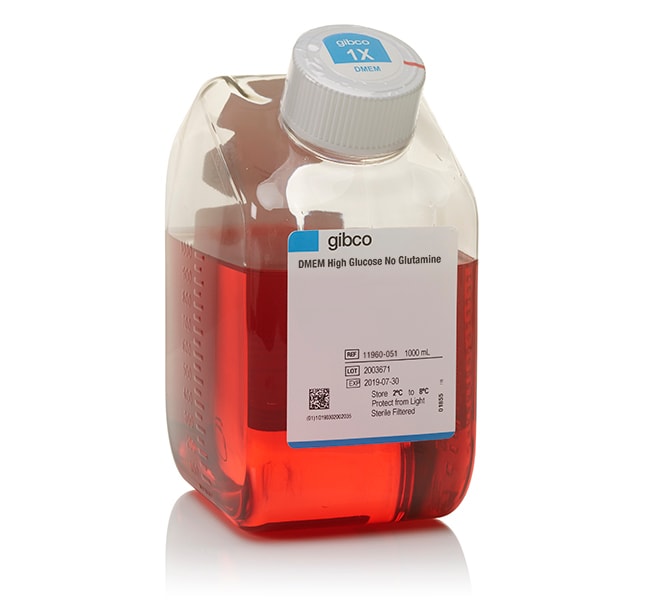
DMEM, high glucose, no glutamine
DMEM (Dulbecco's Modified Eagle Medium) is a widely used basal medium for supporting the growth of many different mammalian cells.
Have Questions?
Change view

| Catalog Number | Quantity |
|---|---|
| 11960051 | 1 x 1000 mL |
| 11960044 | 1 x 500 mL |
| 11960069 | 10 x 500 mL |
| 11960077 | 6 x 1000 mL |
Catalog number 11960051
Price (CNY)
654.00
飞享价
Ends: 31-Dec-2026
817.00Save 163.00 (20%)
Each
Quantity:
1 x 1000 mL
Price (CNY)
654.00
飞享价
Ends: 31-Dec-2026
817.00Save 163.00 (20%)
Each
DMEM (Dulbecco's Modified Eagle Medium) is a widely used basal medium for supporting the growth of many different mammalian cells. Cells successfully cultured in DMEM include primary fibroblasts, neurons, glial cells, HUVECs, and smooth muscle cells, as well as cell lines such as HeLa, 293, Cos-7, and PC-12. We offer a variety of DMEM modifications for a range of cell culture applications. Find the right formulation using the media selector tool.
This DMEM is modified as follows:
With: High Glucose, Phenol Red
Without: L-glutamine, Sodium Pyruvate, HEPES
The complete formulation is available.
Using DMEM
DMEM is unique from other media as it contains 4 times the concentration of amino acids and vitamins than the original Eagle's Minimal Essential Medium. DMEM was originally formulated with low glucose (1 g/L) and sodium pyruvate, but is often used with higher glucose levels, with or without sodium pyruvate. DMEM contains no proteins, lipids, or growth factors. Therefore, DMEM requires supplementation, commonly with 10% Fetal Bovine Serum (FBS). DMEM uses a sodium bicarbonate buffer system (3.7 g/L), and therefore requires a 5–10% CO2 environment to maintain physiological pH.
For Research Use or Further Manufacturing. Not for diagnostic use or direct administration into humans or animals.
Specifications
Cell LineHeLa, 293, Cos-7, and PC-12
Cell TypeMammalian Cells
Concentration1X
Culture EnvironmentCO2
For Use With (Application)Mammalian Cell Culture
FormatBottle
Manufacturing QualitycGMP-compliant under the ISO 13485 standard
Product LineGibco
Product TypeDMEM (Dulbecco's Modified Eagle Medium)
Quantity1 x 1000 mL
Shelf Life12 Months From Date of Manufacture
Shipping ConditionAmbient
ClassificationAnimal Origin-free
Culture TypeMammalian Cell Culture
FormLiquid
Serum LevelStandard Serum Supplementation
SterilitySterile-filtered
Sterilization MethodSterile-filtered
With AdditivesHigh Glucose, Phenol Red
Without AdditivesNo Glutamine, No HEPES, No Sodium Pyruvate
Unit SizeEach
Contents & Storage
Storage conditions: 2°C to 8°C (protect from light)
Shipping conditions: Ambient
Shelf life: 12 months from date of manufacture
Shipping conditions: Ambient
Shelf life: 12 months from date of manufacture
Frequently asked questions (FAQs)
What is the manganese concentration in DMEM? Do you offer manganese-free DMEM?
Citations & References (5)
Citations & References
Abstract
Fibroblast growth factor receptor-1 signaling induces osteopontin expression and vascular smooth muscle cell-dependent adventitial fibroblast migration in vitro.
Journal:Circulation
PubMed ID:12176960
'BACKGROUND: Increased expression of osteopontin (OPN), fibroblast growth factors (FGFs), and their type-1 receptor (FGFR-1) is associated with neointima formation and atherosclerosis. This study tested the hypothesis that ligand activation of FGFR-1 stimulates OPN expression in rat aortic smooth muscle cells (RASMCs), explored the signaling pathway involved, and assessed the
Interaction codes within the family of mammalian Phox and Bem1p domain-containing proteins.
Journal:J Biol Chem
PubMed ID:12813044
'The Phox and Bem1p (PB1) domain constitutes a recently recognized protein-protein interaction domain found in the atypical protein kinase C (aPKC) isoenzymes, lambda/iota- and zeta PKC; members of mitogen-activated protein kinase (MAPK) modules like MEK5, MEKK2, and MEKK3; and in several scaffold proteins involved in cellular signaling. Among the last
Ascorbic-acid transporter Slc23a1 is essential for vitamin C transport into the brain and for perinatal survival.
Journal:Nat Med
PubMed ID:11984580
The only proven requirement for ascorbic acid (vitamin C) is in preventing scurvy, presumably because it is a cofactor for hydroxylases required for post-translational modifications that stabilize collagen. We have created mice deficient in the mouse ortholog (solute carrier family 23 member 1 or Slc23a1) of a rat ascorbic-acid transporter,
Characterization of the 46-kDa intermediates of matrix metalloproteinase 3 (stromelysin 1) obtained by site-directed mutation of phenylalanine 83.
Journal:J Biol Chem
PubMed ID:8631880
The precursor of matrix metalloproteinase 3 (MMP-3/ stromelysin 1) is activated in vitro by proteinases or mercurial compounds by stepwise processes which include the initial formation of short-lived intermediates and the subsequent intermolecular cleavage of the His82-Phe83 bond to generate the fully activated mature MMP-3 (Nagase, H., Enghild, J. J.,
Statin prevents tissue factor expression in human endothelial cells: role of Rho/Rho-kinase and Akt pathways.
Journal:Circulation
PubMed ID:11956113
BACKGROUND: Tissue factor plays a pivotal role in thrombus formation in acute coronary syndromes. However, the regulatory mechanisms underlying tissue factor expression are poorly understood. Statins are effective in patients with acute coronary syndromes. Hence, the aim of this study was to clarify in human endothelial cells the signaling pathways