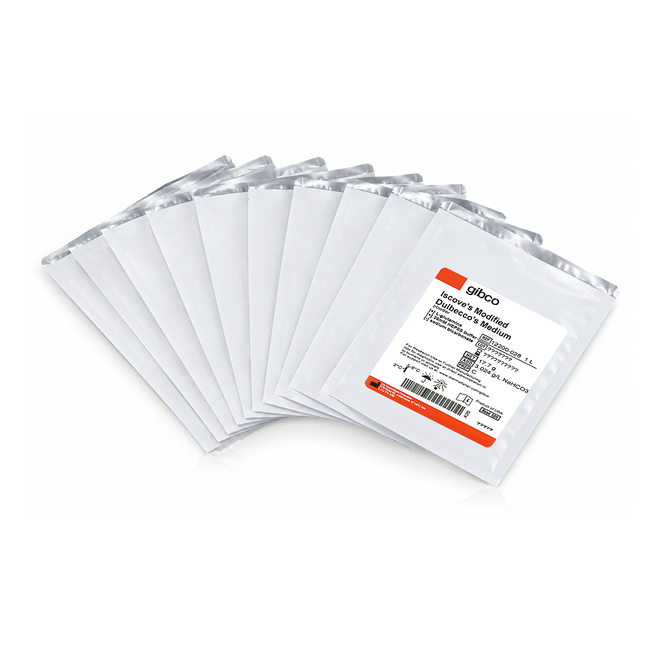
IMDM, powder
Invitrogen17万+抗体限时买二赠一,靶点广,灵活用!
Product Image
Gibco™

IMDM, powder

Iscove's Modified Dulbecco's Medium (IMDM) is well suited for rapidly proliferating, high-density cell cultures, including Jurkat, COS-7, and macrophage cells.Read more
Have Questions?
Change viewbuttonViewtableView
Catalog NumberQuantity
1220003610 x 1 L
1220006910 L
Catalog number 12200036
Price (CNY)
1,652.60
Online Exclusive
Ends: 31-Dec-2025
2,108.00
Save 455.40 (22%)
Each
Add to cart
Quantity:
10 x 1 L
Customize this product
Price (CNY)
1,652.60
Online Exclusive
Ends: 31-Dec-2025
2,108.00
Save 455.40 (22%)
Each
Add to cart

Iscove's Modified Dulbecco's Medium (IMDM) is well suited for rapidly proliferating, high-density cell cultures, including Jurkat, COS-7, and macrophage cells. We offer a variety of Gibco™ IMDM modifications for a range of cell culture applications. Find the right formulation using the media selector tool.

This IMDM is modified as follows:

With: L-glutamine, Phenol Red

Without: α-thioglycerol, 2-mercaptoethanol

The complete formulation is available.

IMDM, a modification of Dulbecco's Modified Eagle Medium, includes selenium as well as additional amino acids and vitamins. In addition, this unique medium lacks iron, with potassium nitrate replacing ferric nitrate.

Please note that the shelf life on delivered products varies. This product has a minimum shelf life of 6 months at time of shipment. For more information regarding product shelf life, including details on specific product lots, please contact Customer Service.

Not for human or animal therapeutic use. Uses other than the intended use may be a violation of local law.
Specifications
Cell LineJurkat, COS-7, and macrophage cells
Manufacturing QualitycGMP-compliant under the ISO 13485 standard
Product LineGibco™
Product TypeIMDM (Iscove's Modified Dulbecco's Medium)
Quantity10 x 1 L
Shelf Life36 Months From Date of Manufacture
Shipping ConditionRoom Temperature
ClassificationAnimal Origin-free
FormPowder
SterilitySterile-filtered
With AdditivesHigh Glucose, Glutamine, HEPES, Phenol Red, Sodium Pyruvate
Without AdditivesNo α-Thioglycerol, No 2-Mercaptoethanol
Unit SizeEach
Contents & Storage
Storage conditions: 2-8° C
Shipping conditions: Ambient
Shelf life: 36 months from date of manufacture

Frequently asked questions (FAQs)

What is the shelf life of my powdered media once I reconstitute it?

Expiration date of most Gibco reconstituted dry format media (AGT or DPM) has not been established; end users should assess performance and stability of this reconstituted media in a system that is relevant to their process. A dry format product (either DPM or AGT) will age upon storage and while we may not be able to detect which component(s) degrade since we can't measure every component, that doesn't mean that the reconstituted liquid will have the same stability as a fresh liquid made by direct weigh methods.

Find additional tips, troubleshooting help, and resources within our Cell Culture Support Center.

How long can I keep my media after supplementing with serum?

Generally speaking, media can be used for up to three weeks after supplementation with serum. There are no formal studies to support this, but it is the rule of thumb used by our scientists.

Find additional tips, troubleshooting help, and resources within our Mammalian Cell Culture Basics Support Center.

My medium was shipped at room temperature but it is supposed to be stored refrigerated. Is it okay?

We routinely ship media that require long-term storage in the refrigerator at room temperature. We have done studies on representative media formulations to show that media can be at room temperature for up to a week without a problem.

Find additional tips, troubleshooting help, and resources within our Mammalian Cell Culture Basics Support Center.

How can I remove mycoplasma contamination from my cell culture medium?

Very often mycoplasma contamination cannot be removed from the culture so it should be discarded. You may have a unique culture that you prefer not to discard and would like to try to clean it. Ciprofloxacin and Plasmocin have reportedly been used for this application. If interested in a protocol or directions for use, check with the antibiotic supplier or published literature. Note that mycoplasma are very difficult to remove from culture and spread easily so the treated cultures should be quarantined until clear of mycoplasma, and your laboratory should be thoroughly cleaned.

Find additional tips, troubleshooting help, and resources within our Cell Culture Support Center.

I see a decrease in growth of my culture. What should I do?

Try changing the medium or serum. Compare media formulations for differences in glucose, amino acids, and other components. Compare an old lot of serum with a new lot. Increase initial cell inoculums. Lastly, adapt cells sequentially to new medium.

Find additional tips, troubleshooting help, and resources within our Cell Culture Support Center.