Search


Citations & References (2)
Gibco™
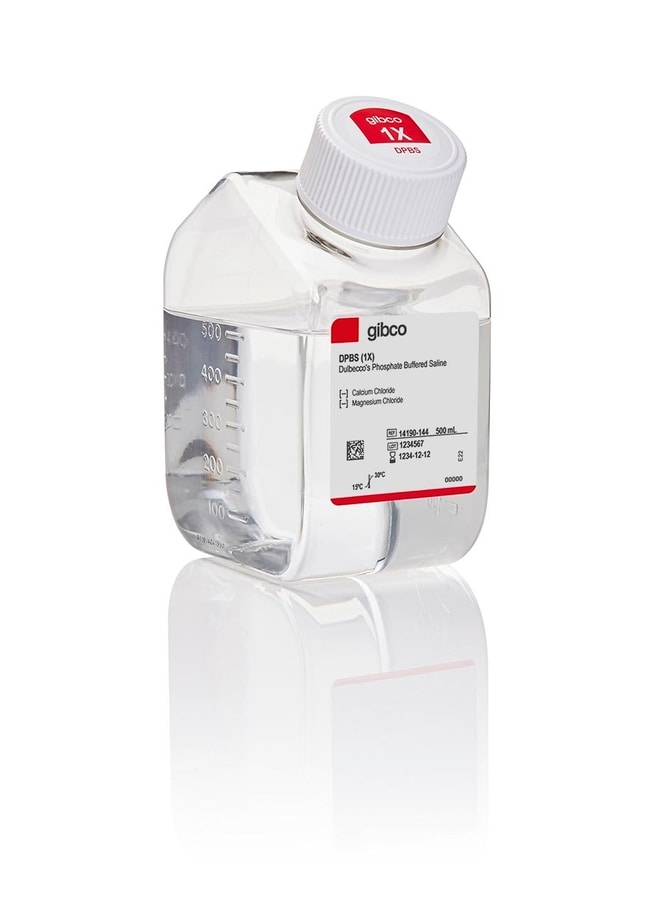
DPBS, no calcium, no magnesium
Dulbecco's Phosphate-Buffered Saline (DPBS) is a balanced salt solution used for a variety of cell culture applications, such as washing cells before dissociation, transporting cells or tissue, diluting cells for counting, and preparing reagents.
Have Questions?
Change view

| Catalog Number | Quantity | Packaging |
|---|---|---|
| 14190250 | 10 x 500 mL | Bottle |
| 14190144 | 500 mL | Bottle |
| 14190136 | 1000 mL | Bottle |
| 14190235 | 6 x 1000 mL | Bottle |
| 14190342 | 5 L | Bag |
| 14190359 | 10 L | Bag |
| 14190367 | 20 L | Bag |
Catalog number 14190250
Price (CNY)
2,958.00
飞享价
Ends: 31-Dec-2026
3,697.00Save 739.00 (20%)
Each
Quantity:
10 x 500 mL
Packaging:
Bottle
Price (CNY)
2,958.00
飞享价
Ends: 31-Dec-2026
3,697.00Save 739.00 (20%)
Each
Dulbecco's phosphate-buffered saline (DPBS) is a balanced salt solution used for a variety of cell culture applications, such as washing cells before dissociation, transporting cells or tissue samples, diluting cells for counting, and preparing reagents. Formulations without calcium and magnesium are required for rinsing chelators from the culture before cell dissociation.
This DPBS is modified as follows:
Without: Calcium, Magnesium, Phenol Red
For Research Use or Further Manufacturing. Not for diagnostic use or direct administration into humans or animals.
Specifications
Chemical Name or MaterialDPBS
ColorClear
IncludesNo Sodium Pyruvate
Manufacturing QualitycGMP-compliant under the ISO 13485 standard
Osmolality270 to 300 mOsm/kg
PackagingBottle
Recommended StorageStorage conditions: 15°C to 30°C, Shipping conditions: Room temperature, Shelf life: 36 months from date of manufacture
SterilitySterile
Sterilization MethodSterile-filtered
Concentration1X
For Use With (Application)Mammalian Cell Culture
GradeCell Culture
Physical FormLiquid
Product LineGibco
Quantity10 x 500 mL
Solution TypeCleaning, Storage, pH Buffer
pH7.0 to 7.3
Unit SizeEach
Frequently asked questions (FAQs)
What is the difference between DPBS, no calcium, no magnesium, 10 x 500 mL, Cat. Nos. 14190250 and 1490169?
What is the shelf life of DPBS after it has been opened?
What is the shelf life of DPBS (Cat. No. 14190136)?
Does Diploid Growth Serum-Reduced Medium (SRM) contain L-glutamine?
Do I have to adjust my infection parameters when using Diploid Production Serum-Free Medium (SFM)?
Citations & References (2)
Citations & References
Abstract
Method for Large-scale Production of hIPSC Spheroids.
Journal:Bio-protocol
PubMed ID:38618177
Stem cell spheroids are rapidly becoming essential tools for a diverse array of applications ranging from tissue engineering to 3D cell models and fundamental biology. Given the increasing prominence of biotechnology, there is a pressing need to develop more accessible, efficient, and reproducible methods for producing these models. Various techniques
Microfluidic single-cell real-time PCR for comparative analysis of gene expression patterns.
Journal:Nat Protoc
PubMed ID:22481529
'Single-cell quantitative real-time PCR (qRT-PCR) combined with high-throughput arrays allows the analysis of gene expression profiles at a molecular level in approximately 11 h after cell sample collection. We present here a high-content microfluidic real-time platform as a powerful tool for comparatively investigating the regulation of developmental processes in single