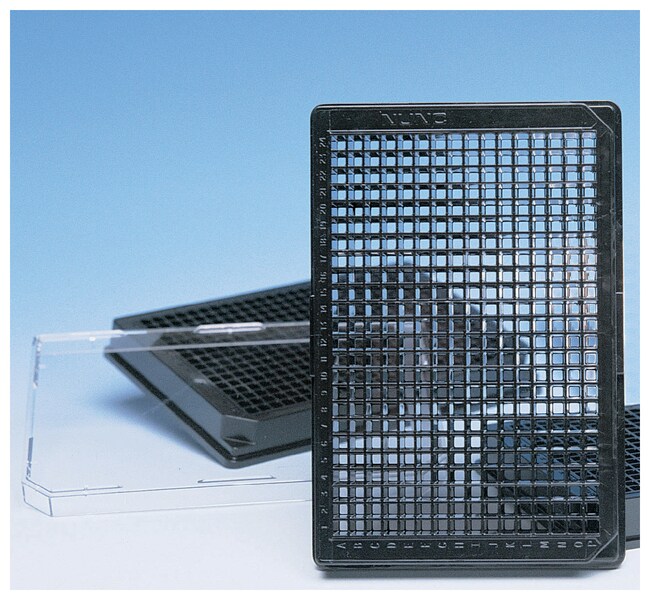
384 Well Black Plate, Optically Clear Polymer Bottom, Pack of 10
Invitrogen17万+抗体限时买二赠一,靶点广,灵活用!
384 Well Black Plate, Optically Clear Polymer Bottom, Pack of 10
Thermo Scientific™

384 Well Black Plate, Optically Clear Polymer Bottom, Pack of 10

Color:Black, Clear Bottom; Sterility:Sterile; Lid:With Lid; Type: Optical Polymer Base
Have Questions?
Catalog NumberQuantity
142761
Catalog number 142761
Price (CNY)
1,229.46
Online Exclusive
Ends: 31-Dec-2025
3,267.00
Save 2,037.54 (62%)
Case of 30
Add to cart
Price (CNY)
1,229.46
Online Exclusive
Ends: 31-Dec-2025
3,267.00
Save 2,037.54 (62%)
Case of 30
Add to cart
Achieve optimal fluorescence and luminescence in cell culture and microscopic applications with Thermo Scientific™ Nunc™ MicroWell™ 384-Well Optical-Bottom Plates with Polymer or Coverglass Base, featuring a polystyrene black or white upper structure with a polystyrene film at the bottom of the plate.
Features:
  • Cell culture treated surface is a hydrophilic surface that promotes cell attachment and growth
  • Untreated Polystyrene is hydrophobic and suited for growth of suspension cultures that can proliferate and grow without attachment
  • Polystyrene upper structureis available with either a #1.5 cover glass or polystyrene base
  • Customized bar coding is available
Specifications
Certifications/ComplianceAll microplates manufactured by Nunc meet the recommendation of American National Standards (ANSI) (ANSI/SBS 1-2004)
LidWith Lid
No. per Case30
No. per Pack10
Packaging10 Pk., 30 Cases
Product TypeOptical Polymer Base
Array16 x 24
BarcodeCustom Barcoding Available
ColorBlack
MaterialPolystyrene
No. of Wells384
Product LineNunc
SterilitySterile
Surface TreatmentCell Culture
Volume (Metric) Well120 μL
Well ShapeFlat Bottom (F-well)
Unit SizeCase of 30

Frequently asked questions (FAQs)

What is the difference between the Nunclon Delta surface and a tissue culture (TC) surface from a competitor?

Our Nunclon Delta surface for adherent cells is a standard tissue culture (TC) surface modification that makes the polystyrene surface more hydrophilic. This facilitates maximum adhesion for a broad range of cell types.

The Nunclon Delta surface is Thermo Scientific Nunclon Delta-certified, which is a Thermo Fisher proprietary certification that has a quality standard to help ensure consistency. Every lot of Thermo Scientific Nunclon Delta-certified cell cultureware is tested with Gibco media for:
- Less than 10% growth variation in L929, Hel299 and primary chick embryo cells
- Less than 15% variation colony formation of V79-4 cells

More information and all applicable products can be found in the "Product selection guide for every step of your cell culture workflow" brochure .

How does cell culturing on Nunc 384-Well Microplates that have a cell culture-treated surface compare with 96-Well Microplates that have a cell culture-treated surface?

The cell culture-treated surfaces are very similar but the wells of the Nunc 384-Well Microplates are smaller than the wells of the Nunc 96-Well Microplate.
Culture recommendations for the Nunc 384-Well Microplates are:
- 15 - 50 µL media per well
- 0.5 - 2.0 x 10^4 cells per well

What are some applications of Nunc 384-Well Black or White Microplates that have a cell culture-treated surface?

We recommend using the Nunc 384-Well Black Microplates for cell-based assays using fluorescent detection. Viability stains such as fluorogenic esterases can be used for proliferation, toxicity, and drug resistance or sensitivity assays. Many types of fluorochrome-conjugated antibodies are available for performing cell-based immunoassays. Fluorescent reporter genes are widely used for determining cell transfection.
We recommend using the Nunc 384-Well White Microplates for cell-based assays using luminescent detection. Viability stains such as luciferin/luciferase can be used for proliferation, toxicity, and drug resistance or sensitivity assays. Cell-based immunoassays can be performed using a HRP-conjugated antibody with a luminol-based substrate. Luciferase reporter genes are widely used for determining cell transfection.