Search


Citations & References (43)
Gibco™
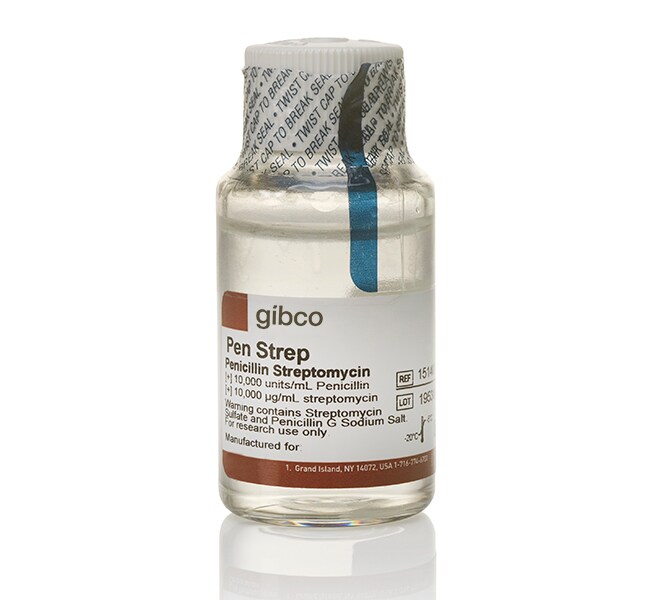
Penicillin-Streptomycin (10,000 U/mL)
This solution contains 10,000 units/mL of penicillin and 10,000 μg/mL of streptomycin. The antibiotics penicillin and streptomycin are used toRead more
Have Questions?
Change view

| Catalog Number | Quantity |
|---|---|
| 15140148 also known as 15140-148 | 20 mL |
| 15140122 also known as 15140-122 | 100 mL |
| 15140163 also known as 15140-163 | 20 x 100 mL |
Catalog number 15140148
also known as 15140-148
Price (CNY)
191.00
飞享价
Ends: 31-Dec-2026
245.00Save 54.00 (22%)
Each
Quantity:
20 mL
Price (CNY)
191.00
飞享价
Ends: 31-Dec-2026
245.00Save 54.00 (22%)
Each
This solution contains 10,000 units/mL of penicillin and 10,000 μg/mL of streptomycin. The antibiotics penicillin and streptomycin are used to prevent bacterial contamination of cell cultures due to their effective combined action against gram-positive and gram-negative bacteria. Penicillin was originally purified from the fungi Penicillium and acts by interfering directly with the turnover of the bacterial cell wall and indirectly by triggering the release of enzymes that further alter the cell wall. Streptomycin was originally purified from Streptomyces griseus. It acts by binding to the 30S subunit of the bacterial ribosome, leading to inhibition of protein synthesis and death in susceptible bacteria.
We offer a wide range of antibiotics and antimycotics in both powder and liquid formats. Learn more about the following types of products:
• Cell Culture Antibiotics
• Selection Antibiotics (including recommended working concentrations)
Learn more about the use of antibiotics and antimycotics in cell culture and review guidelines for decontaminating cultures.
We offer a wide range of antibiotics and antimycotics in both powder and liquid formats. Learn more about the following types of products:
• Cell Culture Antibiotics
• Selection Antibiotics (including recommended working concentrations)
Learn more about the use of antibiotics and antimycotics in cell culture and review guidelines for decontaminating cultures.
For Research Use Only. Not for use in diagnostic procedures.
Specifications
Concentration100 X
For Use With (Application)Prevention of Cell Culture Contamination
Quantity20 mL
Shelf Life12 Months
Shipping ConditionDry Ice
FormLiquid
Product TypeAntibiotic
SterilitySterile-filtered
Sterilization MethodSterile-filtered
Unit SizeEach
Contents & Storage
Storage conditions: -5 to -20°C
Shipping conditions: Frozen
Shelf life: 12 months from date of manufacture
Shipping conditions: Frozen
Shelf life: 12 months from date of manufacture
Frequently asked questions (FAQs)
My Penicillin-Streptomycin solution is not colorless. Is this normal?
How can I decontaminate my cultures?
What antibiotics do you offer to help control or eliminate cell culture contamination?
Citations & References (43)
Citations & References
Abstract
Identification of a novel redox-sensitive gene, Id3, which mediates angiotensin II-induced cell growth.
Journal:Circulation
PubMed ID:12021231
BACKGROUND: Reactive oxygen species, such as superoxide (O(2)(-)), are involved in the abnormal growth of various cell types. Angiotensin II (Ang II) is one of the most potent inducers of oxidative stress in the vasculature. The molecular events involved in Ang II-induced proliferation of vascular smooth muscle cells (VSMCs) are
Functional interaction of caveolin-1 with Bruton's tyrosine kinase and Bmx.
Journal:J Biol Chem
PubMed ID:11751885
'Bruton''s tyrosine kinase (Btk), a member of the Tec family of protein-tyrosine kinases, has been shown to be crucial for B cell development, differentiation, and signaling. Mutations in the Btk gene lead to X-linked agammaglobulinemia in humans and X-linked immunodeficiency in mice. Using a co-transfection approach, we present evidence here
Repression of activator protein-1-mediated transcriptional activation by the Notch-1 intracellular domain.
Journal:J Biol Chem
PubMed ID:11739397
'Developmental decisions that control cell fate are commonly regulated by the Notch signaling pathway. Activation of transmembrane Notch receptors results in proteolytic liberation of the intracellular domain of Notch, which translocates into the nucleus, binds a repressor (C promoter binding factor 1/RBP-Jkappa, Su(H), and Lag-1 (CSL)), and induces target genes.
A differential role for the mitogen-activated protein kinases in lipopolysaccharide signaling: the MEK/ERK pathway is not essential for nitric oxide and interleukin 1beta production.
Journal:J Biol Chem
PubMed ID:11786532
'Endotoxin (lipopolysaccharide, LPS) is a component of the outer membrane of Gram-negative bacteria and promotes the activation of macrophages and microglia. Although these cells are highly LPS-responsive, they serve unique tissue-specific functions and exhibit different LPS sensitivities. Accordingly, it was of interest to evaluate whether these biological differences reside in
Cholesteryl ester is transported from caveolae to internal membranes as part of a caveolin-annexin II lipid-protein complex.
Journal:J Biol Chem
PubMed ID:11733519
'We previously demonstrated that in Chinese hamster ovary cells scavenger receptor, class B, type I-dependent selective cholesteryl ester uptake occurs in caveolae. In the present study we hypothesized that cholesteryl ester is transported from caveolae through the cytosol to an internal membrane by a caveolin chaperone complex similar to the