Search


Citations & References (4)
Gibco™
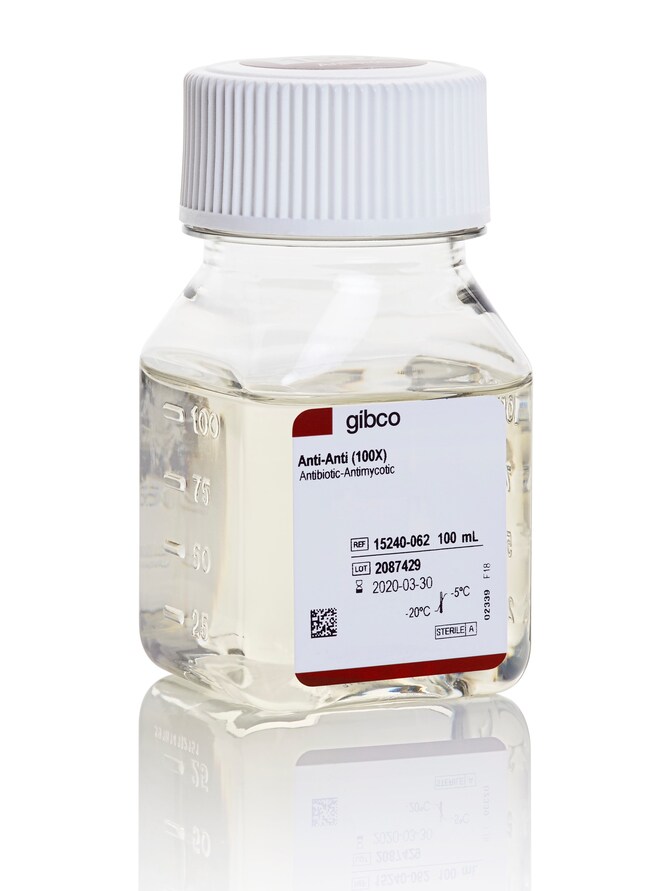
Antibiotic-Antimycotic (100X)
Solution contains penicillin, streptomycin, and Gibco™ Amphotericin B to prevent cell culture contamination.
Have Questions?
Change view

| Catalog Number | Quantity |
|---|---|
| 15240112 | 20 x 100 mL |
| 15240096 | 20 mL |
| 15240062 | 100 mL |
Catalog number 15240112
Price (CNY)
14,135.00
Each
Quantity:
20 x 100 mL
Price (CNY)
14,135.00
Each
Gibco™ Antibiotic-Antimycotic is used to prevent bacterial and fungal contamination. This solution contains 10,000 units/mL of penicillin, 10,000 μg/mL of streptomycin, and 25 μg/mL of Gibco™ Amphotericin B. The antibiotics penicillin and streptomycin prevent bacterial contamination of cell cultures due to their effective combined action against gram-positive and gram-negative bacteria. Amphotericin B prevents fungal contamination of cell cultures due to its inhibition of multi-cellular fungus and yeast.
Penicillin was originally purified from the fungus Penicillium and acts by interfering directly with the turnover of the bacteria cell wall and indirectly by triggering the release of enzymes that further alter the cell wall. Streptomycin was originally purified from Streptomyces griseus. It acts by binding to the 30S subunit of the bacterial ribosome leading to inhibition of protein synthesis and death in susceptible bacteria. Amphotericin B is an antifungal agent that prevents the growth of fungi and yeast by causing an increase in fungal plasma membrane permeability.
For Research Use Only. Not for use in diagnostic procedures.
Specifications
Concentration100 X
Culture TypeMammalian Cell Culture
Quantity20 x 100 mL
Shelf Life12 Months
FormLiquid
Product TypeAntibiotic-Antimycotic
SterilitySterile-filtered
Sterilization MethodSterile-filtered
Unit SizeEach
Contents & Storage
Storage conditions: -5°C to -20°C
Shipping conditions: Dry ice
Shelf life: 12 months from date of manufacture
Shipping conditions: Dry ice
Shelf life: 12 months from date of manufacture
Frequently asked questions (FAQs)
Can I use antibiotics such as Pen-Strep or Antibiotic-Antimycotic (100X) when culturing Sf9 insect cells?
What is the solvent used in Antibiotic-Antimycotic (100X)?
What are the components of Antibiotic-Antimycotic (100X)?
What is the recommended storage condition for Antibiotic-Antimycotic (100X)?
Should I directly add 5 mL of Antibiotic-Antimycotic (100X) to 500 mL cell culture medium or should I dilute the Antibiotic-Antimycotic (100X) 100 times and then add 5 ml of the diluted Antibiotic-Antimycotic to 500 ml of cell culture medium?
Citations & References (4)
Citations & References
Abstract
Common variation at 6q16 within HACE1 and LIN28B influences susceptibility to neuroblastoma.
Journal:Nat Genet
PubMed ID:22941191
Neuroblastoma is a cancer of the sympathetic nervous system that accounts for approximately 10% of all pediatric oncology deaths. Here, we report a genome-wide association study of 2,817 neuroblastoma cases and 7,473 controls. We identified two new associations at 6q16, the first within HACE1 (rs4336470; combined P=2.7×10(-11); odds ratio 1.26,
Wnt-induced activation of glucose metabolism mediates the in vivo neuroprotective roles of Wnt signaling in Alzheimer disease.
Journal:J Neurochem
PubMed ID:30300917
'Dysregulated Wnt signaling is linked to major neurodegenerative diseases, including Alzheimer disease (AD). In mouse models of AD, activation of the canonical Wnt signaling pathway improves learning/memory, but the mechanism for this remains unclear. The decline in brain function in AD patients correlates with reduced glucose utilization by neurons. Here,
Human antigen R protein modulates vascular endothelial growth factor expression in human corneal epithelial cells under hypoxia.
Journal:J Formos Med Assoc
PubMed ID:31262614
'Corneal avascularity is critical for corneal transparency; therefore, a tailored process has been presumed to minimize corneal neovascularization (NV). In most cell types, the transcription of vascular endothelial growth factor (VEGF) is up-regulated, and the stability of VEGF mRNA is sustained by human antigen R (HuR) during hypoxia; however, whether
Increased O-GlcNAcylation of c-Myc Promotes Pre-B Cell Proliferation.
Journal:Cells
PubMed ID:31936366
O-linked ß-N-acetylglucosamine (O-GlcNAc) modification regulates the activity of hundreds of nucleocytoplasmic proteins involved in a wide variety of cellular processes, such as gene expression, signaling, and cell growth; however, the mechanism underlying the regulation of B cell development and function by O-GlcNAcylation remains largely unknown. Here, we demonstrate that changes