Search


Citations & References (2)
Gibco™
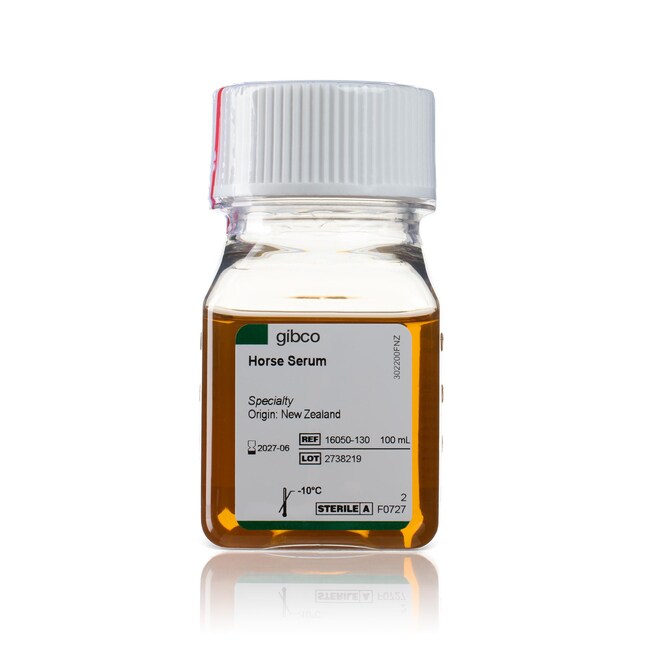
Horse Serum, New Zealand origin
Gibco™ sera offers excellent value for basic cell culture, specialty research, and specific assays, earning the trust of researchers with consistent quality and award-winning support.
Have Questions?
Change view

| Catalog Number | Quantity |
|---|---|
| 16050130 | 100 mL |
| 16050122 | 500 mL |
Catalog number 16050130
Price (CNY)
545.00
Each
Quantity:
100 mL
Price (CNY)
545.00
Each
Gibco™ sera offers excellent value for basic cell culture, specialty research, and specific assays, earning the trust of researchers with consistent quality and award-winning support that helps meet your research needs and budget requirements
- Sera Category: Specialty
- Origin: New Zealand
- EIA tested (negative) serum from a donor herd
For research use or further manufacturing use only. Serum and blood proteins are not for direct administration into humans or animals.
Specifications
Shipping ConditionFrozen
SpeciesHorse/Equine, Horse
AgeAdult
Country of OriginNew Zealand
FormLiquid
Product TypeHorse Serum
Quantity100 mL
Serum TreatmentStandard (Sterile-filtered)
SterilitySterile
Unit SizeEach
Contents & Storage
Storage conditions: ≤-10°C, Shipping conditions: Frozen
Frequently asked questions (FAQs)
Does horse serum contain tetracycline?
Will improper storage of my tissue culture reagents affect the growth rate of my culture?
Citations & References (2)
Citations & References
Abstract
A novel, extraneuronal role for cyclin-dependent protein kinase 5 (CDK5): modulation of cAMP-induced apoptosis in rat leukemia cells.
Journal:J Biol Chem
PubMed ID:11909854
'A number of cyclin-dependent protein kinase (CDK) inhibitors were tested for the ability to protect IPC-81 rat leukemic cells against cAMP-induced apoptosis. A near perfect proportionality was observed between inhibitor potency to protect against cAMP-induced apoptosis and to antagonize CDK5, and to a lesser extent, CDK2 and CDK1. Enforced expression
Muscle-specific exonic splicing silencer for exon exclusion in human ATP synthase gamma-subunit pre-mRNA.
Journal:J Biol Chem
PubMed ID:11744705
Mitochondrial ATP synthase gamma-subunit (F(1)gamma) pre-mRNA undergoes alternative splicing in a tissue- or cell type-specific manner. Exon 9 of F(1)gamma pre-mRNA is specifically excluded in heart and skeletal muscle tissues and in acid-stimulated human fibrosarcoma HT1080 cells, rhabdomyosarcoma KYM-1 cells, and mouse myoblast C2C12 cells. Recently, we found a purine-rich