Nunc™ 384-Well Microplate, white, TC surface, Pack of 10
Thermo Scientific™

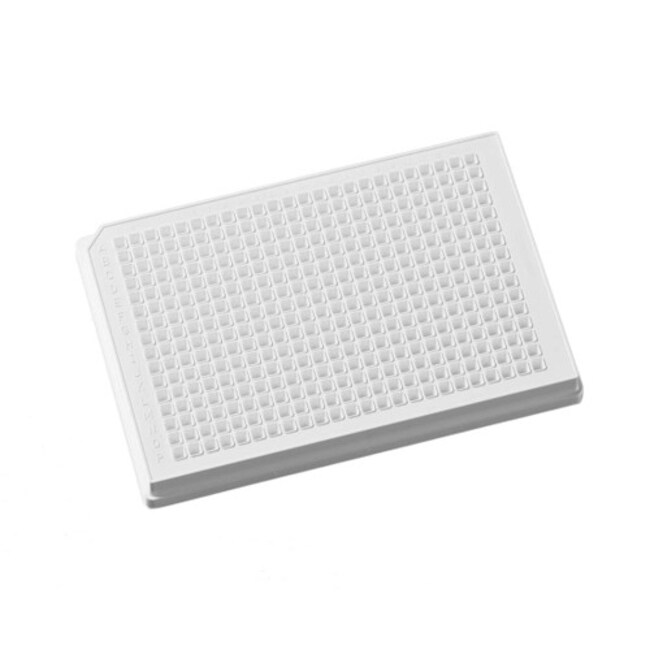
Nunc™ 384-Well Microplate, white, TC surface, Pack of 10

Improve background, autofluorescence and crosstalk with Nunc 384-well polystyrene white microplates.
Have Questions?
Catalog NumberQuantity
164610
Catalog number 164610
Price (CNY)
1,420.26
飞享价
Ends: 31-Dec-2025
3,774.00
Save 2,353.74 (62%)
Case of 30
Add to cart
Price (CNY)
1,420.26
飞享价
Ends: 31-Dec-2025
3,774.00
Save 2,353.74 (62%)
Case of 30
Add to cart

Improve background, autofluorescence and crosstalk with Thermo Scientific™ Nunc 384-Well Polystyrene Black and White Microplates.

  • Color: White
  • Sterility: Sterile
  • Lid: With lid

White microplates are recommended for luminescence measurements; with maximum reflection and minimal autoluminescence.

Specifications
Certifications/ComplianceAll microplates manufactured by Nunc meet the recommendation of American National Standards (ANSI) (ANSI/SBS 1-2004)
Culture Area0.084 cm2/well
LidWith Lid
No. per Case30
No. per Pack10
Packaging10 Pk., 30 Cases
Product TypeMicroplate
Volume (Metric) Working10 to 100 μL
Array16 x 24
ColorWhite
MaterialPolystyrene
No. of Wells384
Product LineNunc
SterilitySterile
Surface TreatmentCell Culture
Volume (Metric) Well120 μL
Well ShapeFlat Bottom (F-well)
Unit SizeCase of 30

Frequently asked questions (FAQs)

What is the difference between the Nunclon Delta surface and a tissue culture (TC) surface from a competitor?

Our Nunclon Delta surface for adherent cells is a standard tissue culture (TC) surface modification that makes the polystyrene surface more hydrophilic. This facilitates maximum adhesion for a broad range of cell types.

The Nunclon Delta surface is Thermo Scientific Nunclon Delta-certified, which is a Thermo Fisher proprietary certification that has a quality standard to help ensure consistency. Every lot of Thermo Scientific Nunclon Delta-certified cell cultureware is tested with Gibco media for:
- Less than 10% growth variation in L929, Hel299 and primary chick embryo cells
- Less than 15% variation colony formation of V79-4 cells

More information and all applicable products can be found in the "Product selection guide for every step of your cell culture workflow" brochure .

Can I use Nunc White 384-Well Microplates for fluorescent assays?

Nunc White 384-Well Microplates can be used for fluorescent applications, but background fluorescence will be much higher compared to Nunc Black 384-Well Microplates.
We recommend the white microplates for scintillation and luminescent detection systems, in which the reflective properties of the microplate enhance the signal without producing any endogenous background signal.

Do you offer Nunc Microplate Lids for the Nunc Black or White 384-Well Microplates?

We offer Nunc Microplate Lids: Cat. No. 448143, that fit both the 384-well microplates and the 1,536-well microplates.

How does cell culturing on Nunc 384-Well Microplates that have a cell culture-treated surface compare with 96-Well Microplates that have a cell culture-treated surface?

The cell culture-treated surfaces are very similar but the wells of the Nunc 384-Well Microplates are smaller than the wells of the Nunc 96-Well Microplate.
Culture recommendations for the Nunc 384-Well Microplates are:
- 15 - 50 µL media per well
- 0.5 - 2.0 x 10^4 cells per well

What are some applications of Nunc 384-Well Black or White Microplates that have a cell culture-treated surface?

We recommend using the Nunc 384-Well Black Microplates for cell-based assays using fluorescent detection. Viability stains such as fluorogenic esterases can be used for proliferation, toxicity, and drug resistance or sensitivity assays. Many types of fluorochrome-conjugated antibodies are available for performing cell-based immunoassays. Fluorescent reporter genes are widely used for determining cell transfection.
We recommend using the Nunc 384-Well White Microplates for cell-based assays using luminescent detection. Viability stains such as luciferin/luciferase can be used for proliferation, toxicity, and drug resistance or sensitivity assays. Cell-based immunoassays can be performed using a HRP-conjugated antibody with a luminol-based substrate. Luciferase reporter genes are widely used for determining cell transfection.