Search

Thermo Scientific™
Nunc™ Cell Culture/Petri Dishes
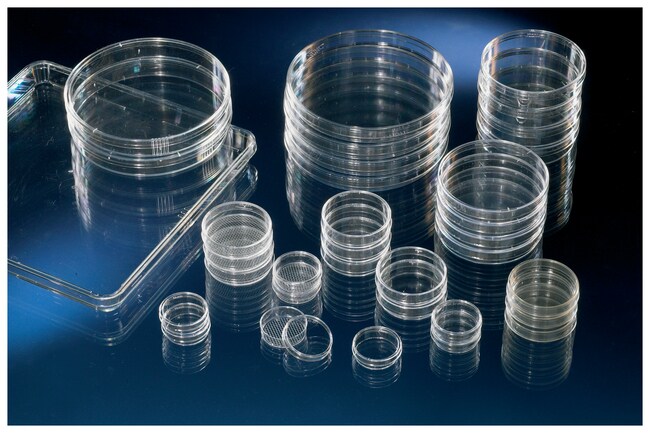
Perform a variety of applications with cell culture/Petri dishes offered in a broad range of sizes and styles to suit a variety of experimental needs.
Have Questions?
Change view

| Catalog Number | Culture Area | Surface Treatment | Gridded | Vent |
|---|---|---|---|---|
| 168381 | 145 sq. cm | Nunclon Delta | Not Gridded | Lid with airvent |
| 150318 | 8.8 sq. cm | Nunclon Delta | Not Gridded | Lid without airvent |
| 153066 | 8.8 sq. cm | Nunclon Delta | Not Gridded | Lid with airvent |
| 174926 | 8.8 sq. cm | Nunclon Delta | Gridded | Lid with airvent |
| 171099 | 8.8 sq. cm | Non-treated | Not Gridded | Lid with airvent |
| 174888 | 20.8 sq. cm | Cell Culture | Not Gridded | Lid with airvent |
| 150340 | 21.5 sq. cm | Non-treated | Not Gridded | Lid with airvent |
| 150326 | 21.5 sq. cm | Nunclon Delta | Not Gridded | Lid without airvent |
| 150288 | 21.5 sq. cm | Nunclon Delta | Not Gridded | Lid with airvent |
| 169558 | 21.5 sq. cm | Nunclon Delta | Gridded | Lid with airvent |
| 150350 | 56.7 sq. cm | Nunclon Delta | Not Gridded | Lid with airvent |
| 172958 | 56.7 sq. cm | Nunclon Delta | Not Gridded | Lid with airvent |
| 172931 | 56.7 sq. cm | Nunclon Delta | Not Gridded | Lid with airvent |
Catalog number 168381
Price (CNY)
-
Culture Area:
145 sq. cm
Surface Treatment:
Nunclon Delta
Gridded:
Not Gridded
Vent:
Lid with airvent
With wide selections in size and style, Thermo Scientific Nunc cell culture dishes suit a multitude of experimental needs in your cell culture routine. Perform a variety of applications in dishes with the Nunclon™ Delta surface treatment that promotes maximum adhesion for a broad range of cell types.
Features
- Top and bottom stacking rings for easier handling and more stable stacking
- Sterile and non-pyrogenic
- Available with or without air vents for gas exchange
- 2 x 2 mm grid for cloning experiments and determination of plating efficiency
Includes: a certificate that assures user of biological performance as well as traceability
Warranty: 90 days
Additional information
- Cat. Nos. 174926 and 169558 feature a 2 x 2 mm grid
- Cat. No. 171099 is for suspension cell culture; it is not Nunclon Delta treated
Disclaimer to internal research use restriction: Any restrictions on the purchaser to utilize the product(s) for internal research purposes only does not apply to the product(s) on the web pages associated with this statement.
Specifications
Closure IncludedClosure Included
Closure MaterialPolystyrene
GriddedNot Gridded
IncludesAirvent
No. per Case80/Cs.
No. per Pack10 Pk.
PackagingResealable Bags
Quantity10 Pk., 80/Cs.
ShapeRound
TypeCell Culture Dish
VentLid with airvent
Volume (Metric) Working35 mL
Bottom ShapeFlat
Capacity (Metric)35 mL (Well)
ColorClear
Culture Area145 sq. cm
Diameter (Metric)150 mm
Height (Metric)21 mm
MaterialPolystyrene
SterilitySterile
Surface TreatmentNunclon Delta
Well Count1
Unit SizeCase of 80