Search


Citations & References (3)
Gibco™
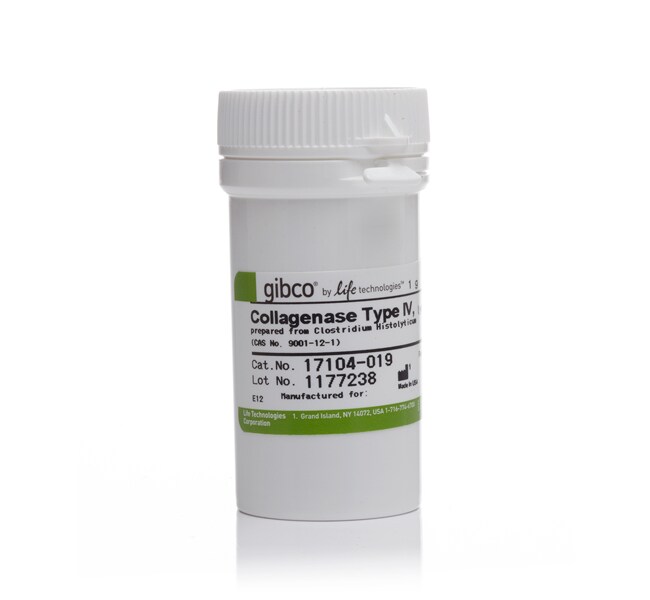
Collagenase, Type IV, powder
Collagenase is a protease that cleaves the bond between a neutral amino acid (X) and glycine in the sequence Pro-X-Glyc-Pro,Read more
| Catalog Number | Quantity |
|---|---|
| 17104019 | 1 g |
Catalog number 17104019
Price (CNY)
2,365.00
飞享价
Ends: 26-Sep-2026
5,269.00Save 2,904.00 (55%)
Each
Quantity:
1 g
Price (CNY)
2,365.00
飞享价
Ends: 26-Sep-2026
5,269.00Save 2,904.00 (55%)
Each
Collagenase is a protease that cleaves the bond between a neutral amino acid (X) and glycine in the sequence Pro-X-Glyc-Pro, which is found with high frequency in collagen. Collagenase is unique among proteases in its ability to degrade the triple-helical native collagen fibrils commonly found in connective tissues such as skin, tendon, blood vessels, and bone. Collagenase disaggregation is suitable for the culture of human tumors, mouse kidney, human adult and fetal brain, and many other tissues including epithelium. Collagenase is relatively gentle, dissociates well at physiological temperature and pH, and requires no mechanical agitation or special equipment.
Gibco™ Collagenase Type IV is isolated from Clostridium histolyticum and packaged as a lyophilized, non-sterile powder for research use in cell or tissue dissociation and organ perfusions. Gibco™ Collagenase Type IV activity is guaranteed to be greater than 160 units/mg. Compared to other collagenase preparations, Gibco™ Collagenase Type IV has low tryptic activity and is well-suited for the digestion of islet cells from the pancreas.
Gibco™ Collagenase Type IV is isolated from Clostridium histolyticum and packaged as a lyophilized, non-sterile powder for research use in cell or tissue dissociation and organ perfusions. Gibco™ Collagenase Type IV activity is guaranteed to be greater than 160 units/mg. Compared to other collagenase preparations, Gibco™ Collagenase Type IV has low tryptic activity and is well-suited for the digestion of islet cells from the pancreas.
For Research Use Only. Not for use in diagnostic procedures.
Specifications
Quantity1 g
Shelf Life24 Months
Shipping ConditionRoom Temperature
FormLyophilized
Product TypeCollagenase
SterilityNon-sterile
Unit SizeEach
Contents & Storage
Storage conditions: 2°C to 8°C. Protect from light.
Shipping conditions: Room temperature
Shelf life: 24 months from date of manufacture
Shipping conditions: Room temperature
Shelf life: 24 months from date of manufacture
Frequently asked questions (FAQs)
How do I make the 1000X stock (100 U/µL) solution from Collagenase powder?
Why is collagenase type IV favored over dispase even though the dissociation with collagenase IV seems to take longer (between 30 and 60 min, depending from the lot, at 37 degrees C) compared to dispase?
What reagents do you offer for cell dissociation, and what are the main differences between them?
Citations & References (3)
Citations & References
Abstract
Isolation and in vitro culture of primary cardiomyocytes from adult zebrafish hearts.
Journal:Nat Protoc
PubMed ID:23538883
'This protocol describes how to isolate primary cardiomyocytes from adult zebrafish hearts and culture them for up to 4 weeks, thereby using them as an alternative to in vivo experiments. After collagenase digestion of the ventricle, cells are exposed to increasing calcium concentrations in order to obtain high-purity cardiomyocytes. The
Production of hepatocyte-like cells from human pluripotent stem cells.
Journal:Nat Protoc
PubMed ID:23424751
Large-scale production of hepatocytes from a variety of genetic backgrounds would be beneficial for drug screening and to provide a source of cells to be used as a substitute for liver transplantation. However, fully functional primary hepatocytes remain difficult to expand in vitro, and circumventing this problem by using an
Feeder layer- and serum-free culture of human embryonic stem cells.
Journal:Biol Reprod
PubMed ID:14627547
In addition to their contribution to the research on early human development, human embryonic stem (hES) cells may also be used for cell-based therapies. Traditionally, these cells have been cultured on mouse embryonic fibroblast feeder layers, which allow their continuous growth in an undifferentiated state. However, the use of hES