Search


Citations & References (2)
Invitrogen™
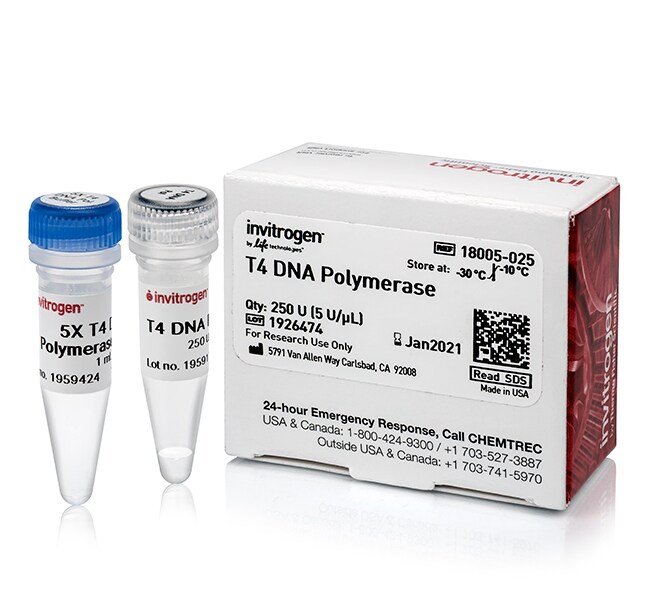
T4 DNA Polymerase
T4 DNA Polymerase is a DNA polymerase that has a 3´-exodeoxyribonuclease activity, but lacks 5´a3´ exodeoxyribonuclease activity. A T4 DNARead more
Have Questions?
Change view

| Catalog Number | Quantity |
|---|---|
| 18005025 | 250 U |
| 18005017 | 50 U |
Catalog number 18005025
Price (CNY)
6,267.00
Each
Quantity:
250 U
Price (CNY)
6,267.00
Each
T4 DNA Polymerase is a DNA polymerase that has a 3´-exodeoxyribonuclease activity, but lacks 5´a3´ exodeoxyribonuclease activity. A T4 DNA Polymerase Technical Bulletin is available.
Applications: Labeling double-stranded linear DNA by replacement synthesis (1). Oligonucleotide-directed, site-specific mutagenesis (2). 3´ end-labeling of double-stranded DNA (3). Polishing both 5´ or 3 overhangs to make blunt ends (4).
Source: Purified from E. coli expressing the T4 DNA Polymerase gene on a plasmid.
Performance and Quality Testing: Single- and double-stranded endodeoxyribonuclease and phosphatase assays; exodeoxyribonuclease and polymerase activities tested.
Unit Definition: One unit incorporates 10 nmol of total deoxyribonucleotide into acid-precipitable material in 30 min. at 37°C using DNase I-nicked DNA as template•primer.
Unit Reaction Conditions: 50 mM glycine-NaOH (pH 8.8), 16.6 mM (NH4)2SO4 , 6 mM MgCl2 , 6.5 μM EDTA, 10 mM 2-mercaptoethanol, 0.165 mg/ml BSA, 1.6 mg/ml DNase I-nicked salmon testes DNA, 0.33 mM dCTP, 0.33 mM dATP, 0.33 mM dGTP, 0.33 mM dTTP, 76 nM [3H]dTTP, and enzyme in 0.1 ml for 30 min. at 37°C.
Applications: Labeling double-stranded linear DNA by replacement synthesis (1). Oligonucleotide-directed, site-specific mutagenesis (2). 3´ end-labeling of double-stranded DNA (3). Polishing both 5´ or 3 overhangs to make blunt ends (4).
Source: Purified from E. coli expressing the T4 DNA Polymerase gene on a plasmid.
Performance and Quality Testing: Single- and double-stranded endodeoxyribonuclease and phosphatase assays; exodeoxyribonuclease and polymerase activities tested.
Unit Definition: One unit incorporates 10 nmol of total deoxyribonucleotide into acid-precipitable material in 30 min. at 37°C using DNase I-nicked DNA as template•primer.
Unit Reaction Conditions: 50 mM glycine-NaOH (pH 8.8), 16.6 mM (NH4)2SO4 , 6 mM MgCl2 , 6.5 μM EDTA, 10 mM 2-mercaptoethanol, 0.165 mg/ml BSA, 1.6 mg/ml DNase I-nicked salmon testes DNA, 0.33 mM dCTP, 0.33 mM dATP, 0.33 mM dGTP, 0.33 mM dTTP, 76 nM [3H]dTTP, and enzyme in 0.1 ml for 30 min. at 37°C.
For Research Use Only. Not for use in diagnostic procedures.
Specifications
DescriptionDNA Polymerase
Exonuclease Activity3' - 5'
Hot StartNo
PolymeraseT4 DNA Polymerase
Quantity250 U
Shipping ConditionWet Ice
Unit SizeEach
Contents & Storage
T4 DNA Polymerase is supplied with a vial of 5X T4 DNA Polymerase buffer [165 mM Tris acetate (pH 7.9), 330 mM sodium acetate, 50 mM magnesium acetate, 5 mM DTT]. Store at -20°C.
Frequently asked questions (FAQs)
What enzymes can I use to convert a molecule with a 5' or 3' overhang to a blunt molecule? What is the main difference between them?
Is there anything to prevent AmpliTaq Gold DNA polymerase from extending from the 3’ end of a TaqMan probe in a 5’ nuclease assay?
How does AmpliTaq Gold DNA Polymerase differ from AmpliTaq DNA Polymerase?
Does AmpliTaq Gold DNA Polymerase contain exonuclease (proofreading) activity?
Does the fidelity of AmpliTaq DNA Polymerase change in the presence of base analogs?
Citations & References (2)
Citations & References
Abstract
Identification of a Novel Transcription Factor, GAGATA-binding Protein, Involved in Androgen-mediated Expression of Prostate-specific Antigen.
Journal:J Biol Chem
PubMed ID:12782640
'Prostate-specific antigen (PSA) is the most valuable marker for the evaluation of prostate cancer progression. The expression of PSA is controlled by androgen receptor (AR) through its binding to androgen-response elements (AREs). Several AREs have been identified within the 5.8-kb PSA promoter. The main activity of this 5.8-kb PSA promoter
A simple method using T4 DNA polymerase to clone polymerase chain reaction products.
Journal:Biotechniques
PubMed ID:7980913
None