Search


Citations & References (4)
Thermo Scientific™
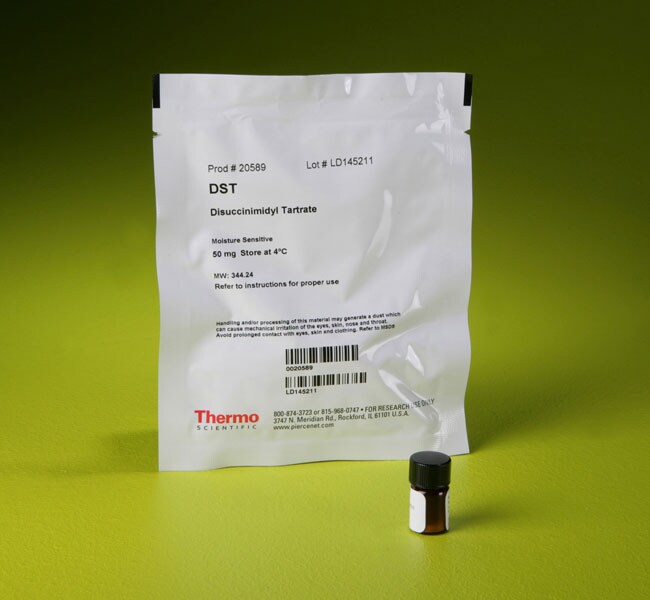
DST (disuccinimidyl tartrate)
Thermo Scientific Pierce DST, also called disuccinimidyl tartrate, is a water-soluble crosslinker that contains amine-reactive NHS ester ends around aRead more
| Catalog Number | Quantity |
|---|---|
| 20589 | 50 mg |
Catalog number 20589
Price (CNY)
5,497.00
Each
Quantity:
50 mg
Price (CNY)
5,497.00
Each
Thermo Scientific Pierce DST, also called disuccinimidyl tartrate, is a water-soluble crosslinker that contains amine-reactive NHS ester ends around a 4-atom spacer arm, whose central diol can be cleaved by periodate oxidation.
Features of disuccinimidyl tartrate:
• Reactive groups: NHS ester (both ends)
• Reactive towards: amino groups (primary amines)
• Soluble in DMSO or DMF at a concentration of ∼10 mM (3 mg/mL)
• Cleavable by sodium meta-periodate (Part No. 20504)
• Ideal for applications in which crosslink cleavability is desired without disturbing protein disulfide bonds
Product References:
Crosslinker Application Guide -- search for recent literature references for this product
Related Products
DST (disuccinimidyl tartrate)
Features of disuccinimidyl tartrate:
• Reactive groups: NHS ester (both ends)
• Reactive towards: amino groups (primary amines)
• Soluble in DMSO or DMF at a concentration of ∼10 mM (3 mg/mL)
• Cleavable by sodium meta-periodate (Part No. 20504)
• Ideal for applications in which crosslink cleavability is desired without disturbing protein disulfide bonds
Product References:
Crosslinker Application Guide -- search for recent literature references for this product
Related Products
DST (disuccinimidyl tartrate)
For Research Use Only. Not for use in diagnostic procedures.
Specifications
Cell PermeabilityYes
DescriptionDST
FormPowder
Labeling MethodChemical Labeling
Molecular Weight (g/mol)344.23
PEGylatedNo
Product LinePierce
Quantity50 mg
Reactive MoietyNHS Ester
Shipping ConditionAmbient
SolubilityWater
Spacer Arm Length6.4 Å
Water SolubleYes
Chemical ReactivityAmine-Amine
CleavableBy Periodate
Crosslinker TypeHomobifunctional
FormatStandard
Product TypeCrosslinker
SpacerShort (<10 Å)
Unit SizeEach
Contents & Storage
Upon receipt store desiccated at 4°C.
Frequently asked questions (FAQs)
Can you provide the shelf-life for DST (disuccinimidyl tartrate)?
Citations & References (4)
Citations & References
Abstract
Catalytically-active complex of HIV-1 integrase with a viral DNA substrate binds anti-integrase drugs.
Journal:Proc Natl Acad Sci U S A
PubMed ID:19416821
HIV-1 integration into the host cell genome is a multistep process catalyzed by the virally-encoded integrase (IN) protein. In view of the difficulty of obtaining a stable DNA-bound IN at high concentration as required for structure determination, we selected IN-DNA complexes that form disulfide linkages between 5'-thiolated DNA and several
Structural and molecular basis of the assembly of the TRPP2/PKD1 complex.
Journal:Proc Natl Acad Sci U S A
PubMed ID:19556541
Mutations in PKD1 and TRPP2 account for nearly all cases of autosomal dominant polycystic kidney disease (ADPKD). These 2 proteins form a receptor/ion channel complex on the cell surface. Using a combination of biochemistry, crystallography, and a single-molecule method to determine the subunit composition of proteins in the plasma membrane
Enhanced tissue penetration-induced high bonding strength of a novel tissue adhesive composed of cholesteryl group-modified gelatin and disuccinimidyl tartarate.
Journal:Colloids Surf B Biointerfaces
PubMed ID:22088758
The aim of this study was to evaluate the effect of cholesteryl group content on the bonding strength of a novel tissue adhesive composed of cholesteryl group-modified geletin (CholGltn) and disuccinimidyl tartarate (DST). The bonding strength of this tissue adhesive with fresh arterial media reached a maximum at a CholGltn
Arabidopsis Cor15am is a chloroplast stromal protein that has cryoprotective activity and forms oligomers.
Journal:Plant Physiol
PubMed ID:17384167
Many plants acquire increased freezing tolerance when they are exposed to nonfreezing temperatures of a certain duration. This process is known as cold acclimation and allows plants to protect themselves from freezing injury. A wide variety of polypeptides are induced during cold acclimation, among which is one encoded by COR15A