Search

Gibco™
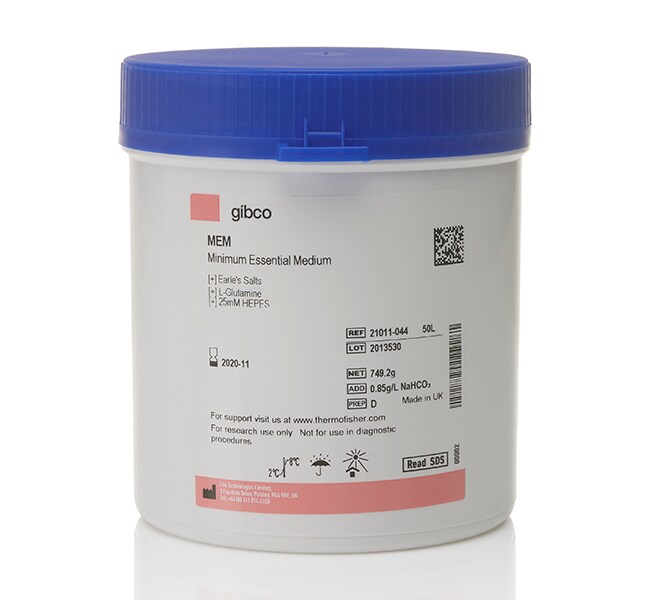
MEM, glutamine, HEPES, powder
Minimum Essential Medium (MEM) is one of the most commonly used of all cell culture media. MEM can be usedRead more
| Catalog Number | Quantity |
|---|---|
| 21011044 | 50 L |
Catalog number 21011044
Price (CNY)
-
Quantity:
50 L
Minimum Essential Medium (MEM) is one of the most commonly used of all cell culture media. MEM can be used with a variety of suspension and adherent mammalian cells, including HeLa, BHK-21, 293, HEP-2, HT-1080, MCF-7, fibroblasts, and primary rat astrocytes. We offer a variety of Gibco™ MEM modifications for a range of cell culture applications. Find the right formulation using the media selector tool.
The complete formulation is available.
Gibco™ MEM, developed by Harry Eagle, was based on his earlier formulation of Basal Medium Eagle (BME). Many other modifications of MEM followed, including Glasgow’s MEM, MEM α, DMEM, and Temin’s Modification. MEM is available with Earle’s salts for use in a CO2 incubator, or with Hanks' salts for use without CO2. This product is made with Earle’s salts.
Product Use
For Research Use Only: Not intended for animal or human diagnostic or therapeutic use.
cGMP Manufacturing and Quality System
Gibco™ MEM is manufactured at a cGMP compliant facility, located in Paisley, Scotland, UK. The facility is registered with the FDA as a medical device manufacturer and is certified to the ISO 13485 standard.
Powder forms of Gibco™ L-15 cell culture medium require pH adjustment and filtration at the time of preparation (see protocol for details).
This MEM is modified as follows:
| With | Without |
| • L-glutamine | • Sodium Bicarbonate |
| • Phenol Red | |
| • HEPES |
The complete formulation is available.
Gibco™ MEM, developed by Harry Eagle, was based on his earlier formulation of Basal Medium Eagle (BME). Many other modifications of MEM followed, including Glasgow’s MEM, MEM α, DMEM, and Temin’s Modification. MEM is available with Earle’s salts for use in a CO2 incubator, or with Hanks' salts for use without CO2. This product is made with Earle’s salts.
Product Use
For Research Use Only: Not intended for animal or human diagnostic or therapeutic use.
cGMP Manufacturing and Quality System
Gibco™ MEM is manufactured at a cGMP compliant facility, located in Paisley, Scotland, UK. The facility is registered with the FDA as a medical device manufacturer and is certified to the ISO 13485 standard.
Powder forms of Gibco™ L-15 cell culture medium require pH adjustment and filtration at the time of preparation (see protocol for details).
For Research Use Only. Not for use in diagnostic procedures.
Specifications
Cell TypeMammalian Cells
Culture EnvironmentCO2
Osmolality240 - 280 mOsm/kg
Product LineGibco
Product TypeMinimum Essential Medium (MEM)
Quantity50 L
Shelf Life36 Months
Shipping ConditionRoom Temperature
ClassificationAnimal Origin-free
Culture TypeMammalian Cell Culture
FormPowder
Serum LevelStandard Serum Supplementation
With AdditivesGlutamine, HEPES, Phenol Red
Without AdditivesNo Sodium Bicarbonate, No Sodium Pyruvate
pH5.2 to 5.6
Unit SizeEach
Contents & Storage
Storage conditions: 2-8° C.
Shipping conditions: Ambient.
Shelf life: 36 months from date of manufacture.
Shipping conditions: Ambient.
Shelf life: 36 months from date of manufacture.