Search


Citations & References (2)
Gibco™
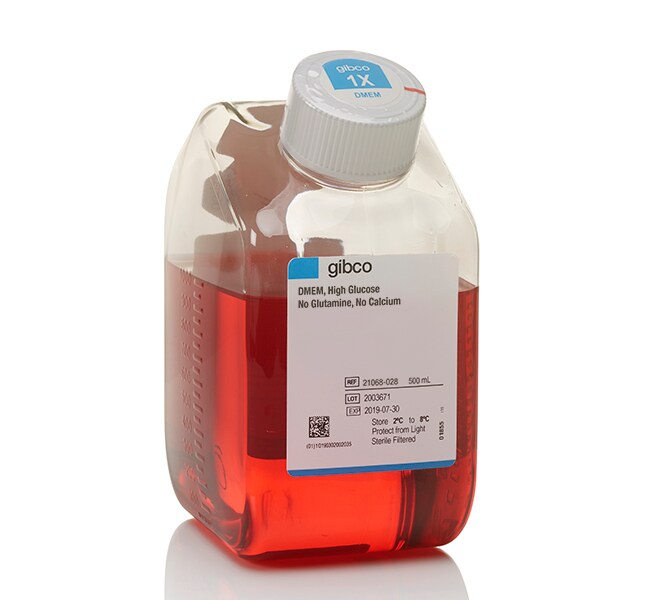
DMEM, high glucose, no glutamine, no calcium
Dulbecco's Modified Eagle Medium (DMEM) is a widely used basal medium for supporting the growth of many different mammalian cells.Read more
| Catalog Number | Quantity |
|---|---|
| 21068028 | 500 mL |
Catalog number 21068028
Price (CNY)
1,434.00
飞享价
Ends: 31-Dec-2026
1,792.00Save 358.00 (20%)
Each
Quantity:
500 mL
Price (CNY)
1,434.00
飞享价
Ends: 31-Dec-2026
1,792.00Save 358.00 (20%)
Each
Dulbecco's Modified Eagle Medium (DMEM) is a widely used basal medium for supporting the growth of many different mammalian cells. Cells successfully cultured in DMEM include primary fibroblasts, neurons, glial cells, HUVECs, and smooth muscle cells, as well as cell lines such as HeLa, 293, Cos-7, and PC-12. We offer a variety of Gibco™ DMEM modifications for a range of cell culture applications. Find the right formulation using the media selector tool.
This DMEM is modified as follows:
| With | Without |
| • High Glucose | • L-glutamine |
| • Phenol Red | • Sodium Pyruvate |
| • HEPES | |
| • Calcium |
The complete formulation is available.
DMEM is unique from other media as it contains 4 times the concentration of amino acids and vitamins than the original Eagle's Minimal Essential Medium. DMEM was originally formulated with low glucose (1 g/L) and sodium pyruvate, but is often used with higher glucose levels, with or without sodium pyruvate.
Product Use
For Research Use Only: Not intended for animal or human diagnostic or therapeutic use.
DMEM contains no proteins, lipids, or growth factors. Therefore, DMEM requires supplementation, commonly with 10% Fetal Bovine Serum (FBS). DMEM uses a sodium bicarbonate buffer system (3.7 g/L) and therefore requires a 5-10% CO2 environment to maintain physiological pH.
For Research Use Only: Not intended for animal or human diagnostic or therapeutic use.
Specifications
Cell LineHeLa, 293, Cos-7, and PC-12
Cell TypePrimary Fibroblasts, Neurons, Glial Cells, HUVECs, Smooth Muscle Cells
Concentration1 X
Manufacturing QualitycGMP-compliant under the ISO 13485 standard
Product LineGibco
Product TypeDMEM (Dulbecco's Modified Eagle Medium)
Quantity500 mL
Shelf Life12 Months From Date of Manufacture
Shipping ConditionRoom Temperature
ClassificationAnimal Origin-free
FormLiquid
Serum LevelStandard Serum Supplementation
SterilitySterile-filtered
With AdditivesHigh Glucose, Phenol Red
Without AdditivesNo Glutamine, No HEPES, No Sodium Pyruvate
Unit SizeEach
Contents & Storage
Storage conditions: 2-8° C. Protect from light
Shipping conditions: Ambient
Shelf life: 12 months from date of manufacture
Shipping conditions: Ambient
Shelf life: 12 months from date of manufacture
Frequently asked questions (FAQs)
What is the manganese concentration in DMEM? Do you offer manganese-free DMEM?
How long can I keep my media after supplementing with serum?
My medium was shipped at room temperature but it is supposed to be stored refrigerated. Is it okay?
How can I remove mycoplasma contamination from my cell culture medium?
I see a decrease in growth of my culture. What should I do?
Citations & References (2)
Citations & References
Abstract
Inhibition of adipocyte differentiation by resistin-like molecule alpha. Biochemical characterization of its oligomeric nature.
Journal:J Biol Chem
PubMed ID:12189153
A novel family of cysteine-rich secreted proteins with unique tissue distribution has recently been identified. One of the members, resistin (for
Oligomerization of G-protein-coupled Receptors Shown by Selective Co-immunoprecipitation.
Journal:J Biol Chem
PubMed ID:11854302
Recent studies have shown that G-protein-coupled receptors (GPCRs) can assemble as high molecular weight homo- and hetero-oligomeric complexes. This can result in altered receptor-ligand binding, signaling, or intracellular trafficking. We have co-transfected HEK-293 cells with differentially epitope-tagged GPCRs from different subfamilies and determined whether oligomeric complexes were formed by co-immunoprecipitation