Search

Thermo Scientific™
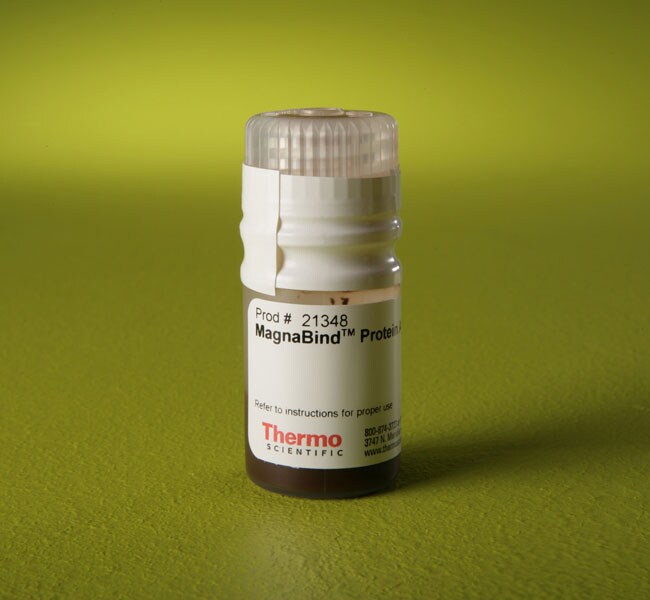
MagnaBind™ Protein A Beads
Enable benchtop magnetic affinity purification with these ligand-coated (streptavidin, Protein A and G, GAM IgG, GAR IgG) magnetic particles and magnet separators.
| Catalog Number | Quantity |
|---|---|
| 21348 | 5 mL |
Catalog number 21348
Price (CNY)
12,743.00
Each
Quantity:
5 mL
Price (CNY)
12,743.00
Each
Thermo Scientific™ MagnaBind™ Beads provide a convenient method for magnetic separation of antibodies, antigens, lectins, enzymes, nucleic acids and cells using affinity binding. To remove the MagnaBind Beads from the suspension, an external magnetic field is used.
Features of MagnaBind Protein A Beads:
- Composition: Silanized iron oxide
- Magnetization: 25-35EMU/g
- Type of Magnetization: Superparamagnetic (no magnetic memory)
- Surface Area: >100m2/g
- Bead Size: 1-4μm diameter
- Settling Rate: 4% in 30 minutes
- Effective Density: 2.5g/mL
- Number of Beads: 1 x 10⁸ beads/mg
- pH Stability: Aqueous solution, above pH 4.0
- Concentration: 5 mg/mL
MagnaBind Protein A Beads are typically used to isolate antibodies from serum and cell culture supernatant and to separate cells of interest from a cell mixture. For antibody purification, the beads are incubated with the antibody solution and then magnetically separated from the supernatant. The antigens and antibodies are then dissociated from the beads using an elution buffer. For cell separation, the monoclonal or polyclonal antibody to the cell surface antigen is incubated with Protein A magnetic beads, magnetically separated, and then incubated with the cell suspension.
Applications:
- Cell sorting using either positive or negative selection
- Protein purification or immunoassays using either direct or indirect methods
For Research Use Only. Not for use in diagnostic procedures.
Specifications
ConcentrationSlurry: 5 mg/mL
DescriptionMagnaBind Protein A Beads
Ligand TypeProtein A
Quantity5 mL
Sufficient For0.2 mg of Rabbit IgG per mL of Beads
TargetAntibody
Capacity (Metric)5 mL
FormLiquid
Particle Size1 to 4 μm
Product LineMagnaBind
TypeMagnetic Affinity Bead
Unit SizeEach
Contents & Storage
Upon receipt store products at 4°C. Do not freeze products. Products are shipped at ambient temperature.