Search


Citations & References (13)
Thermo Scientific™
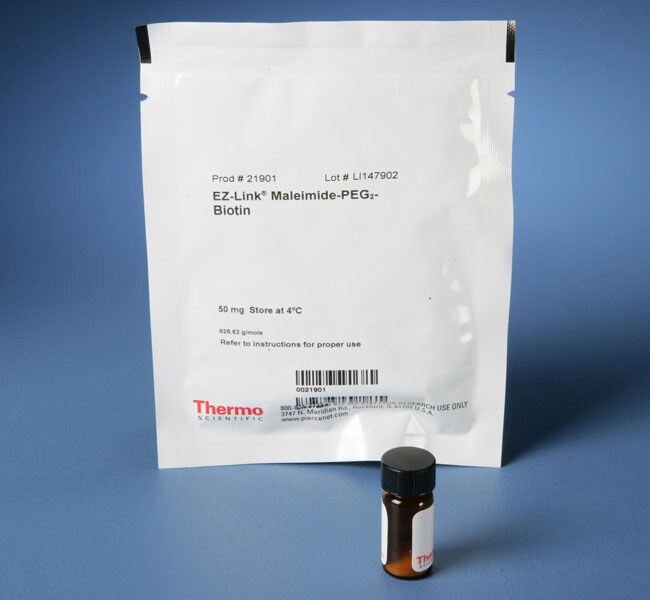
EZ-Link™ Maleimide-PEG2-Biotin, No-Weigh™ Format
Thermo Scientific EZ-Link Maleimide-PEG2-Biotin is a mid-length, maleimide-activated, sulfhydryl-reactive biotinylation reagent that contains a 2-unit ethylene glycol in its spacerRead more
Have Questions?
Change view

| Catalog Number | Quantity |
|---|---|
| 21901BID | 50 mg |
| A39261 | 10 x 2 mg |
Catalog number 21901BID
Price (CNY)
6,098.00
Each
Quantity:
50 mg
Price (CNY)
6,098.00
Each
Thermo Scientific EZ-Link Maleimide-PEG2-Biotin is a mid-length, maleimide-activated, sulfhydryl-reactive biotinylation reagent that contains a 2-unit ethylene glycol in its spacer arm for increased water-solubility characteristics.
Features of EZ-Link Maleimide-PEG2-Biotin:
• Protein labeling—biotinylate antibodies or other proteins for use in protein methods
• Thiol-reactive—reacts with sulfhydryls (-SH), such as the side-chain of cysteine (C)
• Maleimide-activated—perform reactions at pH 6.5 to 7.5 in buffers such as PBS
• Pegylated—spacer arm contains a hydrophilic, 2-unit, polyethylene glycol (PEG) group
• Enhances solubility—pegylation imparts water solubility to the biotinylated molecule, helping to prevent aggregation of biotinylated antibodies stored in solution
• Irreversible—forms permanent thioether bonds; spacer arm cannot be cleaved
• Solubility—can be dissolved directly in aqueous buffers for labeling reactions
• Medium length—spacer arm (total length added to target) is 29.1 angstroms
Maleimide-PEG2-Biotin enables simple and efficient biotinylation of antibodies, cysteine-containing peptides and other thiol-containing molecules. The maleimide group reacts specifically and efficiently with reduced thiols (sulfhydryl groups,—SH) at pH 6.5 to 7.5 to form stable thioether bonds. The hydrophilic, 2-unit polyethylene glycol (PEG) spacer arm imparts water solubility that is transferred to the biotinylated molecule, thus reducing aggregation of labeled proteins stored in solution. The PEG segment adds length and flexibility to the spacer arm, minimizing steric hindrance involved with binding to avidin molecules.
We manufacture biotin reagents to ensure the highest possible overall product integrity, consistency and performance for the intended research applications.
Biotinylation reagents differ in reactivity, length, solubility, cell permeability and cleavability. Three types of sulfhydryl-reactive compounds are available: maleimido, iodoacetyl and pyridyldithiol. Maleimide reagents specifically react with sulfhydryl groups (-SH) in near-neutral buffers to form permanent thioether bonds.
In proteins, sulfhydryls exist where there are cysteine (C) residues. Cystine disulfide bonds must be reduced to make sulfhydryl groups available for labeling. Hinge-region disulfide bridges of antibodies can be selectively reduced to make functional half-antibodies that can be labeled.
Features of EZ-Link Maleimide-PEG2-Biotin:
• Protein labeling—biotinylate antibodies or other proteins for use in protein methods
• Thiol-reactive—reacts with sulfhydryls (-SH), such as the side-chain of cysteine (C)
• Maleimide-activated—perform reactions at pH 6.5 to 7.5 in buffers such as PBS
• Pegylated—spacer arm contains a hydrophilic, 2-unit, polyethylene glycol (PEG) group
• Enhances solubility—pegylation imparts water solubility to the biotinylated molecule, helping to prevent aggregation of biotinylated antibodies stored in solution
• Irreversible—forms permanent thioether bonds; spacer arm cannot be cleaved
• Solubility—can be dissolved directly in aqueous buffers for labeling reactions
• Medium length—spacer arm (total length added to target) is 29.1 angstroms
Maleimide-PEG2-Biotin enables simple and efficient biotinylation of antibodies, cysteine-containing peptides and other thiol-containing molecules. The maleimide group reacts specifically and efficiently with reduced thiols (sulfhydryl groups,—SH) at pH 6.5 to 7.5 to form stable thioether bonds. The hydrophilic, 2-unit polyethylene glycol (PEG) spacer arm imparts water solubility that is transferred to the biotinylated molecule, thus reducing aggregation of labeled proteins stored in solution. The PEG segment adds length and flexibility to the spacer arm, minimizing steric hindrance involved with binding to avidin molecules.
We manufacture biotin reagents to ensure the highest possible overall product integrity, consistency and performance for the intended research applications.
Biotinylation reagents differ in reactivity, length, solubility, cell permeability and cleavability. Three types of sulfhydryl-reactive compounds are available: maleimido, iodoacetyl and pyridyldithiol. Maleimide reagents specifically react with sulfhydryl groups (-SH) in near-neutral buffers to form permanent thioether bonds.
In proteins, sulfhydryls exist where there are cysteine (C) residues. Cystine disulfide bonds must be reduced to make sulfhydryl groups available for labeling. Hinge-region disulfide bridges of antibodies can be selectively reduced to make functional half-antibodies that can be labeled.
For Research Use Only. Not for use in diagnostic procedures.
Specifications
Cell PermeabilityCell-Impermeant
Label TypeBiotin & Analogs
Product LineEZ-Link
Product TypeMaleimide-PEG2-Biotin
Quantity50 mg
Reactive MoietyMaleimide
Chemical ReactivityThiol
Label or DyeBiotin
SolubilityDMF (Dimethylformamide), DMSO (Dimethylsulfoxide), Water
SpacerLong, Pegylated
Unit SizeEach
Contents & Storage
Store desiccated at 4°C. Shipped at ambient temperature.
Citations & References (13)
Citations & References
Abstract
Detection and quantification of free sulfhydryls in monoclonal antibodies using maleimide labeling and mass spectrometry.
Journal:
PubMed ID:30894096
The detection of free sulfhydryls in proteins can reveal incomplete disulfide bond formation, indicate cysteine residues available for conjugation, and offer insights into protein stability and structure. Traditional spectroscopic methods of free sulfhydryl detection, such as Ellman's reagent, generally require a relatively large amount of sample, preventing their use for
Regulating G protein-coupled receptors by topological inversion.
Journal:Elife
PubMed ID:30835201
'G protein-coupled receptors (GPCRs) are a family of proteins containing seven transmembrane helices, with the N- and C-terminus of the protein located at the extracellular space and cytosol, respectively. Here, we report that ceramide or related sphingolipids might invert the topology of many GPCRs that contain a GXXXN motif in
Transducin activates cGMP phosphodiesterase by trapping inhibitory ? subunit freed reversibly from the catalytic subunit in solution.
Journal:Sci Rep
PubMed ID:31076603
'Activation of cGMP phosphodiesterase (PDE) by activated transducin a subunit (Ta*) is a necessary step to generate a light response in vertebrate photoreceptors. PDE in rods is a heterotetramer composed of two catalytic subunits, PDEa and PDEß, and two inhibitory PDE? subunits, each binding to PDEa or PDEß. Activation of
Profilin and formin constitute a pacemaker system for robust actin filament growth.
Journal:Elife
PubMed ID:31647411
'The actin cytoskeleton drives many essential biological processes, from cell morphogenesis to motility. Assembly of functional actin networks requires control over the speed at which actin filaments grow. How this can be achieved at the high and variable levels of soluble actin subunits found in cells is unclear. Here we
Structural and Functional Characterization of the Bacterial Type III Secretion Export Apparatus.
Journal:PLoS Pathog
PubMed ID:27977800
'Bacterial type III protein secretion systems inject effector proteins into eukaryotic host cells in order to promote survival and colonization of Gram-negative pathogens and symbionts. Secretion across the bacterial cell envelope and injection into host cells is facilitated by a so-called injectisome. Its small hydrophobic export apparatus components SpaP and