Search


Citations & References (5)
Thermo Scientific™
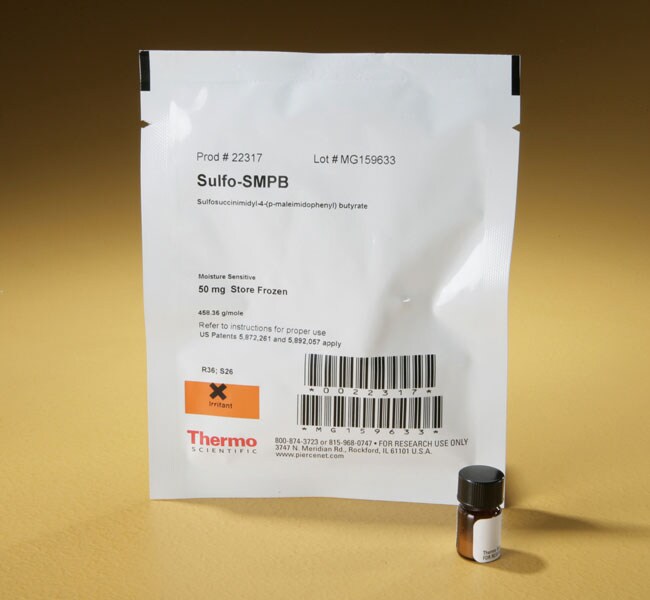
Sulfo-SMPB (sulfosuccinimidyl 4-(N-maleimidophenyl)butyrate)
Thermo Scientific Pierce Sulfo-SMPB is a water-soluble amine-to-sulfhydryl crosslinker that contains NHS-ester and maleimide reactive groups at opposite ends ofRead more
| Catalog Number | Quantity |
|---|---|
| 22317 | 50 mg |
Catalog number 22317
Price (CNY)
3,663.00
Each
Quantity:
50 mg
Price (CNY)
3,663.00
Each
Thermo Scientific Pierce Sulfo-SMPB is a water-soluble amine-to-sulfhydryl crosslinker that contains NHS-ester and maleimide reactive groups at opposite ends of a medium-length aromatic spacer arm (11.6 angstroms).
Features of Sulfo-SMPB:
• Reactive groups: sulfo-NHS ester and maleimide
• Reactive towards: amino and sulfhydryl groups
• Extended chain length limits steric hindrance
• Non-cleavable
• Water-soluble (compare to SMPB)
• Membrane impermeable, allowing for cell surface labeling
Product References:
Crosslinker Application Guide -- search for recent literature references for this product
Related Products
SMPB (succinimidyl 4-(p-maleimidophenyl)butyrate)
Features of Sulfo-SMPB:
• Reactive groups: sulfo-NHS ester and maleimide
• Reactive towards: amino and sulfhydryl groups
• Extended chain length limits steric hindrance
• Non-cleavable
• Water-soluble (compare to SMPB)
• Membrane impermeable, allowing for cell surface labeling
Product References:
Crosslinker Application Guide -- search for recent literature references for this product
Related Products
SMPB (succinimidyl 4-(p-maleimidophenyl)butyrate)
For Research Use Only. Not for use in diagnostic procedures.
Specifications
Cell PermeabilityNo
DescriptionSulfo-SMPB
FormPowder
Labeling MethodChemical Labeling
Molecular Weight (g/mol)458.37
PEGylatedNo
Product LinePierce
Quantity50 mg
Reactive MoietyMaleimide, Sulfo-NHS Ester
Shipping ConditionAmbient
SolubilityWater
Spacer Arm Length11.6 Å
Water SolubleYes
Chemical ReactivityAmine-Sulfhydryl
CleavableNo
Crosslinker TypeHeterobifunctional
FormatStandard
Product TypeCrosslinker
SpacerMedium (10 to 30 Å)
Unit SizeEach
Contents & Storage
Upon receipt store desiccated at -20°C.
Frequently asked questions (FAQs)
Can you provide the shelf-life for Sulfo-SMPB (sulfosuccinimidyl 4-(N-maleimidophenyl)butyrate)?
Citations & References (5)
Citations & References
Abstract
pICln inhibits snRNP biogenesis by binding core spliceosomal proteins.
Journal:Mol Cell Biol
PubMed ID:10330151
'The U1, U2, U4, U5, and U6 small nuclear ribonucleoproteins (snRNPs) form essential components of spliceosomes, the machinery that removes introns from pre-mRNAs in eukaryotic cells. A critical initial step in the complex process of snRNP biogenesis is the assembly of a group of common core proteins (Sm proteins) on
Substrate-induced conformational change in bacterial complex I.
Journal:J Biol Chem
PubMed ID:15037611
'The mechanism coupling electron transfer and proton pumping in respiratory complex I (NADH-ubiquinone oxidoreductase) has not been established, but it has been suggested that it involves conformational changes. Here, the influence of substrates on the conformation of purified complex I from Escherichia coli was studied by cross-linking and electron microscopy.
Decorin evokes protracted internalization and degradation of the epidermal growth factor receptor via caveolar endocytosis.
Journal:J Biol Chem
PubMed ID:15994311
Decorin inhibits the epidermal growth factor receptor (EGFR) by down-regulating its tyrosine kinase activity, thereby blocking the growth of a variety of transformed cells and tumor xenografts. In this study we provide evidence that decorin directly binds to the EGFR causing its dimerization, internalization, and ultimately its degradation. Using various
Combination of DNA-directed immobilization and immuno-PCR: very sensitive antigen detection by means of self-assembled DNA-protein conjugates.
Journal:Nucleic Acids Res
PubMed ID:12907742
An assay for very sensitive antigen detection is described which takes advantage of the self- assembly capabilities of semi-synthetic conjugates of DNA and proteins. The general scheme of this assay is similar to a two-sided (sandwich) enzyme-linked immunoassay (ELISA); however, covalent single-stranded DNA-streptavidin (STV) conjugates, capable of hybridizing to complementary
Biologically active decorin is a monomer in solution.
Journal:J Biol Chem
PubMed ID:14660661
It has been reported that decorin and its protein core can have molecular masses nearly double the size of those previously published, suggesting a dimeric structure. In this study we tested whether biologically active decorin and its glycoprotein core would form dimers in solution. We used homo- and hetero-bifunctional chemical