Search


Citations & References (5)
Thermo Scientific™
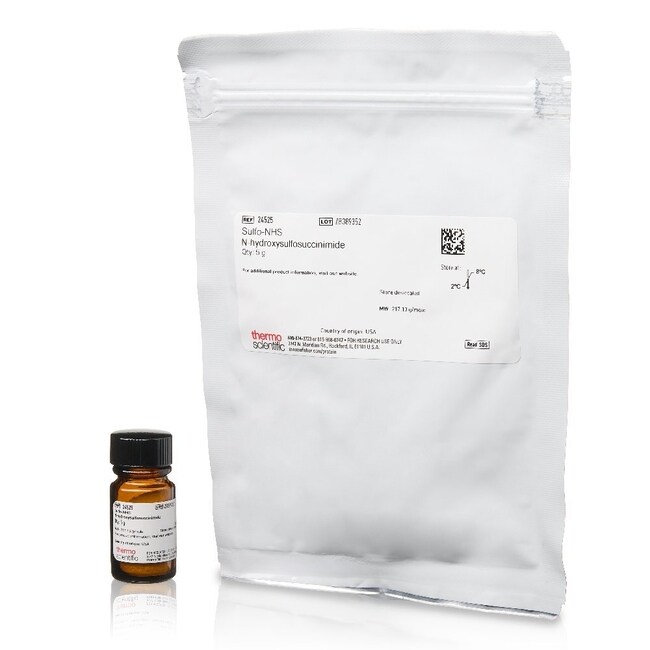
Sulfo-NHS (N-hydroxysulfosuccinimide), No-Weigh™ Format
Thermo Scientific Pierce Sulfo-NHS, No-Weigh Format is a chemical modification reagent for converting carboxyl groups to amine-reactive NHS esters forRead more
Have Questions?
Change view

| Catalog Number | Quantity |
|---|---|
| 24525 | 5 g |
| 24510 | 500 mg |
| A39269 | 10 x 2 mg |
Catalog number 24525
Price (CNY)
28,237.00
Each
Quantity:
5 g
Price (CNY)
28,237.00
Each
Thermo Scientific Pierce Sulfo-NHS, No-Weigh Format is a chemical modification reagent for converting carboxyl groups to amine-reactive NHS esters for bioconjugation, crosslinking, labeling and immobilization methods.
Features of Sulfo-NHS:
• Efficiency of EDC-mediated coupling is increased in the presence of Sulfo-NHS
• Amine-reactive NHS esters or Sulfo-NHS esters can be made with any carboxyl-containing molecule
• Sulfo-NHS derivatives are usually directly water-soluble (can be added directly to physiologic buffers) and membrane-impermable (can be used for cell surface labeling)
• High-purity, crystalline Sulfo-NHS can be used to create high-quality activated derivatives
Sulfo-NHS (N-hydroxysulfosuccinimide) enables control and modification of carbodiimide crosslinking reactions involving activation of carboxylates (—COOH) for conjugation with primary amines (—NH2). Derivatives are easily synthesized by mixing the Sulfo-NHS with a carboxyl-containing molecule and a dehydrating agent such as the carbodiimide EDC (EDAC). The method is the basis for generating many types of protein labeling reagents, including amine-reactive fluorescent dyes, biotin affinity tags and pegylation compounds.
Applications:
• Improve efficiency of EDC coupling reactions
• Convert carboxyls to amine-reactive Sulfo-NHS esters
• Crosslink proteins to carboxyl-coated beads or surfaces more efficiently
• Activate nanoparticles with amine-reactive Sulfo-NHS esters
Specifications for Sulfo-NHS:
We manufacture N-hydroxysulfosuccinimide to the highest possible specifications to produce the most specific bioconjugates, to ensure the integrity of your data and to provide you with the highest degree of consistency. Each lot of Sulfo-NHS is tested to meet the following minimum specifications:
• Purity—Greater than 95% by quantitative NMR (the highest standard for crosslinker purity);
average lot purity is greater than 99%
• Solubility—Sample dissolves at 2 mg/mL in deionized water to yield a clear, colorless solution
• Identity—IR scan shows only peaks characteristic of N-hydroxysulfosuccinimide
Product References:
Crosslinker Application Guide -- search for recent literature references for this product
Related Products
Pierce™ Premium Grade Sulfo-NHS (N-hydroxysulfosuccinimide)
NHS (N-hydroxysuccinimide)
EDC (1-ethyl-3-(3-dimethylaminopropyl)carbodiimide hydrochloride)
Features of Sulfo-NHS:
• Efficiency of EDC-mediated coupling is increased in the presence of Sulfo-NHS
• Amine-reactive NHS esters or Sulfo-NHS esters can be made with any carboxyl-containing molecule
• Sulfo-NHS derivatives are usually directly water-soluble (can be added directly to physiologic buffers) and membrane-impermable (can be used for cell surface labeling)
• High-purity, crystalline Sulfo-NHS can be used to create high-quality activated derivatives
Sulfo-NHS (N-hydroxysulfosuccinimide) enables control and modification of carbodiimide crosslinking reactions involving activation of carboxylates (—COOH) for conjugation with primary amines (—NH2). Derivatives are easily synthesized by mixing the Sulfo-NHS with a carboxyl-containing molecule and a dehydrating agent such as the carbodiimide EDC (EDAC). The method is the basis for generating many types of protein labeling reagents, including amine-reactive fluorescent dyes, biotin affinity tags and pegylation compounds.
Applications:
• Improve efficiency of EDC coupling reactions
• Convert carboxyls to amine-reactive Sulfo-NHS esters
• Crosslink proteins to carboxyl-coated beads or surfaces more efficiently
• Activate nanoparticles with amine-reactive Sulfo-NHS esters
Specifications for Sulfo-NHS:
We manufacture N-hydroxysulfosuccinimide to the highest possible specifications to produce the most specific bioconjugates, to ensure the integrity of your data and to provide you with the highest degree of consistency. Each lot of Sulfo-NHS is tested to meet the following minimum specifications:
• Purity—Greater than 95% by quantitative NMR (the highest standard for crosslinker purity);
average lot purity is greater than 99%
• Solubility—Sample dissolves at 2 mg/mL in deionized water to yield a clear, colorless solution
• Identity—IR scan shows only peaks characteristic of N-hydroxysulfosuccinimide
Product References:
Crosslinker Application Guide -- search for recent literature references for this product
Related Products
Pierce™ Premium Grade Sulfo-NHS (N-hydroxysulfosuccinimide)
NHS (N-hydroxysuccinimide)
EDC (1-ethyl-3-(3-dimethylaminopropyl)carbodiimide hydrochloride)
For Research Use Only. Not for use in diagnostic procedures.
Specifications
Cell PermeabilityNo
DescriptionSulfo-NHS
FormPowder
Labeling MethodChemical Labeling
Molecular Weight (g/mol)217.13
PEGylatedNo
Product LinePierce
Quantity5 g
Reactive MoietyCarbodiimide
Shipping ConditionAmbient
SolubilityWater
Water SolubleYes
Chemical ReactivityAmine-Carboxyl
CleavableNo
Crosslinker TypeHeterobifunctional
FormatStandard, Single-use, Premium-grade
Product TypeCrosslinker
SpacerShort (<10 Å)
Unit SizeEach
Contents & Storage
Upon receipt store at 4°C.
Frequently asked questions (FAQs)
Can NHS and EDC stock solutions be made for long-term storage before use?
Are there any substances that interfere with NHS reactions?
What is the difference between NHS and Sulfo-NHS?
How are NHS and Sulfo-NHS used?
What are NHS and Sulfo-NHS used for?
Citations & References (5)
Citations & References
Abstract
Investigation of platelet responses and clotting characteristics of in situ albumin binding surfaces.
Journal:J Biomater Appl
PubMed ID:20819918
'The response of biomaterial surfaces when exposed to blood is in part dependent upon the nature and composition of the adsorbed layer of proteins. Surfaces passivated with albumin have been shown to reduce platelet adhesion and activation. In an attempt to develop surfaces that can selectively and specifically bind albumin,
Mouse monoclonal antibodies to anthrax edema factor protect against infection.
Journal:Infect Immun
PubMed ID:21911463
'Bacillus anthracis is the causative agent of anthrax, and the tripartite anthrax toxin is an essential element of its pathogenesis. Edema factor (EF), a potent adenylyl cyclase, is one of the toxin components. In this work, anti-EF monoclonal antibodies (MAb) were produced following immunization of mice, and four of the
Metabolism of vertebrate amino sugars with N-glycolyl groups: elucidating the intracellular fate of the non-human sialic acid N-glycolylneuraminic acid.
Journal:J Biol Chem
PubMed ID:22692205
'The two major mammalian sialic acids are N-acetylneuraminic acid and N-glycolylneuraminic acid (Neu5Gc). The only known biosynthetic pathway generating Neu5Gc is the conversion of CMP-N-acetylneuraminic acid into CMP-Neu5Gc, which is catalyzed by the CMP-Neu5Ac hydroxylase enzyme. Given the irreversible nature of this reaction, there must be pathways for elimination or
Surface modification, functionalization and bioconjugation of colloidal inorganic nanoparticles.
Journal:Philos Trans A Math Phys Eng Sci
PubMed ID:20156828
Inorganic colloidal nanoparticles are very small, nanoscale objects with inorganic cores that are dispersed in a solvent. Depending on the material they consist of, nanoparticles can possess a number of different properties such as high electron density and strong optical absorption (e.g. metal particles, in particular Au), photoluminescence in the
The conserved His-144 in the PsbP protein is important for the interaction between the PsbP N-terminus and the Cyt b559 subunit of photosystem II.
Journal:J Biol Chem
PubMed ID:22707728
The PsbP protein regulates the binding properties of Ca(2+) and Cl(-), and stabilizes the Mn cluster of photosystem II (PSII); however, the binding site and topology in PSII have yet to be clarified. Here we report that the structure around His-144 and Asp-165 in PsbP, which is suggested to be