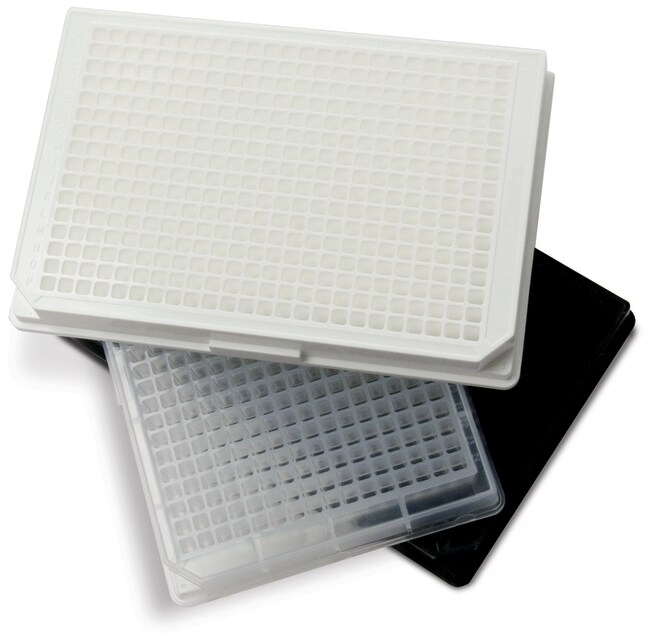
384 Well Black Plate, Non-Treated Surface, Non-Sterile, Pack of 25
Thermo Scientific™

384 Well Black Plate, Non-Treated Surface, Non-Sterile, Pack of 25

Thermo Scientific™ Nunc™ black microplates are ideal for fluorescence measurements, with minimum back-scattered light and background fluorescence.
Have Questions?
Catalog NumberQuantity
262260Case of 100
Catalog number 262260
Price (CNY)
7,660.00
Case of 100
Add to cart
Quantity:
Case of 100
Price (CNY)
7,660.00
Case of 100
Add to cart
Improve background, autofluorescence and crosstalk with Thermo Scientific™ Nunc™ 384-Well Polystyrene Black and White Microplates.
  • Black microplates are recommended for fluorescence measurements; with minimum back-scattered light and background fluorescence
  • White microplates are recommended for luminescence measurements; with maximum reflection and minimal autoluminescence
Specifications
Certifications/ComplianceAll microplates manufactured by Nunc meet the recommendation of American National Standards (ANSI) (ANSI/SBS 1-2004)
Culture Area0.084 cm2/well
LidWithout Lid
No. per Case100
No. per Pack25
Packaging25/Pk., 100/Cs.
Product TypeMicroplate
QuantityCase of 100
Skirt StyleLow Flange Pinchbar
Volume (Metric) Working10 to 100 μL
Array16 x 24
ColorBlack
MaterialPolystyrene
No. of Wells384
Product LineNunc
SterilityNon-sterile
Surface TreatmentNon-treated
Volume (Metric) Well120 μL
Well ShapeFlat Bottom (F-well)
Unit SizeCase of 100

Frequently asked questions (FAQs)

Do you offer Nunc Microplate Lids for the Nunc Black or White 384-Well Microplates?

We offer Nunc Microplate Lids: Cat. No. 448143, that fit both the 384-well microplates and the 1,536-well microplates.

Why do you offer Nunc 384-Well Black or White Microplates when the cells cannot be observed using an inverted light microscope?

We offer Nunc Black or White 384-Well microplates that are intended for use in conjunction with 384-well microplate luminometers and fluorometers that have excitation and detection systems located above the plate. Due to the opaque quality of these microplates, all detection systems must rely on either luminescent or fluorescent reagents, such as viability stains that report cell activity and membrane integrity.

Should I use an opaque black/white immuno plate, or an "optical-bottom" design?

Opaque plates can only be used on “top reader” instruments, which detect (or, in fluorescence mode, excite and detect) from above the plate. Readers that detect from underneath the plate (or imaging systems) use optical-bottom plates, which have a black or white upper well structure and a transparent (polystyrene film or optical coverglass) bottom.

Find additional tips, troubleshooting help, and resources within our Antibodies and Immunoassays Support Center.