Search


Citations & References (4)
Thermo Scientific™
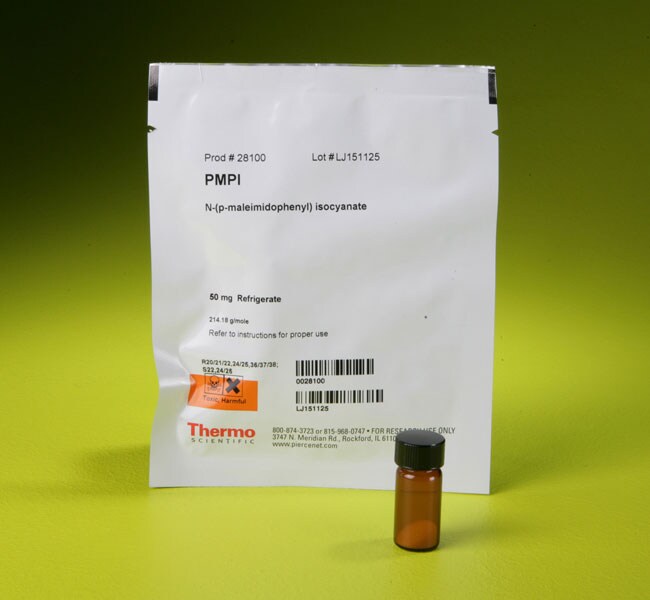
PMPI (p-maleimidophenyl isocyanate)
Thermo Scientific Pierce PMPI is a maleimide-and-isocyanate crosslinker for attaching compounds to sulfhydryl groups (cysteines) after conjugating the linker toRead more
| Catalog Number | Quantity |
|---|---|
| 28100 | 50 mg |
Catalog number 28100
Price (CNY)
4,485.00
Each
Quantity:
50 mg
Price (CNY)
4,485.00
Each
Thermo Scientific Pierce PMPI is a maleimide-and-isocyanate crosslinker for attaching compounds to sulfhydryl groups (cysteines) after conjugating the linker to hydroxyl groups on a molecule by urethane (carbamate) bonds.
Features of PMPI:
• Reactive groups: maleimide and isocyanate
• Reactive towards: sulfhydryl and hydroxyl groups
• Short (8.7A), sulfhydryl-to-hydroxyl crosslinker with an aromatic spacer arm (noncleavable)
• Maleimide group reacts with sulfhydryl groups to form stable thioether linkages
• Isocyanate reacts with non-aqueous hydroxyl groups to form carbamate linkage
• Excellent tool for conjugating hydroxyl-containing compounds such as steroids and vitamins
• Targets and reaction solutions must not contain primary amines
Features of PMPI:
• Reactive groups: maleimide and isocyanate
• Reactive towards: sulfhydryl and hydroxyl groups
• Short (8.7A), sulfhydryl-to-hydroxyl crosslinker with an aromatic spacer arm (noncleavable)
• Maleimide group reacts with sulfhydryl groups to form stable thioether linkages
• Isocyanate reacts with non-aqueous hydroxyl groups to form carbamate linkage
• Excellent tool for conjugating hydroxyl-containing compounds such as steroids and vitamins
• Targets and reaction solutions must not contain primary amines
For Research Use Only. Not for use in diagnostic procedures.
Specifications
Cell PermeabilityNot determined
DescriptionPMPI
FormSolid
Labeling MethodChemical Labeling
Molecular Weight (g/mol)307.1
PEGylatedNo
Product LinePierce
Quantity50 mg
Reactive MoietyMaleimide, Isocyanate
Shipping ConditionAmbient
SolubilityDMF, DMSO
Spacer Arm Length8.7 Å
Water SolubleNo
Chemical ReactivityCarboxyl-Sulfhydryl
CleavableNo
Crosslinker TypeHeterobifunctional
FormatStandard
Product TypeCrosslinker
SpacerShort (<10 Å)
Unit SizeEach
Contents & Storage
Upon receipt store at 4°C protected from moisture.
Citations & References (4)
Citations & References
Abstract
X-ray photoelectron spectroscopy and infrared spectroscopy study of maleimide-activated supports for immobilization of oligodeoxyribonucleotides.
Journal:Nucleic Acids Res
PubMed ID:15537837
'Surface-tethered nucleic acids are widely applied in solid-phase assays in which complementary strands must be detected against a complex mixture of other sequences. In response to such needs, numerous methods have been developed for immobilizing nucleic acids on solid supports. Often, detailed analysis of associated chemical transformations and of potential
Direct electrical detection of DNA synthesis.
Journal:Proc Natl Acad Sci U S A
PubMed ID:16614066
'Rapid, sequence-specific DNA detection is essential for applications in medical diagnostics and genetic screening. Electrical biosensors that use immobilized nucleic acids are especially promising in these applications because of their potential for miniaturization and automation. Current DNA detection methods based on sequencing by synthesis rely on optical readouts; however, a
Discovering ligands for a microRNA precursor with peptoid microarrays.
Journal:Nucleic Acids Res
PubMed ID:19561197
We have screened peptoid microarrays to identify specific ligands for the RNA hairpin precursor of miR-21, a microRNA involved in cancer and heart disease. Microarrays were printed by spotting a library of 7680 N-substituted oligoglycines (peptoids) onto glass slides. Two compounds on the array specifically bind RNA having the sequence
Interaction with the 5D3 monoclonal antibody is regulated by intramolecular rearrangements but not by covalent dimer formation of the human ABCG2 multidrug transporter.
Journal:J Biol Chem
PubMed ID:18644784
Human ABCG2 is a plasma membrane glycoprotein working as a homodimer or homo-oligomer. The protein plays an important role in the protection/detoxification of various tissues and may also be responsible for the multidrug-resistant phenotype of cancer cells. In our previous study we found that the 5D3 monoclonal antibody shows a