Search


Citations & References (25)
Gibco™
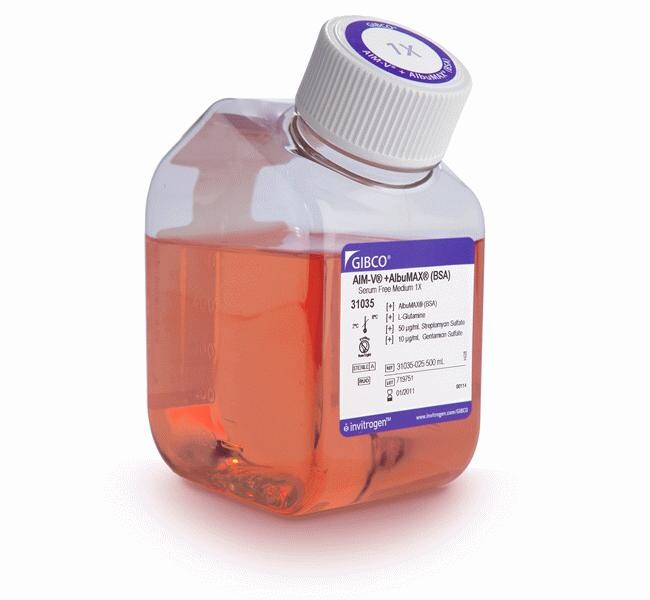
AIM V™ Medium (research grade), AlbuMAX™ Supplement
Contains AlbuMAX® supplement (bovine serum albumin) substituted for human serum albumin. Contains L-glutamine, streptomycin sulfate at 50 μg/mL, and gentamicinRead more
| Catalog Number | Quantity |
|---|---|
| 31035025 | 500 mL |
Catalog number 31035025
Price (CNY)
2,008.00
Each
Quantity:
500 mL
Price (CNY)
2,008.00
Each
Contains AlbuMAX® supplement (bovine serum albumin) substituted for human serum albumin. Contains L-glutamine, streptomycin sulfate at 50 μg/mL, and gentamicin sulfate at 10 μg/mL.
For Research Use Only. Not for use in diagnostic procedures.
Specifications
Cell TypeMonocytes, Dendritic Cells, T Cells, Hybridomas, PBMCs, Fibroblasts, Macrophages, Myeloma Cells, Lymphocytes
Included AntibioticsStreptomycin Sulfate, Gentamicin
Product LineAIM V
Product TypeAIM V™ Medium
Purity or Quality GradeResearch Grade
Quantity500 mL
Shipping ConditionRoom Temperature
Culture TypeMammalian Cell Culture
FormLiquid
SterilitySterile-filtered
With AdditivesGlutamine, Phenol Red, AlbuMAX
Unit SizeEach
Contents & Storage
Store in refrigerator (2–8°C) and protect from light.
Frequently asked questions (FAQs)
Is any supplementation needed for AIM V Medium (research grade), AlbuMAX Supplement (Cat. No. 31035025)?
Citations & References (25)
Citations & References
Abstract
Low oxygen tension and autologous plasma enhance T-cell proliferation and CD49d expression density in serum-free media.
Journal:Cytotherapy
PubMed ID:11953028
'Background As cellular immunotherapy with ex vivo expanded cells becomes more widely used to treat a variety of illnesses, optimization of culture parameters, to maximize cell production and function, is essential for continued success. The effects of reduced oxygen tension and autologous plasma on T-cell expansion, receptor expression, apoptosis, and
Effects of interleukin 4 upon human tumoricidal cells obtained from patients bearing solid tumors.
Journal:J Leukoc Biol
PubMed ID:1991997
'The use of human interleukin 4 (IL4) in the generation of tumoricidal effector cells derived from cancer patients undergoing either interleukin 2/lymphokine activated killer cells (IL2/LAK) therapy or tumor derived activated cell (TDAC) therapy was examined in the present study. Human IL4 alone did not generate LAK cells from patients
T(84) epithelial cells respond to 5-hydroxytryptamine when grown in serum-free media.
Journal:Eur J Pharmacol
PubMed ID:10708712
The aim of this study was to establish the cause of insensitivity of T(84) human colonic epithelial cells to 5-hydroxytryptamine (5-HT). Monolayers of T(84) cells were placed in modified Ussing chambers for measurement of short-circuit current, an index of secretion. When grown in serum-supplemented media, T(84) cells gave secretory responses
Generation of human autologous melanoma-specific cytotoxic T cells from tumor-involved lymph nodes.
Journal:Mol Biother
PubMed ID:1910625
Cytotoxic T lymphocytes (CTL) specific for autologous human melanoma have been successfully generated in vitro from tumor bearing lymph nodes without any stimulation by the autologous tumor. Tumor-involved lymph node cells (LNC) were cultured in serum free medium (AIM-V) containing 1,000 U/ml of recombinant interleukin-2. The best expansion and specific
[Function of dendritic cell in chronic hepatitis C patients]
Journal:Zhonghua Nei Ke Za Zhi
PubMed ID:12133427
OBJECTIVE: To explore the relation between dendritic cell (DC) and the persistence of HCV in chronic hepatitis C. METHODS: The mononuclear cells were separated from the periphral blood and cultured with the AIM-V serum-free culture to induce DC. The shape and the ultrastructure of DC, the phenotype of DC, the