Search

Thermo Scientific™
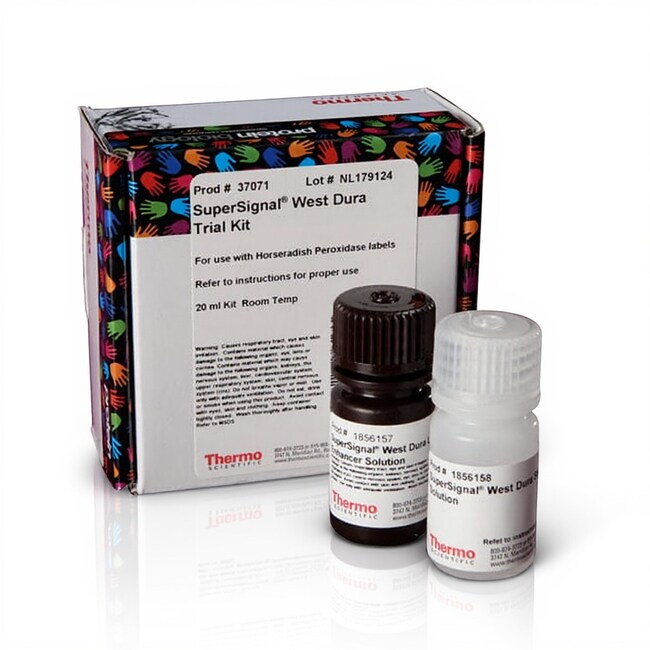
SuperSignal™ West Dura Extended Duration Substrate
Luminol-based enhanced chemiluminescence (ECL) horseradish peroxidase (HRP) substrate ideal for quantitative western blotting with stable light output for mid-femtogram level detection for western blot analysis.
Have Questions?
Change view

| Catalog Number | Quantity |
|---|---|
| 37071 | 20 mL |
| 34075 | 100 mL |
| 34076 | 200 mL |
Catalog number 37071
Price (CNY)
1,166.00
Each
Quantity:
20 mL
Price (CNY)
1,166.00
Each
Thermo Scientific SuperSignal West Dura Extended Duration Substrate is a luminol-based enhanced chemiluminescence (ECL) horseradish peroxidase (HRP) substrate ideal for quantitative western blotting with stable light output for mid-femtogram level detection for western blot analysis.
SuperSignal West Dura Extended Duration Substrate characteristics include:
- Sensitivity: mid-femtogram
- Stability: 24-hr working solution stability; 1-year kit stability at room temperature
- Compatibility: nitrocellulose and PVDF membranes
- Signal duration: 24 hours
- Recommended primary antibody concentration: 1:1,000–1:50,000 dilution (0.02–1.0 μg/mL)
- Recommended secondary antibody concentration: 1:50,000–1:250,000 dilution (4–20 ng/mL)
SuperSignal West Dura Extended Duration Substrate for HRP is optimized for high sensitivity and long signal duration, making it ideal for cooled CCD camera-based detection systems. Unlike substrates with signals that decline to barely detectable levels in 30–60 minutes, the signal produced with SuperSignal West Dura chemiluminescent substrate is stable for 24 hours, allowing multiple film or camera exposures.
For Research Use Only. Not for use in diagnostic procedures.
General References:
- Gangalum, R.K.et al.(2004).J. Biol. Chem. 279,43374-43377.
- MacInnis, B.L. and Campenot, R.B. (2004).Science 295,1536-1539.
- Sato, S.,et al.(2003).J. Biol. Chem. 278,15123-15127.
- Tokumaru, H.,et al.(2001).Cell 104,421-432.
Specifications
Recommended Antibody Concentrations2°: 1:50-250K (4-20ng/mL), 1°: 1:5K (0.02- 1μg/mL)
SensitivityMid-femtogram
Signal Duration24 hr.
Sufficient For2 Mini-Gel Blots, 200 sq. cm of Membrane
Detection MethodChemiluminescence
For Use With (Application)Western Blot
FormLiquid
Membrane CompatibilityNitrocellulose, PVDF
Product LineSuperSignal
Product TypeSubstrate
Quantity20 mL
SubstrateHorseradish Peroxidase
Unit SizeEach
Contents & Storage
Sufficient For: 2 mini-gel blots; 200 cm2 of membrane
• Luminol/Enhancer, 10 mL
• Stable Peroxide Buffer, 10 mL
Store at room temperature.
• Luminol/Enhancer, 10 mL
• Stable Peroxide Buffer, 10 mL
Store at room temperature.