Search


Citations & References (4)
Gibco™
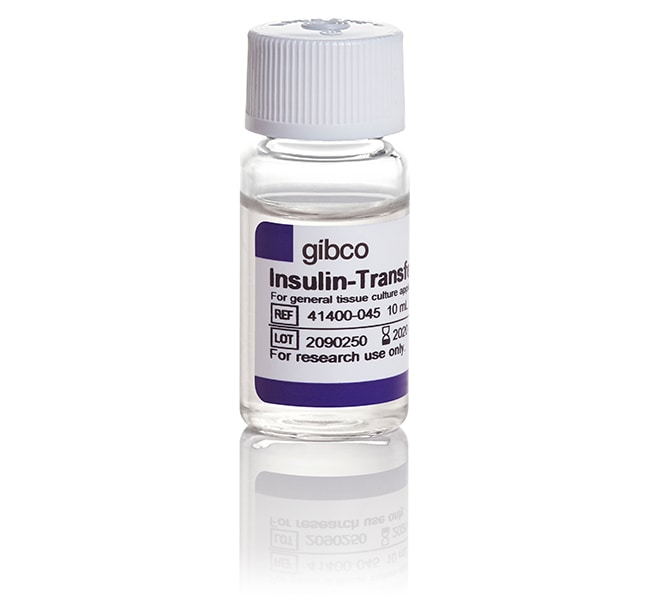
Insulin-Transferrin-Selenium (ITS -G) (100X)
A basal medium supplement to reduce the amount of fetal bovine serum (FBS) needed to culture cells.
| Catalog Number | Quantity |
|---|---|
| 41400045 | 10 mL |
Catalog number 41400045
Price (CNY)
948.00
飞享价
Ends: 31-Dec-2026
1,264.00Save 316.00 (25%)
Each
Quantity:
10 mL
Price (CNY)
948.00
飞享价
Ends: 31-Dec-2026
1,264.00Save 316.00 (25%)
Each
Gibco™ Insulin-Transferrin-Selenium (ITS-G) is used as a basal medium supplement in order to reduce the amount of fetal bovine serum (FBS) needed to culture cells. Originally used with RPMI 1640 and Minimum Essential Medium (MEM), ITS-G solution is now routinely used with other basal media to support a wide variety of cell types in the presence of 2 to 4% FBS.
Insulin promotes glucose and amino acid uptake, lipogenesis, intracellular transport, and the synthesis of proteins and nucleic acids. Transferrin is an iron carrier and it may also help to reduce toxic levels of oxygen radicals and peroxide. Selenium, as sodium selenite, is a co-factor for glutathione peroxidase and other proteins, and is used as an anti-oxidant in media.
The complete formulation is available.
cGMP Manufacturing and Quality System
Gibco™ ITS-G is manufactured at a cGMP compliant facility, located in Grand Island, New York. The facility is registered with the FDA as a medical device manufacturer and is certified to ISO 13485 standards.
For Research Use Only. Not for use in diagnostic procedures.
Specifications
Cell TypeMammalian Cells
Concentration100 X
Quantity10 mL
Shelf Life18 Months
Shipping ConditionRoom Temperature
FormLiquid
Product TypeTransferrin
SterilitySterile-filtered
Sterilization MethodSterile-filtered
Without AdditivesNo Phenol Red
Unit SizeEach
Contents & Storage
Storage conditions: 2°C to 8°C
Shipping conditions: Room temperature
Shelf life: 18 months from date of manufacture
Shipping conditions: Room temperature
Shelf life: 18 months from date of manufacture
Frequently asked questions (FAQs)
What is the buffer composition of the various Insulin-Transferrin-Selenium (ITS) (100X) and Insulin-Transferrin-Selenium (ITS) Select (100X) supplements?
What is the difference between Insulin-Transferrin-Selenium (ITS) (100X) and Insulin-Transferrin-Selenium (ITS) Select (100X) supplements?
What are the individual concentrations of insulin, transferrin, and selenium in the Insulin-Transferrin-Selenium (ITS) (100X) supplements?
Can I store aliquots of Insulin-Transferrin-Selenium (ITS) (100X) supplements at -20 degrees C without compromising the integrity of the product?
Are all Insulin-Transferrin-Selenium (ITS) (100X) supplements offered by Thermo Fisher Scientific animal origin-free?
Citations & References (4)
Citations & References
Abstract
A comparison between different human hepatocyte models reveals profound differences in net glucose production, lipid composition and metabolism in vitro.
Journal:Experimental cell research
PubMed ID:38499143
Protocol to generate human liver spheroids to study liver fibrosis induced by metabolic stress.
Journal:STAR protocols
PubMed ID:38833372
Currently, there is no effective treatment for obesity and alcohol-associated liver diseases, partially due to the lack of translational human models. Here, we present a protocol to generate 3D human liver spheroids that contain all the liver cell types and mimic âlivers in a dish.â We describe strategies to induce
Collective cell migration requires suppression of actomyosin at cell-cell contacts mediated by DDR1 and the cell polarity regulators Par3 and Par6.
Journal:Nat Cell Biol
PubMed ID:21170030
Collective cell migration occurs in a range of contexts: cancer cells frequently invade in cohorts while retaining cell-cell junctions. Here we show that collective invasion by cancer cells depends on decreasing actomyosin contractility at sites of cell-cell contact. When actomyosin is not downregulated at cell-cell contacts, migrating cells lose cohesion.
Human cardiomyocyte progenitor cells differentiate into functional mature cardiomyocytes: an in vitro model for studying human cardiac physiology and pathophysiology.
Journal:Nat Protoc
PubMed ID:19197267
To date, there is no suitable in vitro model to study human adult cardiac cell biology. Although embryonic stem cells are able to differentiate into cardiomyocytes in vitro, the efficiency of this process is very low. Other methods to differentiate progenitor cells into beating cardiomyocytes rely on coculturing with rat