Search


Citations & References (2)
Invitrogen™
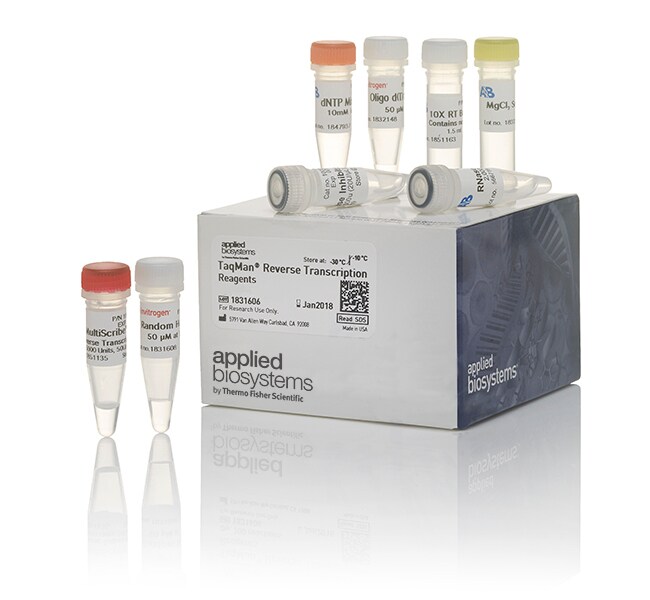
TaqMan™ Reverse Transcription Reagents
TaqMan Reverse Transcription Reagents provide the necessary reagents for reverse transcriptase-PCR (RT-PCR). Random hexamers, oligo (dT)16, and reverse primers are included for cDNA synthesis flexibility.
Have Questions?
Change view

| Catalog Number | No. of Reactions |
|---|---|
| 4304134 | 2000 Reactions at 10 μL |
| N8080234 | 200 Reactions at 10 μL |
Catalog number 4304134
Price (CNY)
56,098.00
飞享价
Ends: 31-Dec-2026
74,797.00Save 18,699.00 (25%)
Each
No. of Reactions:
2000 Reactions at 10 μL
Price (CNY)
56,098.00
飞享价
Ends: 31-Dec-2026
74,797.00Save 18,699.00 (25%)
Each
TaqMan Reverse Transcription Reagents provide the necessary reagents for reverse transcriptase-PCR (RT-PCR). Random hexamers, oligo (dT)16, and reverse primers are included for cDNA synthesis flexibility. These reagents are designed for reverse transcription and PCR amplification of a specific target RNA from either total RNA or mRNA. The reagents in this kit facilitate two-step RT-PCR, which is performed in two separate reactions and is useful when detecting multiple transcripts from a single cDNA reaction or when storing a portion of the cDNA.
Advantages of TaqMan Reverse Transcription Reagents
- Contains MultiScribe Reverse Transcriptase, a recombinant Moloney murine leukemia virus (MMLV) reverse transcriptase
- Includes random hexamers and oligo (dT)16 for flexibility
- Individual components provide versatility in assay setup
- Compatible with two-step RT-PCR reactions
Using TaqMan Reverse Transcription Reagents
- TaqMan Reverse Transcription Reagents provide all the necessary components for reverse transcription of RNA to cDNA
- For two-step RT-PCR, random hexamers, oligo (dT)16, and sequence-specific reverse primers can all be used
- The choice of primers for reverse transcription is best made after experimentally evaluating all three priming systems
For Research Use Only. Not for use in diagnostic procedures.
Specifications
Final Product TypeFirst-Strand cDNA
FormatKit
No. of Reactions2000 Reactions at 10 μL
Optimal Reaction Temperature42°C
Quantity2000 Reactions
Reaction FormatSeparate components
Reagent TypeReverse Transcription
Reverse TranscriptaseMultiScribe
Ribonuclease H ActivityYes
Shipping ConditionDry Ice
Size (Final Product)Up to 5 kb
Starting MaterialRNA
TechniqueReverse Transcription
Concentration50 U/μL
For Use With (Application)Real Time PCR (qPCR)
Unit SizeEach
Contents & Storage
Includes 10 units. Each unit contains:
• MultiScribe Reverse Transcriptase, 100 μL (50 U/μL)
• RNase Inhibitor, 100 μL (20 U/μL)
• dNTP Mixture, 1 mL (2.5 mM each dNTP)
• Oligo (dT)16, 100 μL (50 μM)
• Random Hexamers, 100 μL (50 μM)
• 10X RT Buffer, 1.5 mL
• MgCl2 Solution, 1.5 mL
Store at –25°C to –15°C.
Frequently asked questions (FAQs)
How long can I store the cDNA from my reverse transcription step?
Can the RT buffer for TaqMan Reverse Transcription Reagents kit (Cat. No. N8080234) be purchased separately?
Citations & References (2)
Citations & References
Abstract
Combined analysis of levels of serum B-cell activating factor and a proliferation-inducing ligand as predictor of disease progression in patients with chronic lymphocytic leukemia.
Journal:Leuk Lymphoma
PubMed ID:21707303
'B-cell activating factor (BAFF) and a proliferation-inducing ligand (APRIL) are regulators of normal B-cell development and survival. We investigated their role in chronic lymphocyticleukemia (CLL) by relating serum protein levels and CLL cell mRNA expression with clinical factors and disease progression. In patients with CLL, BAFF serum levels were significantly
Regulating type 1 IFN effects in CD8 T cells during viral infections: changing STAT4 and STAT1 expression for function.
Journal:Blood
PubMed ID:22968462
Type 1 IFNs can conditionally activate all of the signal transducers and activators of transcription molecules (STATs), including STAT4. The best-characterized signaling pathways use STAT1, however, and type 1 IFN inhibition of cell proliferation is STAT1 dependent. We report that type 1 IFNs can basally stimulate STAT1- and STAT4-dependent effects