Search

Invitrogen™
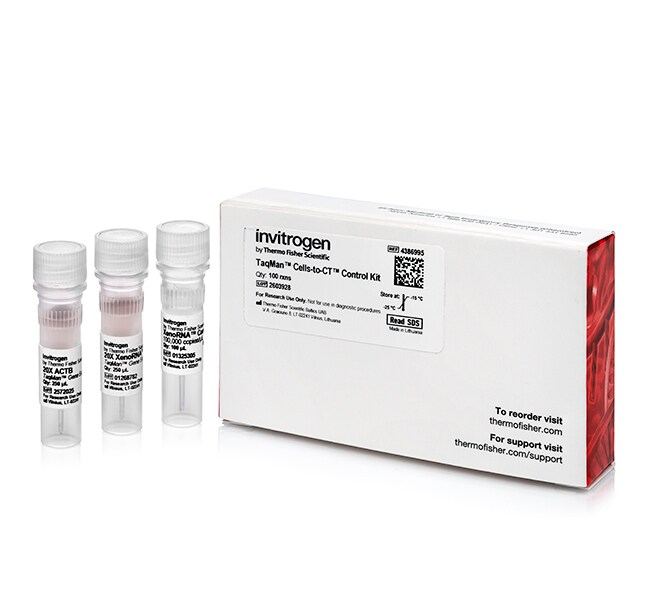
TaqMan™ Cells-to-CT™ Control Kit
The Ambion™ TaqMan™ Cells-to-CT Control Kit is designed for use with the TaqMan™ Gene Expression Cells-to-CT Kit. The Control KitRead more
| Catalog Number | Quantity |
|---|---|
| 4386995 | 100 reactions |
Catalog number 4386995
Price (CNY)
10,530.00
Each
Quantity:
100 reactions
Price (CNY)
10,530.00
Each
The Ambion™ TaqMan™ Cells-to-CT Control Kit is designed for use with the TaqMan™ Gene Expression Cells-to-CT Kit. The Control Kit includes XenoRNA™ Control, a synthetic RNA transcript with a unique sequence that lacks homology to current annotated biological sequences, making it an ideal control for any experiment. The Control Kit also includes a TaqMan™ Gene Expression Assay for the XenoRNA™ Control target, and a TaqMan™ Gene Expression Assay for the highly expressed endogenous control gene β-actin.
Features of the The Ambion™ TaqMan™ Cells-to-CT Control Kit:
• Confirms sufficient cell input
• Monitors the presence of RT or real-time PCR inhibitors
• Controls for sample normalization
Monitor Inhibition and Confirm Sufficient Cell Input
The TaqMan™ Cells-to-CT™ Control Kit is used to assess inhibition and cell input in Cells-to-CT reactions. For example, the XenoRNA™ Control confirms that samples can support RT-PCR and is an indicator of reaction inhibitors. By adding the XenoRNA™ Control to the Stop Solution during the last step of the cell lysis procedure, each sample is provided with a constant amount of control target and subsequently amplified by the XenoRNA™ TaqMan™ Gene Expression Assay.
Amplification with the β-actin Gene Expression Assay functions as an endogenous control for normalization, and ensures that the lysis reaction contains a sufficient number of cells—this is important for experiments with fewer than ∼100 cells and monitors the effectiveness of cell lysis.
Evaluate Compatibility with New Cell Lines
The TaqMan™ Cells-to-CT™ Control Kit is ideal for assessing the compatibility of untested cell lines with the TaqMan™ Gene Expression Cells-to-CT Kit to determine the maximum number of cells that can be used per lysis reaction.
Features of the The Ambion™ TaqMan™ Cells-to-CT Control Kit:
• Confirms sufficient cell input
• Monitors the presence of RT or real-time PCR inhibitors
• Controls for sample normalization
Monitor Inhibition and Confirm Sufficient Cell Input
The TaqMan™ Cells-to-CT™ Control Kit is used to assess inhibition and cell input in Cells-to-CT reactions. For example, the XenoRNA™ Control confirms that samples can support RT-PCR and is an indicator of reaction inhibitors. By adding the XenoRNA™ Control to the Stop Solution during the last step of the cell lysis procedure, each sample is provided with a constant amount of control target and subsequently amplified by the XenoRNA™ TaqMan™ Gene Expression Assay.
Amplification with the β-actin Gene Expression Assay functions as an endogenous control for normalization, and ensures that the lysis reaction contains a sufficient number of cells—this is important for experiments with fewer than ∼100 cells and monitors the effectiveness of cell lysis.
Evaluate Compatibility with New Cell Lines
The TaqMan™ Cells-to-CT™ Control Kit is ideal for assessing the compatibility of untested cell lines with the TaqMan™ Gene Expression Cells-to-CT Kit to determine the maximum number of cells that can be used per lysis reaction.
For Research Use Only. Not for use in diagnostic procedures.
Specifications
Control TemplateXenoRNA™ control (synthetic RNA transcript)
FormatTube
Gene SymbolACTB
Internal Probe ModificationMGB (Minor Groove Binder) (3'), Non-Fluorescent Quencher (3'), FAM (5')
No. of Reactions100 Reactions
Product LineAmbion, Cells-to-CT, TaqMan
Product TypeCells-to-C Control Kit
Quantity100 reactions
Shipping ConditionDry Ice
Sufficient For100 Reactions
TargetXenoRNA™ control, β-actin
Detection MethodPrimer-probe
For Use With (Application)Gene Expression
GC-Rich PCR PerformanceHigh
Label or DyeFAM
PCR MethodqPCR
Unit SizeEach
Contents & Storage
Xeno™ RNA Control, 20X Xeno™ RNA Control Taqman™ Gene Expression Assay, and 20X ACTB (β-actin) TaqMan™ Gene Expression Assay are all stored at -20°C.
All reagents are guaranteed stable for 6 months when properly stored.
All reagents are guaranteed stable for 6 months when properly stored.