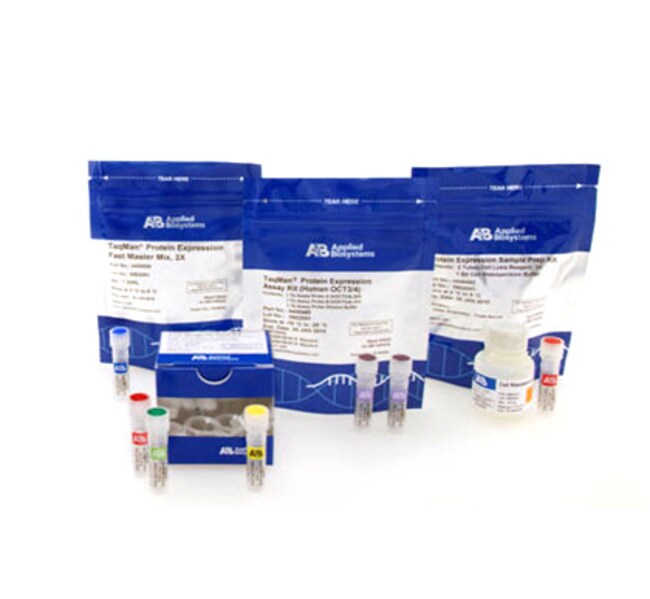
TaqMan™ Protein Assays Fast Master Mix (2X)
Applied Biosystems™

TaqMan™ Protein Assays Fast Master Mix (2X)

The enzyme concentration, ionic strength, and the pH of the TaqMan™ Protein Fast Master Mix are optimized for the amplificationRead more
Have Questions?
Catalog NumberQuantity
4400088100 reactions
Catalog number 4400088
Price (CNY)
1,875.00
Each
Add to cart
Quantity:
100 reactions
Price (CNY)
1,875.00
Each
Add to cart
The enzyme concentration, ionic strength, and the pH of the TaqMan™ Protein Fast Master Mix are optimized for the amplification of ligated oligonucleotide target sequences prepared using TaqMan™ Protein Assay reagents. The DNA polymerase included in the master mix is designed for maximum PCR efficiency and specificity when used with the ligation chemistry.

Running a complete TaqMan™ Protein Assay (pre-designed or made with the Open Kit) requires a Core Reagents Base Kit and Master Mix Kit.
For Research Use Only. Not for use in diagnostic procedures.
Specifications
For Use With (Equipment)7500 Fast System, 7500 System, 7900HT Fast System, 7900HT System, AB 7900 HT 384-Well System, StepOne™, Fast Mode, StepOnePlus™, Fast Mode
Hot StartNo
No. of Reactions100 reactions
Passive Reference DyeROX (Pre-mixed)
PolymeraseAmpliTaq Fast DNA Polymerase
Product LineTaqMan
Quantity100 reactions
Sample TypeCells
Shipping ConditionWet Ice
Target SpecificityNot Target-Specific
TechniqueProximity Ligation Assay
Concentration2X
Detection MethodPrimer-probe
For Use With (Application)Cell Analysis
PCR MethodqPCR
Reaction SpeedFast
Unit SizeEach
Contents & Storage
Store kit at 2-8°C.

Frequently asked questions (FAQs)

Why do I not see any difference in expression between my experimental samples and the negative control in my TaqMan Protein Assay?

There may be several reasons for not seeing any change in expression. Check for the following:

- Did the antibody probes pass the forced proximity test?
- What is being used for the negative control? If there is endogenous expression of the target, consider using buffer instead of a “negative” lysate.
- Make sure to test a range of inputs, using 2- to 3-fold dilutions
- For cells: 1-500 cells
- For recombinant protein: ~200 pg/well
- For total protein (tissue): 1-1,000 ng
- For cell lysate: ~50 ng total protein/well
- Make sure to use a positive control to ensure detection
- Test with one of the control assays, such as for hCSTB or hICAM1

In a TaqMan Protein Assay, what can I do if my antibody probe does not pass the forced proximity test?

The forced proximity test helps to assess the quality of the biotinylated antibody. If it does not pass, then either the antibody is under-biotinylated, or there still is free biotin in the solution. Even as little as 80 nM free biotin can cause the test to fail. Make sure to dialyze the antibody well (change the buffer at least five times, including one overnight exchange). We recommend using the Slide-A-Lyzer Mini Dialysis Unit. Repeat the dialysis steps and perform the test again.

How do I analyze the TaqMan Protein Assay data?

ProteinAssist Software is free analysis software that can be used for relative quantitation analysis of your data, directly compatible with the data from most real-time instruments.

Can I use the TaqMan Protein Assays for absolute quantitation (AQ)?

You can, but it is not supported by our software (ProteinAssist Software). ProteinAssist Software is for relative quantitation only. You would have to use a third-party option, such as MasterPlex, to generate a standard curve and determine absolute quantitation. If you make a standard curve, you can use the NPC as a negative control. If needed you can also use mixed probes for your samples as a negative control. For AQ, you will also need to do a spike-in recovery and linearity tests to make sure the assay will give you accurate quantitative results.

What is an NPC, and what can I use for one?

NPC stands for no-protein control. This is a sample (lysate or just buffer) in which your protein of interest is not present. This is a required sample type for the Relative Quantitation analysis in ProteinAssist Software.