Search


Citations & References (59)
Applied Biosystems™
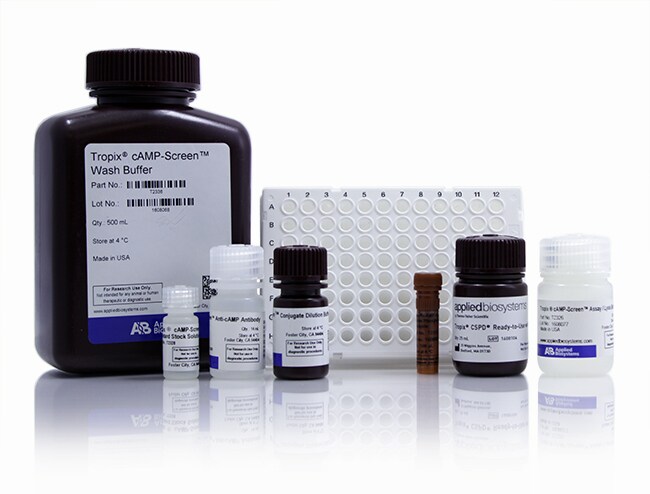
cAMP-Screen™ Cyclic AMP Immunoassay System
The cAMP-Screen™ 96-well Cyclic AMP Immunoassay System enables ultrasensitive determination of cyclic AMP (cAMP) levels in cell lysates. This competitiveRead more
Have Questions?
Change view

| Catalog Number | Quantity |
|---|---|
| 4412182 | 192 assays (2 x 96) |
| 4412183 | 960 assays |
Catalog number 4412182
Price (CNY)
14,444.00
Each
Quantity:
192 assays (2 x 96)
Price (CNY)
14,444.00
Each
The cAMP-Screen™ 96-well Cyclic AMP Immunoassay System enables ultrasensitive determination of cyclic AMP (cAMP) levels in cell lysates. This competitive chemiluminescent immunoassay is formatted with maximum flexibility to permit either manual reagent additions or automated high-throughput processing. The cAMP assay utilizes the highly sensitive chemiluminescent CSPD™ Substrate with Sapphire-II™ Enhancer that is triggered by an enzyme conjugate composed of cAMP bound to alkaline phosphatase (cAMP-AP). The chemiluminescent substrate/enhancer formulation is a ready-to-use reagent that generates a sustained-glow light emission from 30 minutes after addition. This assay is mainly used in secondary screening and pre-clinical research, where sensitivity and no false positives are essential.
• The highest sensitivity of any commercially available cAMP assay
• Hours of read time with little or no degradation of the signal
• A simple protocol
• Useful for a wide range of receptor activation studies
High Sensitivity and Hours of Steady Glow Time
This chemiluminescent assay is designed to provide the highest sensitivity of any commercially available cAMP assay. As few as 60 femtomoles of cAMP can be detected. The assay has a wide dynamic range, detecting from 0.06 to 6,000 picomoles of cAMP without the need for sample dilution or manipulations such as acetylation. This is especially helpful in cell-based assays when measuring Gs- or Gi-coupled agonist or antagonist stimulation and/or inhibition. Intra-assay precision for duplicate samples is typically 5% or less. Once the substrate/enhancer formulation reaches glow signal, the plate can be read for hours with little or no degradation of the signal. This is useful in screens where several plates are compared with each other. In addition, the assay exhibits exceptionally low cross-reactivity with other adenosine-containing or cyclic nucleotides.
For Receptor Activation Studies
The cAMP-Screen™ system is designed for quantitation of cellular cAMP for functional assays of receptor activation. The assay has been used with established cell lines for functional measurements with endogenous receptors, cell lines with exogenously expressed ligand receptors on the cell surface, primary cell cultures, and tissues in response to treatment with the appropriate ligands. In addition it has been used for receptor characterization, orphan receptor ligand identification, and the characterization of novel chimeric receptors. The assay can be used for high-throughput screens for compounds that stimulate or interfere with these signal transduction pathways.
A Simple Protocol
The assay follows a simple protocol. Cells are seeded into plates, cultured, and treated with test compounds as desired. Cell lysates are prepared in either the presence or absence of culture media. Lysates are incubated with a cAMP-AP conjugate and an anti-cAMP antibody in a coated microplate; the resulting immune complexes are captured in the plate. In samples without cAMP, all of the cAMP-AP conjugate is captured on the coated surface, resulting in a high signal. In the presence of cAMP, the amount of cAMP-AP conjugate captured decreases as a result of competition for binding with unlabeled cAMP, causing a reduced signal; signal reduction is proportional to the amount of cAMP present in the cell lysate. After washing to remove unbound cAMP-AP, the chemiluminescent substrate is added, and the resulting glow signal is measured in a luminometer.
An alternate product, the cAMP-Screen Direct™ system, has all of the same benefits as this cAMP-Screen™ system, but eliminates the need to transfer cell lysates from a tissue culture plate to the precoated microplates because the cells can be grown directly in the microplates. This provides better assay precision with one less transfer step. Many different cell types have been grown successfully on the precoated microplates, which also have a clear bottom to allow monitoring of cells.
For Research Use Only. Not for human or animal therapeutic or diagnostic use.
• The highest sensitivity of any commercially available cAMP assay
• Hours of read time with little or no degradation of the signal
• A simple protocol
• Useful for a wide range of receptor activation studies
High Sensitivity and Hours of Steady Glow Time
This chemiluminescent assay is designed to provide the highest sensitivity of any commercially available cAMP assay. As few as 60 femtomoles of cAMP can be detected. The assay has a wide dynamic range, detecting from 0.06 to 6,000 picomoles of cAMP without the need for sample dilution or manipulations such as acetylation. This is especially helpful in cell-based assays when measuring Gs- or Gi-coupled agonist or antagonist stimulation and/or inhibition. Intra-assay precision for duplicate samples is typically 5% or less. Once the substrate/enhancer formulation reaches glow signal, the plate can be read for hours with little or no degradation of the signal. This is useful in screens where several plates are compared with each other. In addition, the assay exhibits exceptionally low cross-reactivity with other adenosine-containing or cyclic nucleotides.
For Receptor Activation Studies
The cAMP-Screen™ system is designed for quantitation of cellular cAMP for functional assays of receptor activation. The assay has been used with established cell lines for functional measurements with endogenous receptors, cell lines with exogenously expressed ligand receptors on the cell surface, primary cell cultures, and tissues in response to treatment with the appropriate ligands. In addition it has been used for receptor characterization, orphan receptor ligand identification, and the characterization of novel chimeric receptors. The assay can be used for high-throughput screens for compounds that stimulate or interfere with these signal transduction pathways.
A Simple Protocol
The assay follows a simple protocol. Cells are seeded into plates, cultured, and treated with test compounds as desired. Cell lysates are prepared in either the presence or absence of culture media. Lysates are incubated with a cAMP-AP conjugate and an anti-cAMP antibody in a coated microplate; the resulting immune complexes are captured in the plate. In samples without cAMP, all of the cAMP-AP conjugate is captured on the coated surface, resulting in a high signal. In the presence of cAMP, the amount of cAMP-AP conjugate captured decreases as a result of competition for binding with unlabeled cAMP, causing a reduced signal; signal reduction is proportional to the amount of cAMP present in the cell lysate. After washing to remove unbound cAMP-AP, the chemiluminescent substrate is added, and the resulting glow signal is measured in a luminometer.
An alternate product, the cAMP-Screen Direct™ system, has all of the same benefits as this cAMP-Screen™ system, but eliminates the need to transfer cell lysates from a tissue culture plate to the precoated microplates because the cells can be grown directly in the microplates. This provides better assay precision with one less transfer step. Many different cell types have been grown successfully on the precoated microplates, which also have a clear bottom to allow monitoring of cells.
For Research Use Only. Not for human or animal therapeutic or diagnostic use.
For Research Use Only. Not for use in diagnostic procedures.
Specifications
Assay Sensitivity60 femtomoles cAMP
For Use With (Equipment)Microplate Reader
Gene ID (Entrez)Non-Gene
Gene SymbolNon-Gene
Label or DyeAP
Product LinecAMP-Screen
Protein FamilyGPCR (G-Protein Coupled Receptors)
Quantity192 assays (2 x 96)
Sample Volume60 μL
Target Kit NamedCyclic AMP
Detection MethodChemiluminescence
Sample TypeCell Lysates
Unit SizeEach
Contents & Storage
1 kit, store at 2°C to 8 °C
Frequently asked questions (FAQs)
What chemiluminescent detection assays do you offer for determining cyclic AMP levels in cell lysates?
Citations & References (59)
Citations & References
Abstract
Constitutive endocytic cycle of the CB1 cannabinoid receptor.
Journal:J Biol Chem
PubMed ID:15210689
'The CB1 cannabinoid receptor (CB1R) displays a significant level of ligand-independent (i.e. constitutive) activity, either when heterologously expressed in nonneuronal cells or in neurons where CB1Rs are endogenous. The present study investigates the consequences of constitutive activity on the intracellular trafficking of CB1R. When transfected in HEK-293 cells, CB1R is
A G protein-coupled receptor responsive to bile acids.
Journal:J Biol Chem
PubMed ID:12524422
'So far some nuclear receptors for bile acids have been identified. However, no cell surface receptor for bile acids has yet been reported. We found that a novel G protein-coupled receptor, TGR5, is responsive to bile acids as a cell-surface receptor. Bile acids specifically induced receptor internalization, the activation of
The regulation of feeding and metabolic rate and the prevention of murine cancer cachexia with a small-molecule melanocortin-4 receptor antagonist.
Journal:Endocrinology
PubMed ID:15774557
'Cachexia is metabolic disorder characterized by anorexia, an increased metabolic rate, and loss of lean body mass. It is a relatively common disorder, and is a pathological feature of diseases such as cancer, HIV infection, and renal failure. Recent studies have demonstrated that cachexia brought about by a variety of
Immunomodulatory mediators from pollen enhance the migratory capacity of dendritic cells and license them for Th2 attraction.
Journal:J Immunol
PubMed ID:17548598
'The immune response of atopic individuals against allergens is characterized by increased levels of Th2 cytokines and chemokines. However, the way in which the cytokine/chemokine profile is matched to the type of invading allergen, and why these profiles sometimes derail and lead to disease, is not well understood. We recently
Elucidation of signaling properties of vasopressin receptor-related receptor 1 by using the chimeric receptor approach.
Journal:Proc Natl Acad Sci U S A
PubMed ID:14757815
'The identification of endogenous or surrogate ligands for orphan G protein-coupled receptors (GPCRs) represents one of the most important tasks in GPCR biology and pharmacology. The challenge lies in choosing an appropriate assay in the absence of ways to activate the receptor of interest. We investigated the signaling pathway for