Search


Citations & References (3)
Invitrogen™
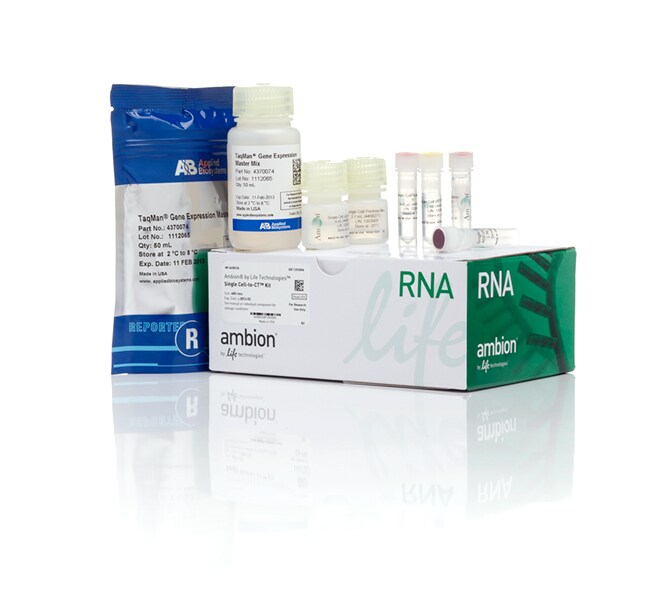
Single Cell-to-CT™ qRT-PCR Kit
The Ambion™ Single Cell-to-CT™ Kit contains a complete validated workflow for gene expression analysis for samples containing 1–10 cells. EachRead more
Have Questions?
Change view

| Catalog Number | No. of Reactions |
|---|---|
| 4458236 | 400 Reactions |
| 4458237 | 50 Reactions |
Catalog number 4458236
Price (CNY)
111,097.00
Each
No. of Reactions:
400 Reactions
Price (CNY)
111,097.00
Each
The Ambion™ Single Cell-to-CT™ Kit contains a complete validated workflow for gene expression analysis for samples containing 1–10 cells. Each kit contains reagents for sample preparation, reverse transcription, pre-amplification, and qPCR that have been optimized together in a simple workflow that can be completed in only 5 steps (see figure).
Key product features:
- Pre-optimized workflow for real-time RT-PCR from single cells
- Maximum sensitivity for single-cell analysis
- Superior performance and reproducibility compared to alternative methods
- Complete kit convenience and easy-to-follow protocol
Pre-optimized protocol ensures success and saves time
Each workflow begins with a simple 7-minute sample prep, where cells are effectively and reproducibly lysed with minimal processing into a solution that is compatible with downstream RT-PCR, without the need for purification. This is followed by the use of Superscript™ RT for reverse transcription, the TaqMan™ PreAmp Master Mix to amplify the cDNA, and TaqMan™ Gene Expression Master Mix for qPCR. All four of these steps have been developed to provide maximum sensitivity. The entire cell sample is maintained in the same well throughout the procedure so there is no sample loss or dilution of the precious limited material that could affect sensitivity.
Single cell sensitivity
Sensitivity of real-time PCR results can be affected by the efficiency of sample preparation, reverse transcription, or amplification. The Single Cell-to-CT™ Kit has addressed each of these potential problem areas to create a solution that enables reliable and robust gene expression analysis from single cells with maximal sensitivity. Detection of single cell equivalents using the Single Cell-to-CT™ Kit demonstrates appropriate linearity and sensitivity of qPCR results compared to a 100 cell sample control with excellent technical reproducibility (see figure). As expected, individual single cells exhibit greater variability due to inherent biological heterogeneity. In addition, through inclusion of a cDNA pre-amplification step, targets of interest are accurately amplified prior to real-time PCR. This critical step boosts signal in an unbiased manner, extending the analysis potential of limited samples. The accuracy and signal enhancement of a 96-gene panel using pre-amplification is shown (see figure).
Superior performance and reproducibility compared to alternative methods
Traditional sample preparation methods using organic solvents, glass fiber filters, or magnetic beads are not suitable for single-cell analysis due to the loss of sample through incomplete RNA precipitation, binding, and elution. Additionally, most single-cell homebrew methods which involve simple boiling to lyse cells lack the ability to inactivate endogenous RNases to stabilize gene expression profiles and can result in chemical cleavage of the RNA and inhibitor carryover, including gDNA contamination, which can affect all qRT-PCR applications. In contrast, the Single Cell-to-CT™ Kit shows superior sensitivity and reproducibility for single-cell analysis compared to traditional purification or homebrew boiling methods (see figure).
For Research Use Only. Not for use in diagnostic procedures.
Specifications
For Use With (Equipment)7000 System, 7300 System, 7500 System, 7900HT Fast System, 7900HT System, GeneAmp 9700, GeneAmp™ 2400, StepOne™, Fast Mode, StepOne™, Standard Mode, StepOnePlus™, Fast Mode, StepOnePlus™, Standard Mode, Veriti Thermal Cycler
No. of Reactions400 Reactions
Product LineAmbion, Cells-to-CT
Purification Time7 min.
Quantity400 reactions
Sample TypeMammalian Cells
Shipping ConditionDry Ice
Starting Material1-10 Cells
Detection MethodTaqMan
For Use With (Application)RT-PCR
PCR Method2-step RT-qPCR
Reaction Speed7 min.
Unit SizeEach
Contents & Storage
400 μL Single Cell DNase I, 4.0 mL Single Cell Lysis Solution (store at 4°C), 400 μL Single Cell Stop Solution, 600 μL Single Cell SuperScript™ RT, 50 mL TaqMan™ Gene Expression MasterMix (store at 4°C), 2.1 mL Single Cell Pre-Amp Mix, 1.2 mL Single Cell VILO™ RT Mix, Store kit components at -20°C except for Single Cell Stop Solution and TaqMan™ Gene Expression MasterMix, which should be stored at 4°C.
Frequently asked questions (FAQs)
What can I do to improve the sensitivity of my qPCR assay?
Would the direct lysis approach to DNA/RNA analysis be a good alternative for very small samples?
Will the Cells-to-CT system work with my special cell line?
With the Single Cell-to-CT Kit, do samples need to be frozen immediately?
For single-cell analysis using the Single Cell-to-CT Kit, do I need to normalize my data?
Citations & References (3)
Citations & References
Abstract
Single cell gene expression analysis of pluripotent stem cells.
Journal:Methods Mol Biol
PubMed ID:23546759
Analyzing gene expression profiles from cells en masse provides an average profile for the population which may obscure differences in individual cells. Using an optimized workflow for qRT-PCR, gene expression profiles of undifferentiated pluripotent stem cells reveal distinct gene expression profiles for individual cells, and a large expression level range
Toll-like receptor 4 engagement drives differentiation of human and murine dendritic cells from a pro- into an anti-inflammatory mode.
Journal:PLoS One
PubMed ID:23408948
The dendritic cell (DC) coordinates innate and adaptive immunity to fight infections and cancer. Our observations reveal that DCs exposed to the microbial danger signal lipopolysaccharide (LPS) in the presence of interferon-? (IFN-?) acquire a continuously changing activation/maturation phenotype. The DCs' initial mode of action is pro-inflammatory via up-regulation among
Interleukin-10 inhibits angiotensin II-induced decrease in neuronal potassium current.
Journal:Am J Physiol Cell Physiol
PubMed ID:23426971
Previously we demonstrated that viral-mediated increased expression of the anti-inflammatory cytokine interleukin-10 within the paraventricular nucleus of the hypothalamus significantly reduces blood pressure in normal rats made hypertensive by infusion of angiotensin II. However, the exact cellular locus of this interleukin-10 action within the paraventricular nucleus is unknown. In the