Search

Ion Torrent™
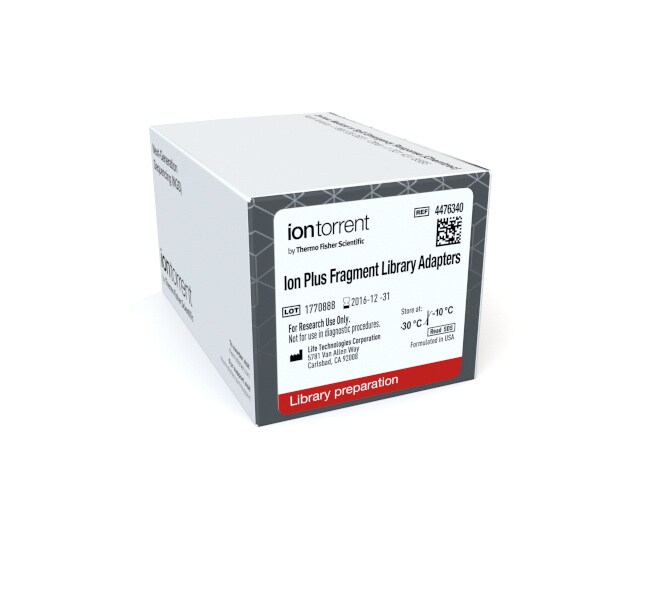
Ion Plus Fragment Library Adapters
| Catalog Number | Quantity |
|---|---|
| 4476340 | 10 Reactions |
Catalog number 4476340
Price (CNY)
-
Quantity:
10 Reactions
The Ion Plus Fragment Library Adapters consist of standard fragment library adapter oligos for library construction of 10-20 DNA libraries (depending on input DNA type and amount) for semiconductor sequencing. While library-creation kits like the Ion Plus Fragment Library Kit and Ion Xpress Plus Fragment Library Kit include standard library adapters, the need for additional adapters can sometimes arise. For example, these Ion Plus Fragment Library Adapters are suitable for use with the AB Library Builder™ System to construct automated fragment libraries. Additionally, the Long Mate-Pair Library protocol for the Ion PGM™ Sequencer requires users to purchase standard adapter oligos – a task made easy with the introduction of our Ion Plus Fragment Library Adapters.
The Ion Plus Fragment Library Adapters offer you:
• Amplification primers for PCR amplification of standard Ion Plus fragment libraries
• The convenience of premixed and appropriately diluted adapter oligos for use in Ion fragment library construction protocols including automated library construction on the AB Library Builder™ System
For Research Use Only. Not intended for human or animal therapeutic or diagnostic use.
The Ion Plus Fragment Library Adapters offer you:
• Amplification primers for PCR amplification of standard Ion Plus fragment libraries
• The convenience of premixed and appropriately diluted adapter oligos for use in Ion fragment library construction protocols including automated library construction on the AB Library Builder™ System
For Research Use Only. Not intended for human or animal therapeutic or diagnostic use.
For Research Use Only. Not for use in diagnostic procedures.
Specifications
For Use With (Application)Sequencing
For Use With (Equipment)Ion PGM™ System
LibrariesFragment Library
No. of Reactions10
Product LineIon Torrent
Product TypeIon Plus Fragment Library Adapters
Quantity10 Reactions
Sample TypeDNA
Shipping ConditionDry Ice
Workflow StepLibrary Generation
Sequencing TypeGenome and DNA Sequencing
Unit SizeEach
Contents & Storage
4 tubes; store -20°C