Search

Applied Biosystems™
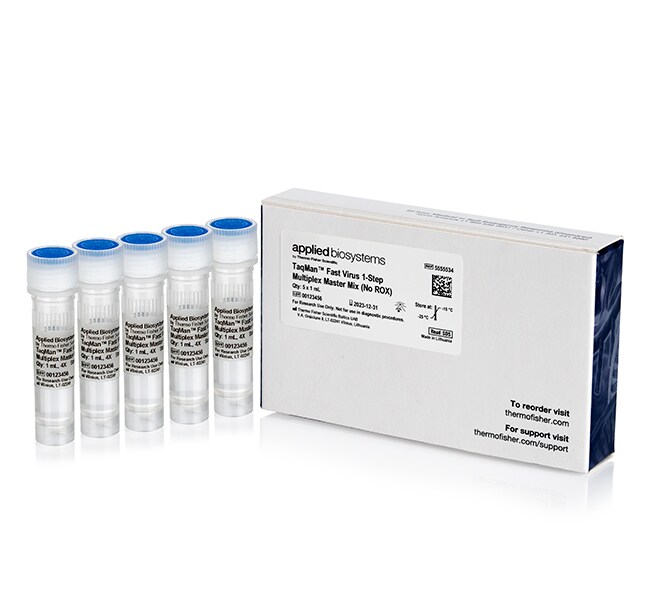
TaqMan™ Fast Virus 1-Step Multiplex Master Mix for qPCR (No ROX)
TaqMan Fast Virus 1-Step Multiplex Master Mix (No ROX) is designed to enable dye flexibility for multiplexing up to four different RNA/DNA targets for high-throughput RT-qPCR.
Have Questions?
Change view

| Catalog Number | Volume |
|---|---|
| 5555534 | 5 x 1 mL |
| 5555532 | 1 x 1 mL |
| 5555536 | 1 x 10 mL |
Catalog number 5555534
Price (CNY)
21,978.00
Each
Volume:
5 x 1 mL
Price (CNY)
21,978.00
Each
TaqMan Fast Virus 1-Step Multiplex Master Mix (No ROX) is designed to enable dye flexibility for multiplexing up to four different RNA/DNA targets for high-throughput RT-qPCR. The 4X formulation enhances detection of both RNA and DNA viral pathogens, even in the presence of challenging PCR inhibitors. TaqMan Fast Virus master mix is used for sensitive pathogen detection in research samples as well as multiplex gene expression studies with low target input. It has a single-tube format for consistent handling and processing and is ideal for high-throughput workflows, delivering results in <30 minutes.
Benefits of TaqMan Fast Virus 1-Step Multiplex Master Mix (No ROX) include:
- Multiplexing—optimized to detect up to four RNA/DNA viral pathogen and gene expression targets
- High sensitivity—4X master mix to amplify RNA and DNA targets at low target input levels with six logs of dynamic range
- Tolerant to PCR inhibitors—formulated to work in the presence of common RT-qPCR inhibitors found in blood, stool, and other complex samples
- Dye flexibility—the formulation without ROX dye enables use of other dyes in the channel previously used to measure ROX
- Simplified application—one-tube, one-step master mix offers a single run profile with RNA and DNA and allows easy mix-and-match of targets on a plate
- High efficiency—increased RT-qPCR speed on fast and standard instruments
Optimized for multiplexing
TaqMan Fast Virus 1-Step Multiplex Master Mix (No ROX) has been validated for detection of up to four targets simultaneously. Viral pathogen research often includes complex reactions with multiplexed primers and probes and internal controls. To meet this need, we developed this master mix for higher order multiplex reactions with multiple gene expression targets (see figure below). To simplify your experiments, a single TaqMan Fast Virus master mix protocol has been developed to amplify both types of nucleic acid, so you can interrogate both RNA and DNA virus targets next to each other on the same plate using the same handling steps.
High sensitivity
Many viral pathogen research samples have very low levels of nucleic acid targets. TaqMan Fast Virus 1-Step Multiplex Master Mix (No ROX) is optimized for highly sensitive detection of viral targets and low-titer pathogens (see figure). Formulated at a higher concentration, this master mix allows you to set up smaller reactions and run fast-cycling instruments and protocols while obtaining at least the same sensitivity as expected from standard-cycling qPCR. Alternatively, larger sample input amounts can be added to standard reaction volumes for more accurate quantification of low-titer samples.
Consistent results in the presence of inhibitors
Research samples assayed for viral pathogens commonly include materials such as blood, dirt, and tissues that can inhibit qPCR reactions. TaqMan Fast Virus 1-Step Multiplex Master Mix (No ROX) includes buffer components and proprietary additives that are optimized to handle RT-qPCR inhibitors to help ensure consistent performance and provide confidence in your results. The master mix has been tested to enable robust performance in the presence of common inhibitors, including heparin, hematin, and humic acid (see figure).
Dye flexibility
TaqMan Fast Virus 1-Step Multiplex Master Mix (No ROX) does not contain the ROX passive reference dye. This allows higher order multiplexing because other dyes, such as JUN (or similar emission wavelength dye) can be measured in the channel previously used to measure ROX. Because of this flexibility, TaqMan Fast Virus master mix can be used with common real-time PCR system and allows selection of the desired passive reference dye to best fit your needs.
Fast results
TaqMan Fast Virus 1-Step Multiplex Master Mix (No ROX) speeds your time to results and streamlines the use of your real-time PCR instruments with a fast protocol. The high-concentration formulation allows for more sample containing the target nucleic acid to be added in the smaller reaction volumes required to run fast protocols. This enables you to maintain sensitivity with low-titer research samples while improving speed and throughput.
TaqMan Fast Virus 1-Step Multiplex Master Mix (No ROX) provides robust performance, multiplexing capabilities in the presence of common RT-qPCR inhibitors, and convenient reaction setup allow you to have more confidence in your results.
For Research Use Only. Not for use in diagnostic procedures.
Specifications
For Use With (Equipment)7500 Fast System, 7500 System, 7900HT System, QuantStudio 12k Flex, QuantStudio 3, QuantStudio 5, QuantStudio 6 Flex, QuantStudio 6 Pro, QuantStudio 7 Flex, QuantStudio 7 Pro, StepOne, StepOnePlus, ViiA 7 System, Roche LightCycler PRO System, Bio-Rad CFX Opus 96 Real-Time PCR System
Hot StartBuilt-In Hot Start
Inhibitor Tolerance (Simple)High
Multiplex CapabilityUp to 4-plex
No. of Reactions1000 x 20 μL Reactions
Passive Reference DyeNone
Quantity5 x 1 mL
Sample TypeRNA, DNA
Shipping ConditionDry Ice
Target SpecificityRNA only, Both RNA and DNA
ThermostabilityNot Applicable
Volume5 x 1 mL
Concentration4X
Detection MethodPrimer-probe
For Use With (Application)Microbial Detection, Gene Expression, DNA Quantification, Presence/Absence
PCR Method1-step RT-qPCR
Reaction SpeedFast or Standard
Unit SizeEach
Contents & Storage
Contains 5 x 1 mL tubes of 4X RT-PCR master mix sufficient for 1000 x 20 μL reactions.
The master mix contains:
• Hot-start AmpliTaq Fast DNA Polymerase
• Thermostable MMLV Reverse Transcriptase
• dNTPs
• RNase Inhibitor
• Optimized buffer
Store at -15°C to -25°C.
The master mix contains:
• Hot-start AmpliTaq Fast DNA Polymerase
• Thermostable MMLV Reverse Transcriptase
• dNTPs
• RNase Inhibitor
• Optimized buffer
Store at -15°C to -25°C.