Search

Thermo Scientific™
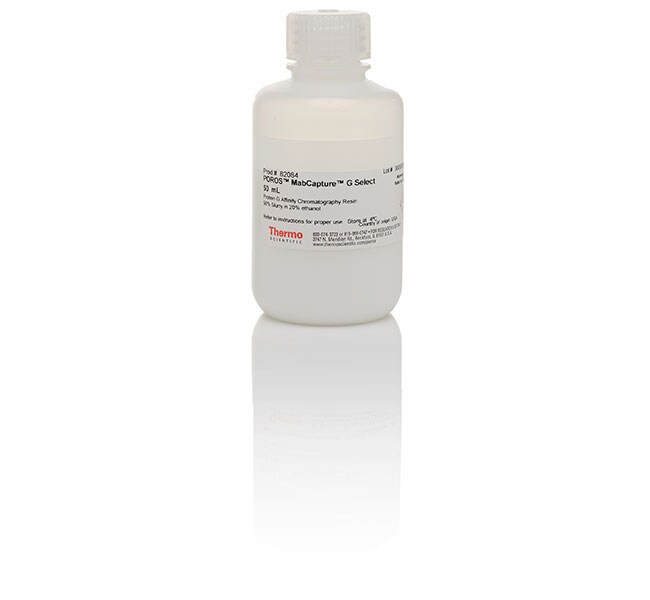
POROS™ MabCapture™ G Select Resin
POROS™ MabCapture™ G Select Resin is a high-throughput, lower-priced Protein G chromatography resin manufactured using our own Protein G ligandRead more
Have Questions?
Change view

| Catalog Number | Volume (Metric) |
|---|---|
| 82084 | 50 mL |
| 82083 | 15 mL |
Catalog number 82084
Price (CNY)
42,999.00
Each
Volume (Metric):
50 mL
Price (CNY)
42,999.00
Each
POROS™ MabCapture™ G Select Resin is a high-throughput, lower-priced Protein G chromatography resin manufactured using our own Protein G ligand to enable high-throughput purification performance. It is used in a variety of antibody affinity purification methods and is ideal for polyclonal IgG purification from mouse, human, cow, goat, and sheep serum, including human IgG3 and mouse IgG1 isotypes. POROS MabCapture G Select Resin demonstrates high dynamic binding performance at low linear flow rates and maintains superior binding capacity at high linear flow rates where other chromatography media products cannot operate.
With POROS MabCapture G affinity chromatography resin you can:
• Maintain high dynamic binding capacity at liner flow rates over 700 cm/hr
• Design processes with greater flexibility (shorter bed heights, faster flow rates, or both) due to the improvements made to the antibody binding efficiency
• Obtain the highest dynamic binding capacity for antibodies vs. conventional agarose- or silica-based Protein G resins
• Purify polyclonal IgG from mouse, human, cow, goat, and sheep serum, including human IgG3 and mouse IgG1 isotypes
• Sanitize and depyrogenate with standard agents used for other chromatography products
• Recognize major increases to process productivity and reduce the downstream bottleneck
Protein G is a bacterial cell wall protein isolated from group G Streptococci. Recombinant Protein G has been modified to eliminate its binding to albumin. The Protein G molecule contains two binding domains. Although the tertiary structures of Protein A and Protein G are very similar, their amino acid compositions differ significantly, resulting in different binding characteristics. Protein G has greater affinity than Protein A for most mammalian IgGs, especially for certain subclasses, including human IgG3, mouse IgG1, and rat IgG2a. Unlike Protein A, Protein G does not bind to human IgM, IgD, and IgA.
The development of humanized monoclonal antibodies has continued to fuel the growth of the biotherapeutic market. Addressing the therapeutic demand for monoclonal antibodies has led to major improvements to the cell-based expression systems that are used to manufacture these proteins. Consequently, these improvements have moved the processing bottleneck from upstream cell expression to downstream purification. The introduction of POROS MabCapture G Select chromatography resin was aimed at cracking open the downstream bottleneck and providing the capacity, efficiency, and flexibility needed to make improvements to the downstream purification platform, resulting in major increases to process productivity and antibody manufacturing.
With POROS MabCapture G affinity chromatography resin you can:
• Maintain high dynamic binding capacity at liner flow rates over 700 cm/hr
• Design processes with greater flexibility (shorter bed heights, faster flow rates, or both) due to the improvements made to the antibody binding efficiency
• Obtain the highest dynamic binding capacity for antibodies vs. conventional agarose- or silica-based Protein G resins
• Purify polyclonal IgG from mouse, human, cow, goat, and sheep serum, including human IgG3 and mouse IgG1 isotypes
• Sanitize and depyrogenate with standard agents used for other chromatography products
• Recognize major increases to process productivity and reduce the downstream bottleneck
Protein G is a bacterial cell wall protein isolated from group G Streptococci. Recombinant Protein G has been modified to eliminate its binding to albumin. The Protein G molecule contains two binding domains. Although the tertiary structures of Protein A and Protein G are very similar, their amino acid compositions differ significantly, resulting in different binding characteristics. Protein G has greater affinity than Protein A for most mammalian IgGs, especially for certain subclasses, including human IgG3, mouse IgG1, and rat IgG2a. Unlike Protein A, Protein G does not bind to human IgM, IgD, and IgA.
The development of humanized monoclonal antibodies has continued to fuel the growth of the biotherapeutic market. Addressing the therapeutic demand for monoclonal antibodies has led to major improvements to the cell-based expression systems that are used to manufacture these proteins. Consequently, these improvements have moved the processing bottleneck from upstream cell expression to downstream purification. The introduction of POROS MabCapture G Select chromatography resin was aimed at cracking open the downstream bottleneck and providing the capacity, efficiency, and flexibility needed to make improvements to the downstream purification platform, resulting in major increases to process productivity and antibody manufacturing.
For Research Use Only. Not for use in diagnostic procedures.
Specifications
For Use With (Application)IgG Purification
FormatPoros Bead
Product LinePOROS
Purification TargetIgG Antibodies, Ig Antibodies
Quantity50 mL
Shipping ConditionWet Ice
Standard ComponentsProtein G
Stationary PhaseProtein G
Volume (Metric)50 mL
TypeG Select Resin
Unit SizeEach
Contents & Storage
Store in refrigerator (2–8°C).