Search

Thermo Scientific™
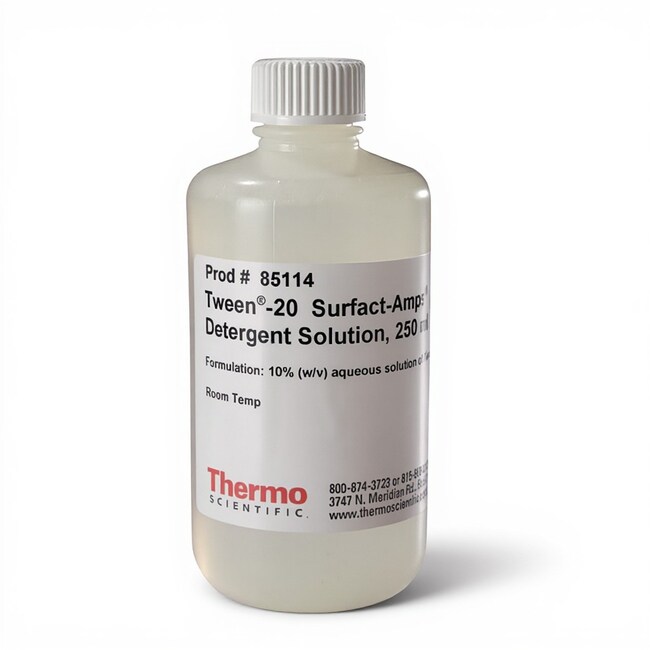
Tween™ 20 Surfact-Amps™ Detergent Solution
Thermo Scientific Tween-20 Surfact-Amps Detergent Solution is a highly-purified Tween™ 20 detergent stabilized as a 10% solution (w/v) and packagedRead more
Have Questions?
Change view

| Catalog Number | Quantity |
|---|---|
| 85114 | 250 mL |
| 85113 | 50 mL |
| 28320 | 6 x 10 mL |
| 85115 | 500 mL |
| 28321 | 1 L |
Catalog number 85114
Price (CNY)
7,976.00
Each
Quantity:
250 mL
Price (CNY)
7,976.00
Each
Thermo Scientific Tween-20 Surfact-Amps Detergent Solution is a highly-purified Tween™ 20 detergent stabilized as a 10% solution (w/v) and packaged under nitrogen in glass ampules or non-leaching HDPE bottles, ensuring it's stability and eliminating the accumulation of peroxides and degradation products.
Features of Tween-20 Surfact-Amps Detergent Solution:
• Tween 20—a popular nonionic detergent for use in ELISA, Western blotting and other immunoassay PBS or TBS wash buffers
• Accurate—precise 10% detergent solution in ultrapure water
• Easy-to-use—solution is simple to dispense and dilute for use
• Exceptionally pure—less than 1.0μeq/mL peroxides and carbonyls
• Stable—packaged under inert nitrogen gas in glass ampules or HDPE bottles
Properties of Tween 20:
• Molecular Weight: 1228g
• Detergent Class: Nonionic polyoxyethylene surfactant
• Aggregation Number: Unknown
• Micelle Molecular Weight: Unknown
• Critical Micelle Concentration (CMC): 0.06 mM (0.0074%, w/v)
• Cloud Point: 95°C
• Dialyzable: No
Specifications for Tween 20 Surfact-Amps Detergent Solution:
• Visual: Clear, light yellow liquid, free of particulates.
• Concentration: 10.0±1.0%
• Oxidants: ≤1.0μeq/mL
• Carbonyls: ≤1.0μeq/mL
• Suspended Solids: Residue present must not exceed Residue Reference.
Related Products
Surfact-Amps™ Detergent Sampler
Features of Tween-20 Surfact-Amps Detergent Solution:
• Tween 20—a popular nonionic detergent for use in ELISA, Western blotting and other immunoassay PBS or TBS wash buffers
• Accurate—precise 10% detergent solution in ultrapure water
• Easy-to-use—solution is simple to dispense and dilute for use
• Exceptionally pure—less than 1.0μeq/mL peroxides and carbonyls
• Stable—packaged under inert nitrogen gas in glass ampules or HDPE bottles
Properties of Tween 20:
• Molecular Weight: 1228g
• Detergent Class: Nonionic polyoxyethylene surfactant
• Aggregation Number: Unknown
• Micelle Molecular Weight: Unknown
• Critical Micelle Concentration (CMC): 0.06 mM (0.0074%, w/v)
• Cloud Point: 95°C
• Dialyzable: No
Specifications for Tween 20 Surfact-Amps Detergent Solution:
• Visual: Clear, light yellow liquid, free of particulates.
• Concentration: 10.0±1.0%
• Oxidants: ≤1.0μeq/mL
• Carbonyls: ≤1.0μeq/mL
• Suspended Solids: Residue present must not exceed Residue Reference.
Related Products
Surfact-Amps™ Detergent Sampler
For Research Use Only. Not for use in diagnostic procedures.
Specifications
Quantity250 mL
Reagent TypeDetergent Solution
FormLiquid
Product LineSurfact-Amps, Tween
Unit SizeEach
Contents & Storage
Store in a cool, dry, and well-ventilated area