Search


Citations & References (3)
Thermo Scientific™
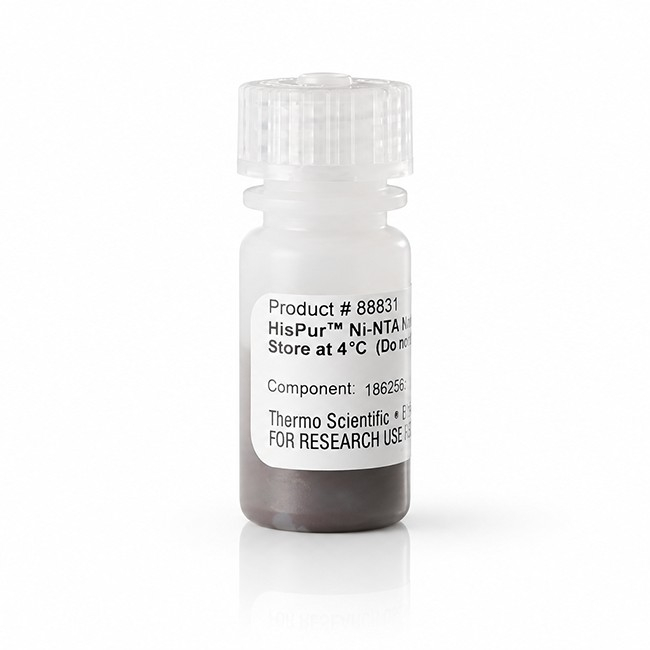
HisPur™ Ni-NTA Magnetic Beads
Perform affinity purification of His-tagged fusion proteins in manual or automated formats with the high capacity nickel-IMAC Thermo Scientific™ HisPur Ni-NTA Magnetic Beads.
Have Questions?
Change view

| Catalog Number | Quantity |
|---|---|
| 88831 | 2 mL |
| 88832 | 10 mL |
Catalog number 88831
Price (CNY)
1,851.00
飞享价
Ends: 26-Sep-2026
2,963.00Save 1,112.00 (38%)
Each
Quantity:
2 mL
Price (CNY)
1,851.00
飞享价
Ends: 26-Sep-2026
2,963.00Save 1,112.00 (38%)
Each
Thermo Scientific HisPur Ni-NTA Magnetic Beads are high-capacity nickel-IMAC beads for affinity purification of His-tagged fusion proteins in manual or automated formats.
Features of HisPur Ni-NTA Magnetic Beads:
- High capacity—equivalent or higher binding capacity than Ni-NTA magnetic beads from other suppliers
- Low nonspecific binding—the bead surface is pre-blocked and the protocol provides optimized buffers for purification
- Fast—protocol is completed in 1 hour
- Scalable—process microliter to milliliter sample volumes
- Versatile—purify proteins using native or denaturing conditions
- Reagent compatible—can be used with common cell lysis reagents and a variety of buffer additives
- Multiple formats—protein coupling to the beads and downstream applications can be performed both manually and on an automated platform (e.g., Thermo Scientific KingFisher Instruments)
The blocked magnetic bead surface is derivatized with the nitrilotriacetic acid (NTA) chelation moiety and loaded with divalent nickel ions (Ni2+). The immobilized metal affinity chromatography (IMAC) beads provide high binding capacity with very low background. The HisPur Ni-NTA Magnetic Beads can be used both manually with a magnetic stand as well as with automated platforms such as the Thermo Scientific KingFisher Instruments for high-throughput needs.
HisPur Ni-NTA Magnetic Beads are used for small scale affinity purification as well as high-throughput screening of recombinant His-tagged proteins. The polyhistidine tag is the most popular affinity tag and typically consists of six consecutive histidine residues (6xHis). These tagged proteins are overexpressed in a number of different systems, most commonly in bacteria, and purified from cell lysates such as those prepared using B-PER Bacterial Protein Extraction Reagents. Purification of His-tagged proteins is achieved using a NTA chelate charged with nickel that coordinates with the histidine side chains. The NTA chelate contains four metal-binding sites which allow for low metal ion leaching and high binding capacity. The protocol for the HisPur Ni-NTA Magnetic Beads has been optimized to allow for high purity of the isolated His-tagged protein. Performance is equivalent to or better than Ni-NTA magnetic beads from other suppliers.
For Research Use Only. Not for use in diagnostic procedures.
Specifications
ConcentrationSlurry: 12.5mg/mL, 1.25% solids
Ligand TypeNickel-NTA
Protein FormRecombinant
Quantity2 mL
TargetHis
Capacity (Metric)2 mL
FormLiquid
Particle Size1 μm
Product LineHisPur
TypeMagnetic Affinity Bead
Unit SizeEach
Contents & Storage
Store at 4°C
Frequently asked questions (FAQs)
Are there other sequences that can bind to nickel more tightly than 6xHis-tagged proteins and how can they be eluted.
What should the typical protein recovery be when using the Probond Purification System or Ni-NTA Purification system?
What is the difference between HisPur Nickel Resin and HisPur Cobalt Resin?
Citations & References (3)
Citations & References
Abstract
Neuronal death in pneumococcal meningitis is triggered by pneumolysin and RrgA interactions with b-actin
Journal:PLOS Pathogens
PubMed ID:
Chapter 1 - Isolation of mitochondria from cells and tissues
Journal:Methods in Cell Biology
PubMed ID:
Diverse high-affinity DNA aptamers for wild-type and B.11.7 SARS-CoV-2 spike proteins from a pre-structured DNA library
Journal:Nucleic Acids Research Oxford Academic (oup.com)
PubMed ID: