Search

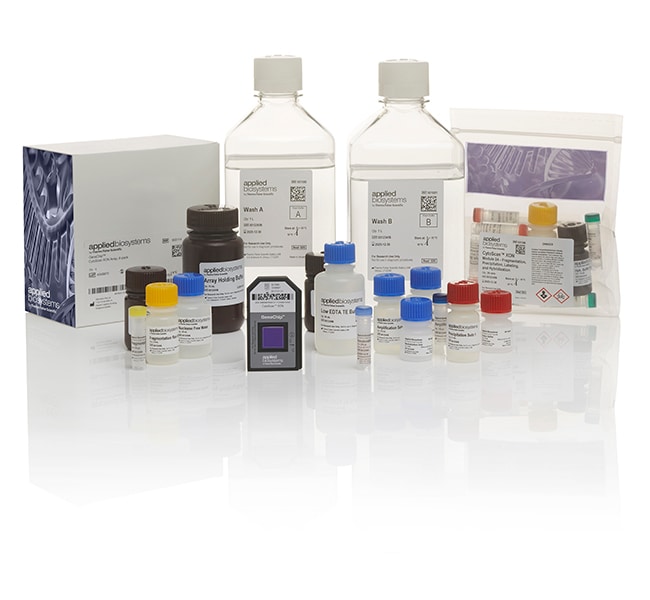
Applied Biosystems™
CytoScan™ 750K Suite
The complete CytoScan 750K Suite includes CytoScan 750K Arrays, CytoScan Reagent Kit, easy-to-use Chromosome Analysis Suite (ChAS) Software, and theRead more
| Catalog Number | Quantity |
|---|---|
| 901859 | 1 kit |
Catalog number 901859
Price (CNY)
59,495.00
Each
Quantity:
1 kit
Price (CNY)
59,495.00
Each
The complete CytoScan 750K Suite includes CytoScan 750K Arrays, CytoScan Reagent Kit, easy-to-use Chromosome Analysis Suite (ChAS) Software, and the proven GeneChip™ Instrument System.
Whole-genome coverage: best value
CytoScan 750K Suite enables cytogenetic researchers to detect and analyze relevant chromosomal aberrations with confidence. CytoScan 750K Suite provides high-resolution coverage of cancer and constitutional genes of interest, along with high-density SNP coverage for loss of heterozygosity (LOH) detection.
The CytoScan 750K Array provides a cost-effective solution that delivers industry-leading performance. CytoScan 750K Array, reagents, and software were developed with input from the international cytogenetics community to deliver an intuitive platform for fast and reliable detection of chromosomal aberrations.
Optimized reagent kit: streamlined workflow
CytoScan 750K Suite is designed to save time and money and reduce operator error. The simplified and streamlined assay protocol is aligned with laboratory workflow requirements, making it easier to obtain consistent and high-quality results. Each component passes strict quality control inspection to ensure the highest reproducibility and performance with CytoScan 750K Arrays. The CytoScan protocol can be accomplished in 2.5 days with just seven hours of hands-on time.
High density SNPs for heterozygocity determination
CytoScan 750K Array includes 200,000 gene-centric SNPs to enable confident breakpoint estimation, 5 Mb loss of heterozygosity (LOH) determination and detection of uniparental iso-disomy (UPD) and regions identical-by-descent.
Chromosome Analysis Suite (ChAS) Software: designed by cytogeneticists for cytogeneticists
The popular ChAS Software is tailored to cytogenetic research analysis and reporting. The software is available free of charge as part of the complete CytoScan 750K Suite.
• To install ChAS onto one or more analysis workstations, download the ChAS Software zip file, extract the zip archive, and install by following the instructions in the Installation Instructions file.
• GeneChip array-specific GeneChip Command Console™ Software plug-in package is required for each array. Please download these and other array-specific files.
Download the latest Chromosome Analysis Suite (ChAS) 3.1 Software
Hardware and Software Requirements, ChAS 3.1 (pdf, 121 KB)
ChAS Analysis Files for the CytoScan 750K Array version NA33.1 (zip, 345 MB)
Download the most recent Fluidics Scripts
Download the AGCC™ CytoScan 750K Array Software plug-in (zip, 91.7 MB)
CytoScan 750K Customer Training: get ready for success
Customer training is required for CytoScan 750K assay for both new and existing customers. Different products are available based upon your experience level; please contact your regional sales distributor for more information. Also, see our CytoScan 750K Training Kit (outside US and Canada only).
Related Links
CytoScan™ 750K Training Kit (Available Outside US/Canada Only)
Whole-genome coverage: best value
CytoScan 750K Suite enables cytogenetic researchers to detect and analyze relevant chromosomal aberrations with confidence. CytoScan 750K Suite provides high-resolution coverage of cancer and constitutional genes of interest, along with high-density SNP coverage for loss of heterozygosity (LOH) detection.
The CytoScan 750K Array provides a cost-effective solution that delivers industry-leading performance. CytoScan 750K Array, reagents, and software were developed with input from the international cytogenetics community to deliver an intuitive platform for fast and reliable detection of chromosomal aberrations.
Optimized reagent kit: streamlined workflow
CytoScan 750K Suite is designed to save time and money and reduce operator error. The simplified and streamlined assay protocol is aligned with laboratory workflow requirements, making it easier to obtain consistent and high-quality results. Each component passes strict quality control inspection to ensure the highest reproducibility and performance with CytoScan 750K Arrays. The CytoScan protocol can be accomplished in 2.5 days with just seven hours of hands-on time.
High density SNPs for heterozygocity determination
CytoScan 750K Array includes 200,000 gene-centric SNPs to enable confident breakpoint estimation, 5 Mb loss of heterozygosity (LOH) determination and detection of uniparental iso-disomy (UPD) and regions identical-by-descent.
Chromosome Analysis Suite (ChAS) Software: designed by cytogeneticists for cytogeneticists
The popular ChAS Software is tailored to cytogenetic research analysis and reporting. The software is available free of charge as part of the complete CytoScan 750K Suite.
• To install ChAS onto one or more analysis workstations, download the ChAS Software zip file, extract the zip archive, and install by following the instructions in the Installation Instructions file.
• GeneChip array-specific GeneChip Command Console™ Software plug-in package is required for each array. Please download these and other array-specific files.
Download the latest Chromosome Analysis Suite (ChAS) 3.1 Software
Hardware and Software Requirements, ChAS 3.1 (pdf, 121 KB)
ChAS Analysis Files for the CytoScan 750K Array version NA33.1 (zip, 345 MB)
Download the most recent Fluidics Scripts
Download the AGCC™ CytoScan 750K Array Software plug-in (zip, 91.7 MB)
CytoScan 750K Customer Training: get ready for success
Customer training is required for CytoScan 750K assay for both new and existing customers. Different products are available based upon your experience level; please contact your regional sales distributor for more information. Also, see our CytoScan 750K Training Kit (outside US and Canada only).
Related Links
CytoScan™ 750K Training Kit (Available Outside US/Canada Only)
For Research Use Only. Not for use in diagnostic procedures.
Specifications
Number of Markers750,000 markers
Quantity1 kit
Type750K Suite
ArrayCytogenetics, Copy Number
FormatGenechip 64 Array Format
Number of Arrays24 arrays
Unit SizeEach