Search


Citations & References (21)
Invitrogen™
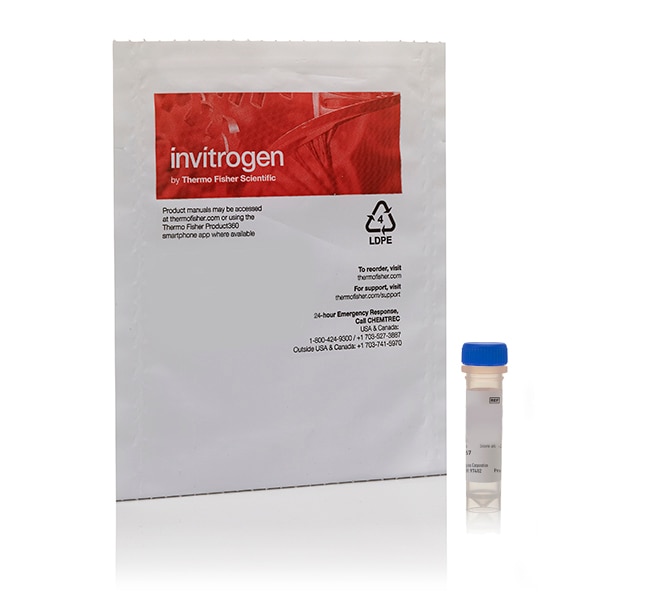
Alexa Fluor™ 568 Hydrazide, for microinjection
Alexa Fluor™ 568 Hydrazide is useful as a cell tracer and as a reactive dye for labeling aldehydes or ketonesRead more
| Catalog Number | Quantity |
|---|---|
| A10441 also known as A-10441 | 125 μL |
Catalog number A10441
also known as A-10441
Price (CNY)
5,462.00
Each
Quantity:
125 μL
Price (CNY)
5,462.00
Each
Alexa Fluor™ 568 Hydrazide is useful as a cell tracer and as a reactive dye for labeling aldehydes or ketones in polysaccharides or glycoproteins. This version is formatted as a ready-to-use solution that is dissolved in a 200 mM KCl solution and filter sterilized.
Alexa Fluor™ 568 is a bright, red fluorescent dye. Used for stable signal generation in imaging and flow cytometry, Alexa Fluor™ 568 dye is water soluble and pH-insensitive from pH 4 to pH 10. In addition to reactive dye formulations, we offer Alexa Fluor™ 568 dye conjugated to a variety of antibodies, peptides, proteins, tracers, and amplification substrates optimized for cellular labeling and detection (learn more).
Detailed information about this AlexaFluor™ hydrazide:
• Fluorophore label : Alexa Fluor™ 568 dye
• Reactive group: hydrazide
• Reactivity: Aldehydes or keytones in polysaccharides or glycoproteins
• Ex/Em of the conjugate: 576/599 nm
• Extinction coefficient: 86,000 cm-1M-1
• Spectrally similar dyes: Rhodamine Red
• Molecular weight: 730.74
Cell Tracking and Tracing Applications
Alexa Fluor™ hydrazides and hydroxlamines are useful as low molecular weight, membrane-impermeant, aldehyde-fixable cell tracers, exhibiting brighter fluorescence and greater photostability than cell tracers derived from other spectrally similar fluorophores. They are easily loaded into cells by microinjection, infusion from patch pipette, or uptake induced by our Influx™ Pinocytic Cell-Loading Reagent. It is designed to be loaded into cells by microinjection or infusion from patch pipette. Learn more about cell tracking and tracing.
Glycoprotein and Polysaccharide Labeling Applications
The Alexa Fluor™ hydrazides and hydroxlamines are reactive molecules that can be used to add a fluorescent label to biomolecules containing aldehydes or ketones. Aldehydes and ketones can be introduced into polysaccharides and glycoproteins by periodate-mediated oxidation of vicinal diols. Galactose oxidase can also be used to oxidize terminal galactose residues of glycoproteins to aldehydes.
Hydrazide vs Hydroxylamine
Hydrazine derivatives react with ketones and aldehydes to yield relatively stable hydrazones. Hydroxylamine derivatives (aminooxy compounds) react with aldehydes and ketones to yield oximes. Oximes are superior to hydrazones with respect to hydrolytic stability. Both hydrazones and oximes can be reduced with sodium borohydride (NaBH4) to further increase the stability of the linkage.
Learn More About Protein and Antibody Labeling
We offer a wide selection of Molecular Probes™ antibody and protein labeling kits to fit your starting material and your experimental setup. See our Antibody Labeling kits or use our Labeling Chemistry Selection Tool for other choices. To learn more about our labeling kits, read Kits for Labeling Proteins and Nucleic Acids—Section 1.2 in The Molecular Probes™ Handbook.
We’ll Make a Custom Conjugate for You
If you can’t find what you’re looking for in our online catalog, we’ll prepare a custom antibody or protein conjugate for you. Our custom conjugation service is efficient and confidential, and we stand by the quality of our work. We are ISO 13485:2000 certified.
Related Products
DMSO (dimethylsulfoxide) (D12345)
Antibody Conjugate Purification Kit for 0.5-1 mg (A33086)
Antibody Conjugate Purification Kit for 20-50 μg (A33087)
Antibody Conjugate Purification kit for 50-100 μg (A33088)
Alexa Fluor™ 568 is a bright, red fluorescent dye. Used for stable signal generation in imaging and flow cytometry, Alexa Fluor™ 568 dye is water soluble and pH-insensitive from pH 4 to pH 10. In addition to reactive dye formulations, we offer Alexa Fluor™ 568 dye conjugated to a variety of antibodies, peptides, proteins, tracers, and amplification substrates optimized for cellular labeling and detection (learn more).
Detailed information about this AlexaFluor™ hydrazide:
• Fluorophore label : Alexa Fluor™ 568 dye
• Reactive group: hydrazide
• Reactivity: Aldehydes or keytones in polysaccharides or glycoproteins
• Ex/Em of the conjugate: 576/599 nm
• Extinction coefficient: 86,000 cm-1M-1
• Spectrally similar dyes: Rhodamine Red
• Molecular weight: 730.74
Cell Tracking and Tracing Applications
Alexa Fluor™ hydrazides and hydroxlamines are useful as low molecular weight, membrane-impermeant, aldehyde-fixable cell tracers, exhibiting brighter fluorescence and greater photostability than cell tracers derived from other spectrally similar fluorophores. They are easily loaded into cells by microinjection, infusion from patch pipette, or uptake induced by our Influx™ Pinocytic Cell-Loading Reagent. It is designed to be loaded into cells by microinjection or infusion from patch pipette. Learn more about cell tracking and tracing.
Glycoprotein and Polysaccharide Labeling Applications
The Alexa Fluor™ hydrazides and hydroxlamines are reactive molecules that can be used to add a fluorescent label to biomolecules containing aldehydes or ketones. Aldehydes and ketones can be introduced into polysaccharides and glycoproteins by periodate-mediated oxidation of vicinal diols. Galactose oxidase can also be used to oxidize terminal galactose residues of glycoproteins to aldehydes.
Hydrazide vs Hydroxylamine
Hydrazine derivatives react with ketones and aldehydes to yield relatively stable hydrazones. Hydroxylamine derivatives (aminooxy compounds) react with aldehydes and ketones to yield oximes. Oximes are superior to hydrazones with respect to hydrolytic stability. Both hydrazones and oximes can be reduced with sodium borohydride (NaBH4) to further increase the stability of the linkage.
Learn More About Protein and Antibody Labeling
We offer a wide selection of Molecular Probes™ antibody and protein labeling kits to fit your starting material and your experimental setup. See our Antibody Labeling kits or use our Labeling Chemistry Selection Tool for other choices. To learn more about our labeling kits, read Kits for Labeling Proteins and Nucleic Acids—Section 1.2 in The Molecular Probes™ Handbook.
We’ll Make a Custom Conjugate for You
If you can’t find what you’re looking for in our online catalog, we’ll prepare a custom antibody or protein conjugate for you. Our custom conjugation service is efficient and confidential, and we stand by the quality of our work. We are ISO 13485:2000 certified.
Related Products
DMSO (dimethylsulfoxide) (D12345)
Antibody Conjugate Purification Kit for 0.5-1 mg (A33086)
Antibody Conjugate Purification Kit for 20-50 μg (A33087)
Antibody Conjugate Purification kit for 50-100 μg (A33088)
For Research Use Only. Not for use in diagnostic procedures.
Specifications
Chemical ReactivityCarboxylic Acid, Ketone, Aldehyde
Emission599 nm
Excitation576 nm
Label or DyeAlexa Fluor™ 568
Product TypeHydrazide
Quantity125 μL
Reactive MoietyAmine, Hydrazide
Shipping ConditionRoom Temperature
Label TypeAlexa Fluor
Product LineAlexa Fluor
Unit SizeEach
Contents & Storage
Store in freezer (-5 to -30°C) and protect from light.
Frequently asked questions (FAQs)
What dye can I use that is non-reactive and can show an injection site?
Citations & References (21)
Citations & References
Abstract
Intracellular astrocyte calcium waves in situ increase the frequency of spontaneous AMPA receptor currents in CA1 pyramidal neurons.
Journal:J Neurosci
PubMed ID:14736858
'Spontaneous neurotransmitter release and activation of group I metabotropic glutamate receptors (mGluRs) each play a role in the plasticity of neuronal synapses. Astrocytes may contribute to short- and long-term synaptic changes by signaling to neurons via these processes. Spontaneous whole-cell AMPA receptor (AMPAR) currents were recorded in CA1 pyramidal cells
Characterization of a synaptiform transmission between a neuron and a glial cell in the leech central nervous system.
Journal:Glia
PubMed ID:11968059
'The cross-talk between neurons and glial cells is receiving increased attention because of its potential role in information processing in nervous systems. Stimulation of a single identifiable neuron, the neurosecretory Leydig interneuron in segmental ganglia of the leech Hirudo medicinalis, which modulates specific behaviors in the leech, evokes membrane hyperpolarization
Robust coding of flow-field parameters by axo-axonal gap junctions between fly visual interneurons.
Journal:Proc Natl Acad Sci U S A
PubMed ID:17551009
'Complex flight maneuvers require a sophisticated system to exploit the optic flow resulting from moving images of the environment projected onto the retina. In the fly''s visual course control center, the lobula plate, 10 so-called vertical system (VS) cells are thought to match, with their complex receptive fields, the optic
Long-term potentiation of exogenous glutamate responses at single dendritic spines.
Journal:Proc Natl Acad Sci U S A
PubMed ID:16186507
'Long-term increases in the strength of excitatory transmission at Schaffer collateral-CA1 cell synapses of the hippocampus require the insertion of new alpha-amino-3-hydroxy-5-methyl-4-isoxazolepropionate receptors (AMPARs) into the synapse, but the kinetics of this process are not well established. Using microphotolysis of caged glutamate to activate receptors at single dendritic spines in
Three-dimensional reconstruction of tubular structure of vacuolar membrane throughout mitosis in living tobacco cells.
Journal:Plant Cell Physiol
PubMed ID:14581629
'Plant vacuoles are the largest of organelles, performing various functions in cellular metabolism, morphogenesis and cell division. Dynamic changes in vacuoles during mitosis were studied by monitoring tubular structure of vacuolar membrane (TVM) in living transgenic tobacco BY-2 cells stably expressing a GFP-AtVam3p fusion protein (BY-GV). Comprehensive images of the